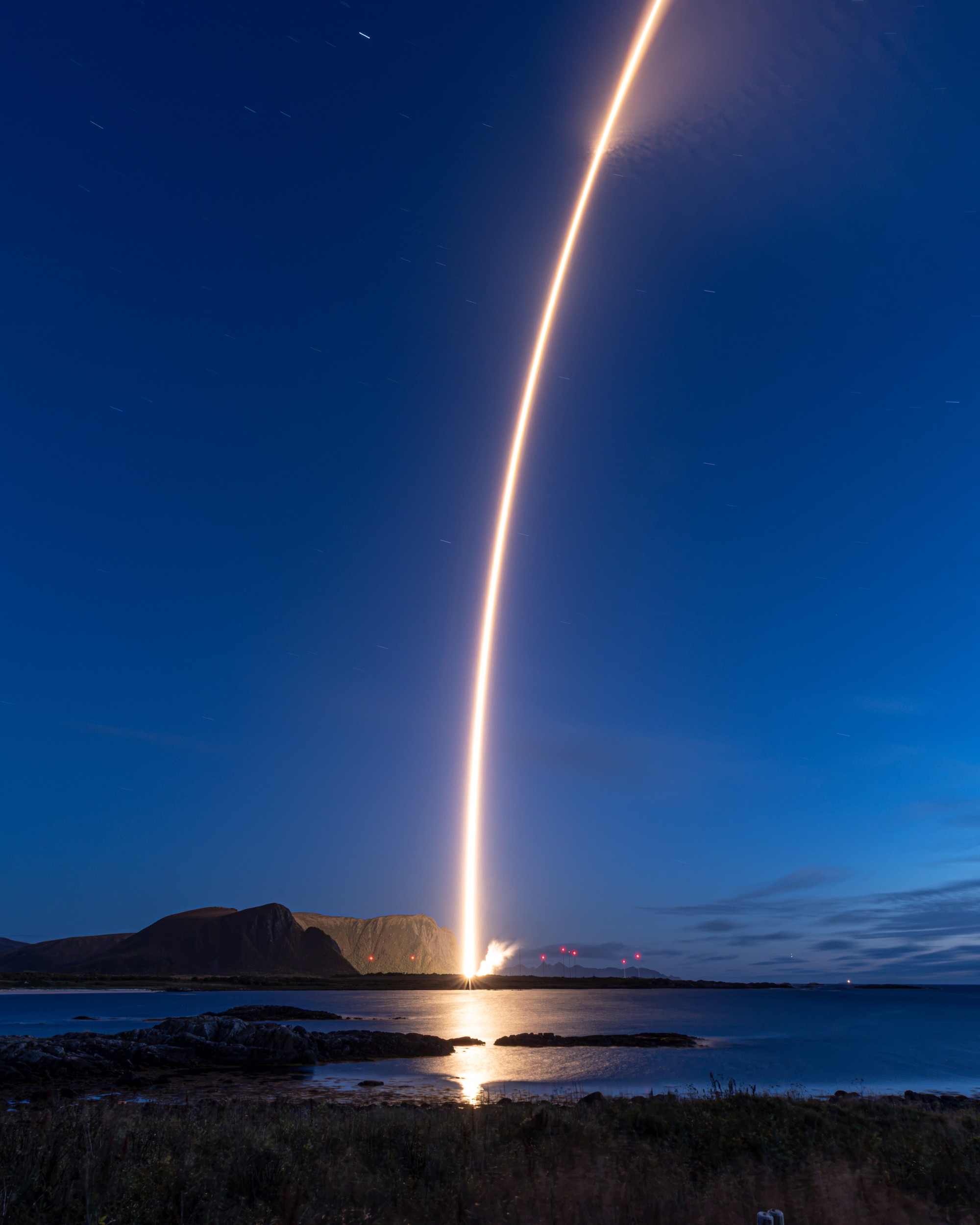
A two-stage rocket about 28 meters tall lifted off from Andøya Spaceport in northern Norway at roughly 22:12 CEST on 5 September 2026, or 20:12 UTC. Roughly seven minutes later, Isar Aerospace said Spectrum had reached orbit, completing a flight documented by the European Space Agency. Ars Technica described Spectrum as the first fully commercial European launch vehicle to reach orbit.
Andøya sits at 69 degrees north, inside the Arctic Circle. The spaceport’s operator says the location provides direct access to high-inclination, polar, and sun-synchronous orbits while avoiding significant air and maritime traffic, conditions particularly useful for small Earth-observation satellites. The rocket’s trajectory carried it north over the Norwegian Sea, away from populated land.
Spectrum, Andøya, and a second flight that had to work
Spectrum uses nine Aquila engines on its first stage and one vacuum-optimized Aquila engine on its second stage. The engines burn propane and liquid oxygen, a less common pairing among Western launch startups than kerosene or methane. Isar Aerospace was founded in 2018 by three students at the Technical University of Munich and named the mission Onward and Upward.
The official manifest comprised five commercial and educational CubeSats plus one non-deployable experiment. An ESA briefing issued before the launch describes them as six passengers: five CubeSats and one experiment. The payloads were selected through the German Aerospace Center’s Microlauncher Competition, with the mission supported through ESA’s Boost! program.
The result followed Spectrum’s unsuccessful first flight from Andøya in March 2025. The rocket lost attitude control after the unintended opening of a vent valve, began spinning less than 20 seconds after liftoff, and crashed near the launch site after a flight lasting about 30 seconds. Isar then encountered additional technical, weather, and range delays before the second rocket finally flew.
Spectrum initially entered an elliptical orbit and was expected to conduct another burn to circularize its path near 500 kilometers. Isar Aerospace later confirmed in its post-launch statement that the circularization burn and spacecraft separation were completed successfully. The company did not publish precise final altitude and inclination figures in that statement.
What the “first” claim covers, and what it does not
Europe has launched satellites on European rockets since the 1970s. Ariane vehicles and, later, Vega have flown from the Guiana Space Centre at Kourou in French Guiana, while Arianespace has sold commercial launch services for decades. Spectrum’s success does not replace or erase that history.
The geographic qualifier must also be stated carefully. Contemporary reporting identifies Spectrum as the first rocket to reach orbit from Western European soil, rather than the first from continental Europe in the broad geographic sense. The distinction matters because Plesetsk Cosmodrome in European Russia launched its first satellite in March 1966 and has supported orbital missions for decades.
The second qualifier concerns how the rocket was developed. Spectrum was designed and manufactured by a privately funded company rather than emerging from an agency-led European launcher program. This supports the narrower description of Spectrum as the first privately developed or fully commercial European launch vehicle to reach orbit.
Institutionally, the mission still benefited from public support. ESA’s Boost! program backed Spectrum’s development, the German Aerospace Center’s competition supplied its passengers, and the European Launcher Challenge requires participating providers to achieve an orbital launch by 2027. ESA says Isar became the first provider to clear that milestone.
One orbit is not a launch market
The gap between reaching orbit once and operating a dependable launch business remains substantial. Spectrum must now fly repeatedly and deliver predictable performance for customers purchasing schedule certainty as well as payload capacity. That will require reliable engine production, consistent vehicle integration, and launch operations capable of handling Andøya’s subarctic maritime weather.
The wider European launch market is also still developing. Ariane 6 is increasing its flight activity while other privately developed European launchers work toward orbital missions and operational service. Sovereign access to orbit will ultimately be measured in dependable launches per year, not only in historical firsts.
For now, the verified achievement remains significant. On 5 September 2026, Spectrum’s second flight carried five CubeSats and one experiment into orbit from Andøya, becoming the first fully commercial European launch vehicle to reach orbit and the first rocket to achieve orbit from Western European soil.