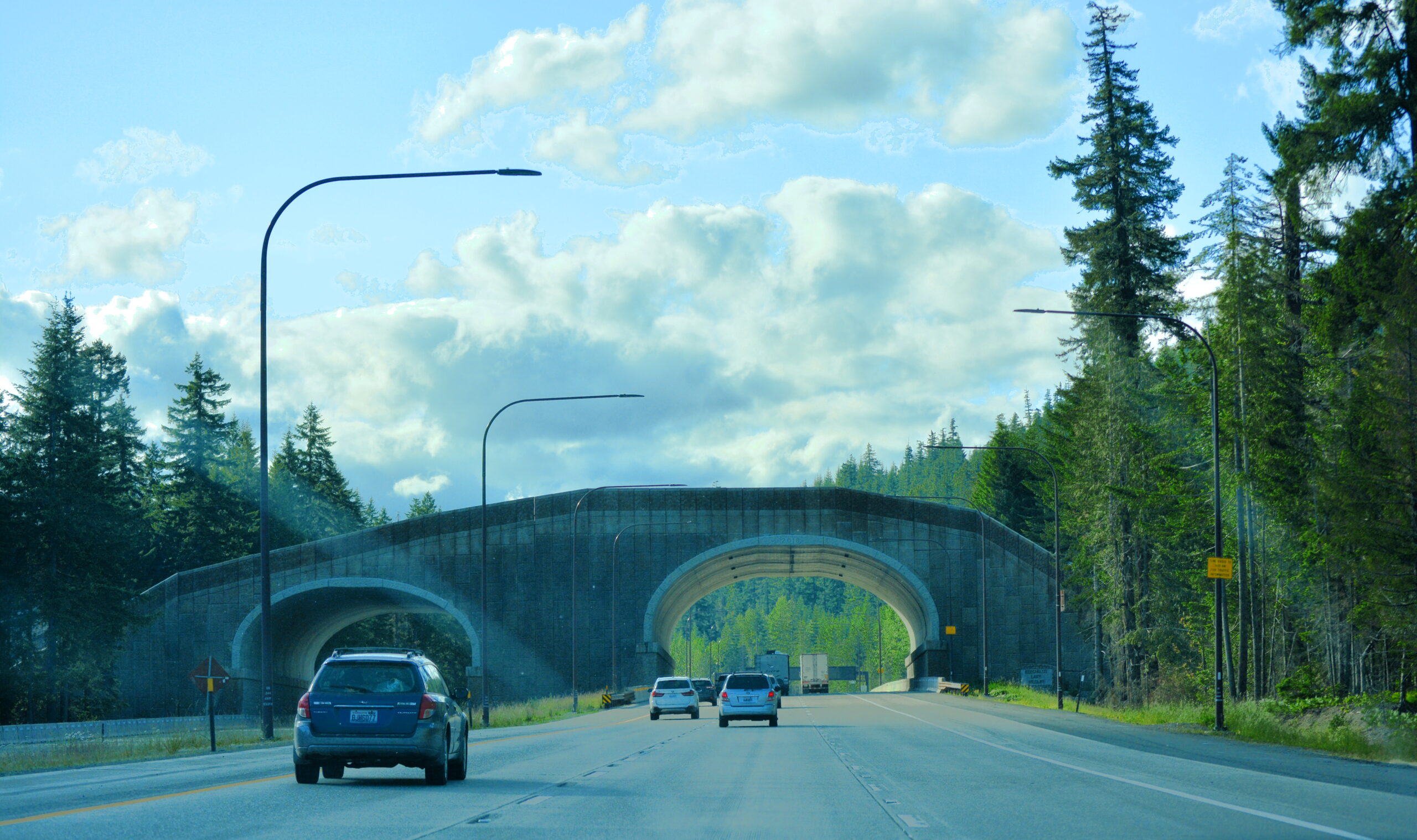
In 2014, motion-activated cameras went up on a new set of wildlife structures along a roughly 15-mile stretch of Interstate 90 between Hyak and Easton, Washington, and began doing the one thing instruments do well: counting. In July 2026, according to a Washington State Department of Transportation social post quoted by Good Good Good, those cameras logged the 10,000th successful crossing on the I-90 Snoqualmie Pass wildlife overcrossing alone — with nearly 40,000 crossings recorded across all 12 structures, one overcrossing and 11 undercrossings, since the counting began. The agency’s separate performance record, the Gray Notebook, tells a longer and differently bounded version of the same tally.
That distinction is the story. A crossing count is not a single number. It is a number attached to a structure, a date range, and a camera.
What the cameras count, and what each number is attached to
The Snoqualmie Pass East project runs through the Okanogan-Wenatchee National Forest, and its instruments are unglamorous: motion-activated trail cameras, triggered by movement, recording animals that complete a passage rather than approach and turn back. Each image is a data point. Ten thousand of them, by July 2026, belong to the overcrossing — the vegetated bridge that carries animals over the interstate rather than beneath it.
The nearly 40,000 figure, in WSDOT’s July 2026 social framing, covers all 12 structures together: the overcrossing plus 11 undercrossings, counted since 2014. Those two numbers describe different things. The 10,000 is one structure’s ledger. The 40,000 is the corridor’s, as the agency described it in that post.
And neither is the Gray Notebook’s number. WSDOT’s performance report states that at the end of 2023, motion-activated cameras had recorded the 25,000th safe wildlife crossing at completed Snoqualmie Pass East structures since 2014. That milestone predates July 2026 by more than two years and covers the structures completed at that time. It is larger than the overcrossing-only 10,000 because it is not the overcrossing-only count. Readers reaching for a single running total will find that the published record does not offer one cleanly; the Gray Notebook also describes 11 large wildlife crossing structures built in completed Phases 1 and 2, a framing that does not map tidily onto the 2026 social post’s overcrossing-plus-11. We are not going to invent the bridge between those two counts. We are going to report both as their sources state them.
What the long record shows
The Gray Notebook’s cumulative species tallies, running from 2014 through the end of 2023 across the completed structures, are where the counting becomes texture. Deer lead: 13,525 recorded crossings. Elk follow at 7,967. Coyotes account for 3,216.
Then the numbers get small enough to name individually. Six cougar crossings across the entire period — five of them in 2023 alone. That is what a low-density species looks like when an instrument watches the same span of ground for a decade: not a trend line, but a handful of events, each one a single animal choosing a structure on a single night.
The rarer entries in the record include moose, American marten, fisher, and American pika. Monitoring by Central Washington University has extended the survey below the large-mammal threshold, tracking small mammals, amphibians, and fish — western toads, coastal giant salamanders, and bull trout in the pools at Gold Creek Bridge. A crossing structure, in that accounting, is not only a deer overpass. It is a culvert a salamander uses, a bridge span a trout swims under.
The project itself was never framed as a wildlife project alone. WSDOT’s stated aims for the corridor include reducing avalanche and rockfall impacts, replacing pavement, adding lanes, reducing wildlife-vehicle collisions, and improving ecological connectivity — the crossings serving several of those at once.
Collisions, “nearly zero,” and what is still planned
WSDOT’s July 2026 social post, as relayed by Good Good Good, offered a statewide figure for scale: between 2019 and 2023, the agency removed 39,258 carcasses from state highways across Washington. On the Snoqualmie Pass East stretch — the segment with the overcrossing and undercrossings — the agency described that number as having shrunk to nearly zero.
That phrasing is the agency’s, and it is qualitative. “Nearly zero” is not a published count, and this article will not convert it into one. What can be said is that WSDOT presents the corridor as an outlier against its own statewide carcass-removal totals.
The agency also attached economic framing to the same post: an average deer collision carrying roughly $15,000 in economic cost, an elk collision roughly $54,000. Those are WSDOT’s figures for the cost of a collision, not measured savings on this stretch. Broader context from the Pew Charitable Trusts, cited in the Good Good Good piece, puts reductions in large mammal collisions at crossing sites as high as 97 percent — a general finding about crossing structures, not a Snoqualmie Pass East measurement. Conservation Northwest, which has advocated for the corridor, describes it as a national model; that characterization belongs to the organization.
More structures are announced. Between now and 2031, per the WSDOT post, the agency plans an additional 15 undercrossings and one more overcrossing along Snoqualmie Pass East. The project’s longer horizon calls for more than 20 large wildlife crossing structures in total. Those are plans, not completions, and the cameras have not counted anything on them yet.
What the cameras have counted is twelve years of animals deciding, one at a time, that a vegetated bridge or a concrete span under six lanes was a reasonable way to get to the other side. The 10,000th image on the overcrossing arrived in July 2026. The shutter did not stop there.