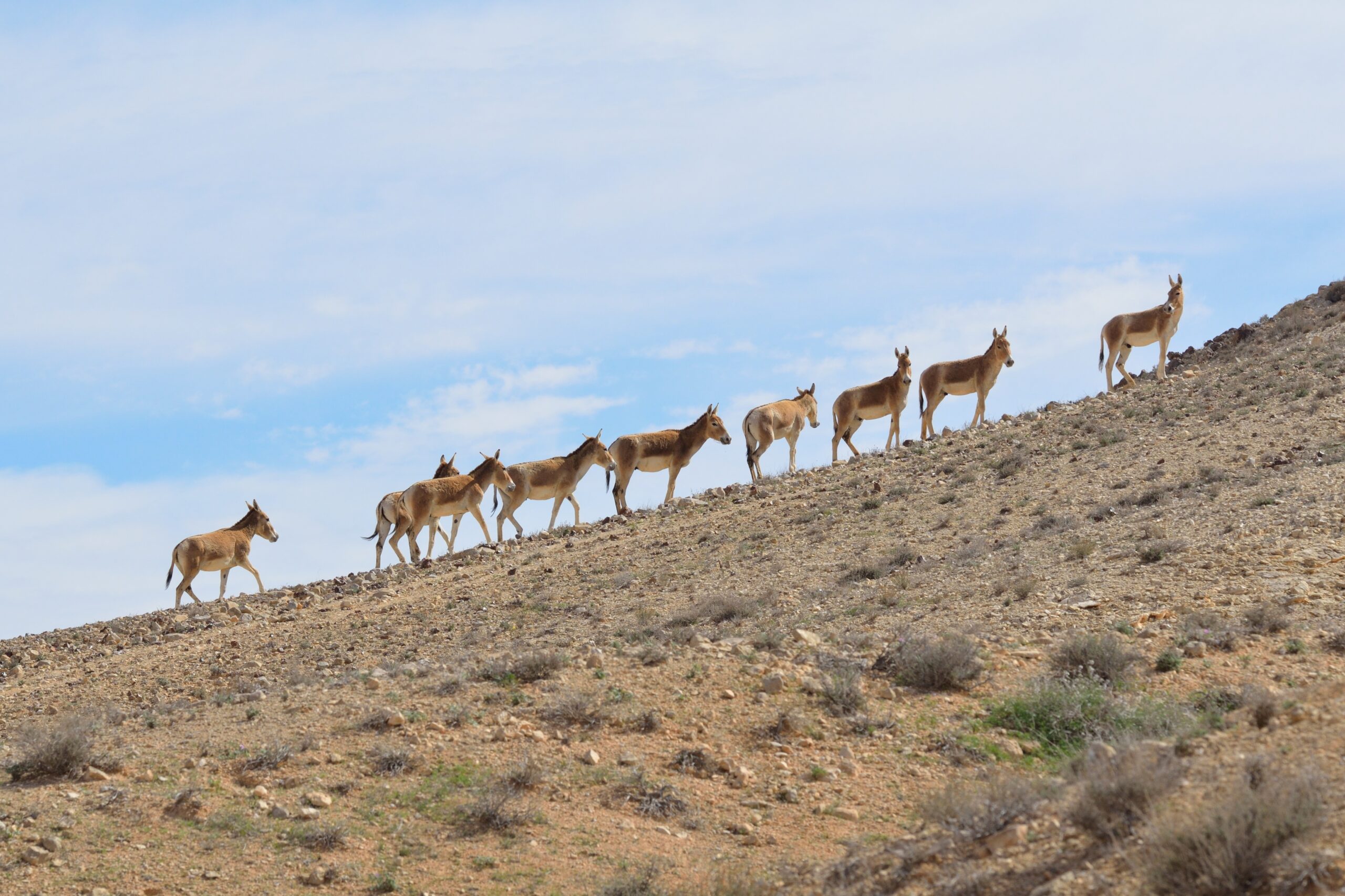
Beginning in 1982, wildlife managers in southern Israel opened crates in the Negev and let 28 Asiatic wild asses walk out into a desert their species had not occupied since the 1920s, and then added 10 more animals in 1992–93 — a founding group of 38 that took hold well enough that, decades later, the seeds passing through the animals’ dung, acacia among them, are counted as part of how desert plants move. The reintroduction and the long effort to find out what became of it are documented by Washington University in St. Louis, while the dung’s role in moving seeds was measured in a comparative study of three reintroduced ungulates published in Animal Conservation (doi:10.1111/acv.12122).
The then/now shape is unusually clean. Then: a locally extinct large herbivore, a small captive herd, and a set of release dates. Now: a wary population that people mostly see at water holes in summer, and a documented seed-dispersal function running through its digestive tract.
The animal that came back was never a donkey
The species released was Equus hemionus, the Asiatic wild ass — the onager lineage, known in Hebrew as the pere, meaning “wild.” That name carries the point. This is not the African wild ass lineage from which domestic donkeys descend, and it is not a feral donkey population. As Washington University’s account notes, drawing on the work of geneticist Alan Templeton, the Asiatic wild ass has a long-standing reputation for being untameable; no domestic line was ever drawn from it.
The animals that repopulated the Negev arrived by a route that now reads as a narrow historical window. Wild asses from the Shah of Iran’s zoo were brought to Israel before the 1979 Iranian revolution — imported in 1968, per the Washington University account — and bred at the Hai-Bar Yotvata Reserve in the Arava. The captive stock was a hybrid of subspecies, and Templeton’s assessment, as relayed by the university, is direct about the consequence: there is no pure Negev subspecies left to restore. What returned was the species, not a reconstructed local genotype.
From that captive herd came the releases. Twenty-eight animals were let go into the Negev beginning in 1982, in a program running through 1987 and centered on the Makhtesh Ramon area; ten more followed in 1992–93. That is the whole founding population — 38 animals, released across roughly a decade, into open desert.
What dung and GPS collars revealed about a population nobody could count
By about 2005, managers faced an awkward gap in the record: the asses were out there, but their status was unclear. The species is extremely wary of people, which defeats the straightforward approach of walking out and counting.
The solution was indirect and patient. Researchers including Shirli Bar-David, Amos Bouskila and Templeton worked the problem through dung DNA — genetic material recovered from droppings, which identifies individuals without anyone laying hands on the animal — alongside GPS collars fitted to darted individuals and observation blinds set at water holes. In a desert summer, water is the constraint that brings a wary animal into view, and counting at water holes turned out to be the practical census method.
The result, reported by Washington University in 2013, was an estimate of roughly 250 animals — grown from those 38 founders. That figure belongs to the mid-2000s research window and should be read as what the science established then, not as a current census.
The dung DNA carried a second finding, offered here as the researchers framed it: the genetic data indicated structure within the population, with the makhteshim — the Negev’s erosional craters — appearing to function as a barrier separating groups. A landscape feature visible from orbit, showing up in the genetics of an animal’s droppings.
Acacia seeds, three ungulates, and what the vegetation did not do
The Animal Conservation paper by Polak, Gutterman, Hoffman and Saltz — titled “Redundancy in seed dispersal by three sympatric ungulates: a reintroduction perspective” — put the question precisely. Three reintroduced or resident ungulates share the Negev: the Asiatic wild ass, the Arabian oryx (Oryx leucoryx) and the dorcas gazelle (Gazella dorcas). Do they duplicate each other’s ecological work, or not?
They do not. Each species dispersed a different assemblage of plants, with little overlap between them — the finding that gives the paper its title, since redundancy is what conservation planners often assume and this study did not find. Germination of Acacia raddiana from dung collected in summer occurred in 51 percent of oryx samples, 30 percent of wild-ass samples and 7.5 percent of gazelle samples, per the study’s ESA-abstract framing of that work.
Acacia is where precision matters. The oryx were the key dispersers of acacia seeds in that study, and an experimental result in the work — acacia (Acacia raddiana) seeds that had passed through an oryx and were planted with oryx pellets germinating far more successfully than uningested seeds planted without pellets — is oryx-specific and should stay attached to the oryx. The wild ass also transports acacia seeds through its dung, and carries a broader, largely distinct set of other species that no other ungulate in the system was moving.
There is an equally important thing the wild asses were not found to do. A vegetation study by Ward and Saltz examining grazing by reintroduced Equus hemionus in Makhtesh Ramon found no significant impact on vegetation cover, species richness, diversity or dominance. The major differences between plots traced to altitude and rainfall, not to the asses. The desert was not remade; nothing greened.
What the record supports is narrower and, arguably, more interesting: a species absent since the 1920s was returned from a hybrid captive herd, released in two small batches, and grew into a population that moves seeds — including acacia — across ground it had not crossed in sixty years. A function restored, measured in dung, without a transformation attached to it.