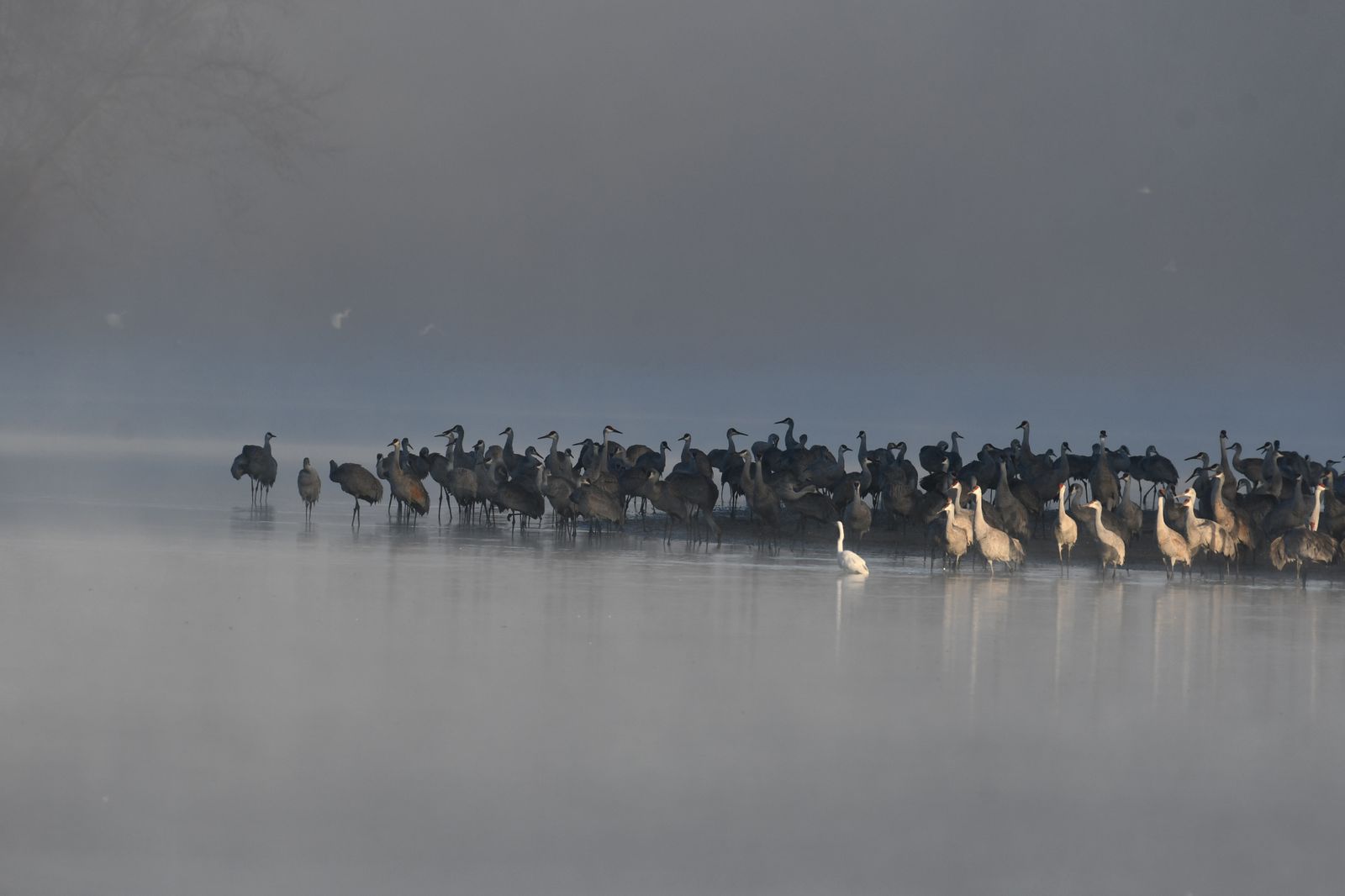
Every March, the shallow, mile-wide Platte River in south-central Nebraska hosts what is likely the single largest gathering of any crane species on Earth: more than a million sandhill cranes funnel into an eighty-mile stretch of river between Grand Island and Kearney, roosting shoulder to shoulder on sandbars so shallow a person could wade across them without soaking a belt loop.
The birds stand in six inches of moving water. They pack the bars so tightly that from a blind at dawn the sandbar itself seems to shift and breathe.
The six-week window
The staging runs, roughly, from Valentine’s Day to Tax Day. Bethany Ostrom, lead biologist at the Crane Trust between Grand Island and Hastings, uses exactly that shorthand in a March 2026 Nebraska Public Media interview. Peak numbers usually land in mid-March, though the peak is a moving target that slides earlier by roughly a day each year as winters warm.
The full-season total, based on turnover as birds arrive and depart, approaches or exceeds a million in most years.
The cranes are not passing through casually. They are refueling. Adult sandhills can put on substantial body weight in fat during the Platte stopover, largely from waste corn gleaned from surrounding fields, before continuing to nesting grounds in the northern Great Plains, Alaska and Siberia.
Why this river, and not another
The Platte’s appeal is a specific geometry. Sandhill cranes roost in flowing water because moving water carries the sound and scent of an approaching coyote or bobcat before the predator can reach the flock. The bar must be broad enough to hold thousands of birds and shallow enough that a crane’s legs, roughly the length of a broomstick, can stand comfortably. The water needs to be ankle-deep at most.
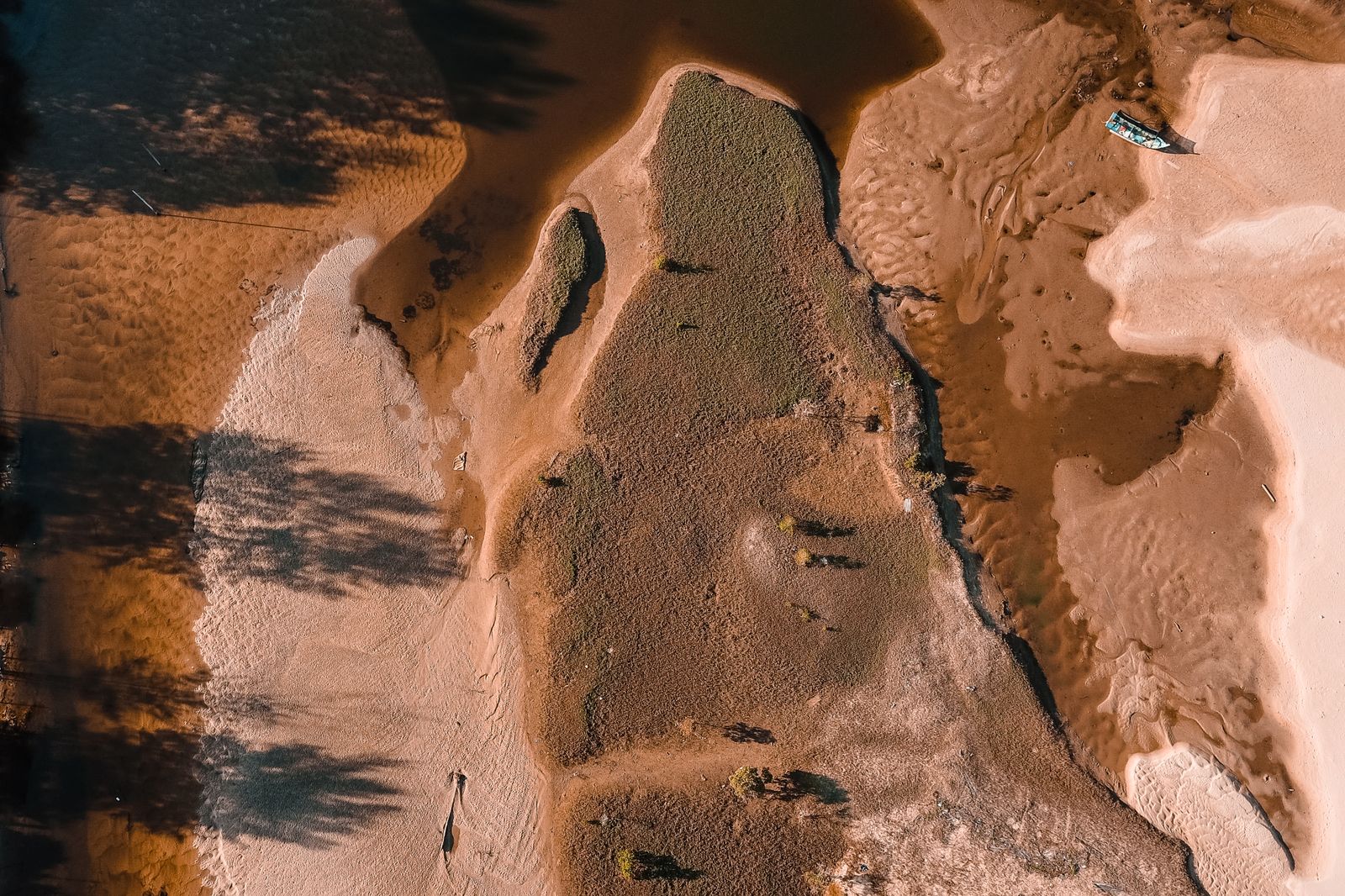
Historically, the Platte was a braided river, splitting and rejoining across a floodplain more than a mile wide in places, choked with sandbars scoured clean each spring by ice and snowmelt. Upstream dams and irrigation withdrawals have cut the river’s peak flows substantially and allowed cottonwoods, willows and invasive Russian olive to colonize what used to be open sand.
The birds concentrate on the reaches where enough water still runs and enough sand still shows. That is roughly the stretch from Chapman to Overton, where habitat groups actively mow, disc and clear encroaching vegetation to mimic the ice-scour the river no longer delivers on its own.
A settlement, a sanctuary, a trust
Two organizations do most of the physical work of keeping the channel open. Audubon’s Rowe Sanctuary, southwest of Gibbon, purchased its first parcel in the 1970s and now manages thousands of acres and several miles of river channel. The Crane Trust, headquartered at the Alda exit off Interstate 80, holds thousands of acres of tallgrass prairie, wetland and riverfront under ownership or easement.
The Crane Trust exists because of a lawsuit. It was established in 1978 as part of a court-approved settlement over the construction of the Grayrocks Dam on the Laramie River, a Wyoming tributary of the North Platte, according to a Flatwater Free Press profile of crane conservationist George Archibald. Downstream water users and conservation groups argued the dam would further starve the Platte of the flows that sustain crane habitat. The settlement created a permanent endowment for habitat management.
Archibald, now 80, met Ron Sauey at Cornell University in 1971 and co-founded the International Crane Foundation with him two years later, in 1973, in a horse barn on Sauey’s family farm in Wisconsin. He has come to the Platte nearly every March since 1975, missing only 2021 for the pandemic. In 2026, he stayed a month.
“You have one of the world’s great migration spectacles that people from all over the world come to see,” Archibald told the Flatwater Free Press. “The river is the most important part.”
What the flock sounds like
A sandhill crane is a tall bird with a wingspan of several feet. The call — a rolling, guttural bugle produced by a windpipe that coils into the sternum — carries for miles across open prairie. Multiply that by half a million birds converging on a single roost at dusk and the sound is closer to distant surf than to birdsong, a low continuous roll punctuated by higher purrs and ticks from birds settling next to their mates.
The daily rhythm is precise. Before sunrise, the flocks lift off the river in waves, flying out to cornfields within a fifteen-mile radius. They spend the day feeding on waste grain, probing for invertebrates in wet meadows, and dancing — the leaping, wing-spreading, stick-tossing display that pairs use to reinforce bonds and unpaired birds use to find mates. At dusk they return to the river, calling continuously as they descend onto the bars.
Warmer winters, earlier arrivals
The migration is shifting. The peak day of Sandhill crane arrival on the Platte is advancing over time, tracking milder winter conditions across the Central Flyway. Some birds are skipping the southern leg entirely. Ostrom told Nebraska Public Media that as many as 35,000 sandhills stayed on the central Platte through the winter of 2025-2026, refusing to migrate further south because snow cover was thin enough that waste corn remained accessible.
Migration is a learned behavior in sandhill cranes. Chicks follow their parents on their first southbound flight and imprint on the route. If parents winter on the Platte instead of continuing to Texas and northern Mexico, their young may never learn the longer journey. A generation from now, the wintering range of the mid-continent population could look meaningfully different.
Bird migration timing across North America has been shifting for decades, with peak movements generally advancing earlier in spring, according to a 2019 continental-scale analysis of weather-radar data published in Nature Climate Change. Timing mismatches — between when animals arrive at a stopover and when the food they depend on peaks — are one of the quieter consequences of a warming climate.
The economics of a bird spectacle
The cranes have become an economic engine. Visitor spending across central Nebraska during crane season nearly doubled between 2017 and 2025, reaching $28 million in economic impact and drawing nearly 35,000 visitors in 2025, according to a University of Nebraska-Lincoln Bureau of Business Research study cited by Nebraska Public Media. Tens of thousands of out-of-town visitors book hotel rooms, fill gas tanks and pay for guided blinds. Visitors include Nebraskans and people from neighboring states — Colorado, Minnesota, Iowa — as well as travelers from further afield. Nearly all cite the cranes as their primary reason for the trip.
Kearney fills up fast. “We aren’t your average community where you can just show up on a whim one evening and be expected to find a hotel room,” Visit Kearney executive director Sarah Focke told Nebraska Public Media.
The whooping crane in the crowd
Hidden inside the gray tide is one of North America’s rarest birds. The whooping crane, taller and pure white with black wingtips, was reduced to a critically small population by the mid-twentieth century. The wild flock that migrates from Wood Buffalo National Park in Canada to Aransas National Wildlife Refuge on the Texas coast has since recovered but remains endangered. A handful stop on the Platte each spring, usually in late March, tucking themselves in among the sandhills.
Spotting one is the birder’s grail. A single flash of white against a horizon of gray confirms the sighting, and the news travels the length of the valley within hours.
What the river still does
The Platte’s ecological role sits in a broader pattern of North American rivers and floodplains whose subtle features carry disproportionate weight for wildlife. Spacewar has looked at how breaching a single earthen levee in California’s Central Valley can reconnect juvenile salmon to floodplain rice fields where they grow up to five times faster than fish stuck in the main channel, and at how alligators dig depressions through Everglades peat that concentrate fish, turtles and wading birds through the dry season. Small physical structures — a levee cut, a gator hole, a scoured sandbar — end up being the ecological hinges entire populations depend on.
The Platte’s hinge is its braid. If the channel narrows further, if cottonwoods march across the last open bars, if peak flows fall below the threshold that keeps sand mobile, the roosting geometry breaks. Cranes need a bar wider than about 150 meters to feel safe. Below that, they abandon it.
Dawn on the sandbar
The morning liftoff is what visitors remember. In the last minutes before sunrise, the calling swells. A few birds pick up. Then a hundred. Then the whole bar lifts at once, thousands of six-foot wingspans beating over the water, and the noise becomes something you feel in the sternum rather than hear in the ears. It lasts about twenty minutes. Then the river goes quiet, and the sandbar — pounded flat by tens of thousands of feet — sits empty in the low sun, waiting for evening.
The birds have been doing this on the Platte for at least 9 million years, based on fossil evidence from Nebraska sandpits — a crane leg bone recovered from Miocene deposits in the state is nearly identical to the modern sandhill’s. The river has moved, shrunk, braided and rebraided across that span. The cranes have kept coming back to the same latitude, the same flyway, the same shallow bars catching the same low March sun.