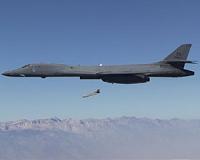
The U.S. Navy and Lockheed Martin have conducted the first free-flight launch of a Long Range Anti-ship Missile from a B-1B Lancer bomber at Point Mugu, Calif.
The missile navigated pre-programmed waypoints before targeting and destroying a single moving target out of a group using onboard sensor criteria. It was the first complete functionality test of the LRASM.
"Today marks a significant step towards providing the operational community with a leap in critical surface warfare capability by next year," LRASM director Capt. Todd Huber said in a press release.
The Long Range Anti-ship Missile is a derivative of the Joint Air to Surface Standoff Missile. It is a stealthy cruise missile designed to pick out specific naval targets using a modified Tactical Tomahawk mission data set.
The missile is guided by anti-jamming GPS, a 2-way data link, radar, and a day/night camera for target identification. The redundancy helps mitigate enemy jamming and allows autonomous targeting.
It will be deployed by F/A-18E/f Super Hornet fighters and the B-1B bomber and can be launched from ships such as the Arleigh-Burke class destroyer using the Mk 41 Vertical Launch System .
LRASM is slated to start entering operational service with the B-1B by next year and the Super Hornet by 2019.
Raytheon and Lockheed secure contract for foreign Javelin missile sales
Raytheon/Lockheed Martin JV has received an additional $133.9 million for Javelin anti-tank missile sales to Jordan, Qatar and Taiwan.
The sale will include test rounds, command launch units, Javelin vehicle mounts and associated services. The contract is expected to run through August 2020.
The Javelin is a man-portable infrared guided missile launcher in use by the United State … read more