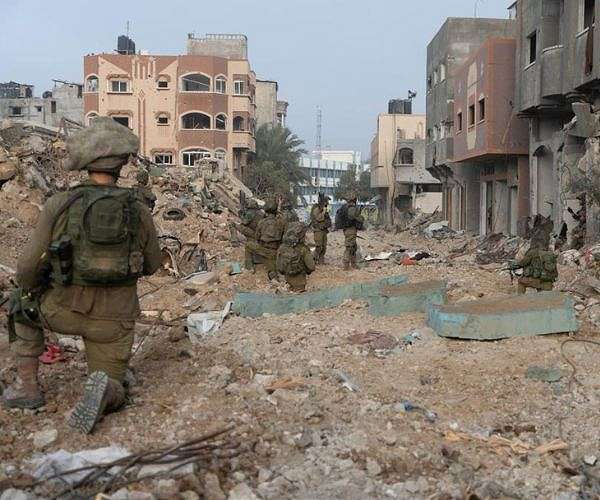
Top United Nations officials are calling on Israel to avoid taking actions that would worsen "the already catastrophic humanitarian situation in Gaza," after the Middle Eastern country widened evacuation orders and expanded ground operations in the besieged Palestinian enclave.
The warnings on Monday came separately from U.N. Secretary-General Antonio Guterres and his head emergency relief coordinator Martin Griffiths in the wake of a weeklong truce between Hamas and Israel having collapsed on Friday.
Their words also came as the Israeli military over the weekend expanded ground operations and ordered residents near the southern Gazan city of Khan Younis to evacuate the region.
According to a Monday statement from his spokesman Stephane Dujarric, Guterres said that he was "extremely alarmed" by the resumption of fighting and ground operations by the Israeli forces, which he called on to "avoid exacerbating the already catastrophic humanitarian situation in Gaza and to spare civilians from more suffering."
"Civilians — including health workers, journalists and U.N. personnel — and civilian infrastructure must be protected at all times," Dujarric said on behalf of Guterres.
United Nations and other international and humanitarian agencies have been warning about the worsening conditions in Gaza since the war began on Oct. 7 when Hamas launched a surprise and bloody attack on Israel, killing 1,200 people. Another 240 were taken hostage by the Palestinian militant group.
In response, Israeli forces have launched seemingly incessant airstrikes on Gaza and a ground invasion that preceded the evacuation of northern Gazans to the southern half of the enclave.
Some 1.8 million Gazans, representing nearly 80% of the enclave's entire population, have been internally displaced, according to U.N. estimates, while the Hamas-controlled Palestinian healthy ministry said Monday that the death toll has reached nearly 16,000 with 70% of the victims being women and children.
During a press conference Monday, Dujarric told reporters that the U.N.'s office for humanitarian affairs is warning that "the current situation" prevents its personnel from addressing the needs of the people in Gaza.
While there were "limited aid distributions" in the Rafah governorate in southern Gaza, in nearby Khan Younis, "aid distribution largely stopped due to the intensity of hostilities," he said.
Other "grave" concerns include the spread of waterborne diseases due to the consumption of unsafe water, especially in northern Gaza where the water desalination plant and pipeline from Israel have been shutdown, Dujarric explained.
"There has been almost no improvement in the access of residents in the north to water for drinking and domestic purposes for weeks," he said.
"And the World Food Program warns that, eight weeks into the war, there is a big risk of famine for all of Gaza's people, especially for those with chronic diseases, older persons, children and people living with disabilities."
World Health Organization Director-General Tedros Adhanom Ghebreyesus on Monday said that he has been informed by Israeli defense forces that they have 24 hours to remove supplies from their southern Gaza medical warehouse as "ground operations will put it beyond use."
"We appeal to Israel to withdraw the order, and take every possible measure to protect civilians and civilian infrastructure, including hospitals and humanitarian facilities," he said in a statement.
In the strongest words from a U.N. official on Monday, Griffiths demanded that the fighting stop, describing the situation in Gaza as a "blatant disregard for basic humanity."
"Every time we think things cannot get any more apocalyptic in Gaza, they do," he said in a statement.
"People are being ordered to move again, with little to survive on, forced to make one impossible choice after another. NOWHERE IS SAFE IN GAZA," he continued. "Not hospitals, not shelters, not refugee camps. No one is safe. Not children. Not health workers. Not humanitarians."
Israel says 'not trying to move anybody' out of Palestinian territories
Jerusalem (AFP) Dec 4, 2023 –
Israel said Monday it was not seeking to force Palestinian civilians to permanently leave their homes, even as it acknowledged conditions in the besieged Gaza Strip were "tough".
Any suggestion of Palestinian dispersal is highly contentious in the Arab world as the war that led to Israel's creation 75 years ago gave rise to the exodus or forced displacement of 760,000 Palestinians, an event known as the Nakba, or "catastrophe".
Israel declared war on Hamas, which rules Gaza, after its brutal October 7 attacks on Israel killed 1,200 people, mostly civilians, according to Israeli authorities.
With the health ministry in the Palestinian territory reporting a death toll of more than 15,500 people, the impact of Israel's relentless bombardment and ground offensive has sparked growing international concern.
Since the collapse last week of a truce that allowed for the release of dozens of Israeli and other hostages in exchange for Palestinian prisoners, Israel has expanded its offensive in Gaza.
In its latest estimate, OCHA said around 1.8 million people in Gaza, roughly 75 percent of the population, had been displaced, many to overcrowded and unsanitary shelters.
Speaking to reporters on Monday, Israeli military spokesman Jonathan Conricus said: "We are not trying to displace anyone, we are not trying to move anybody from anywhere permanently.
"We have asked civilians to evacuate the battlefield and we have provided a designated humanitarian zone inside the Gaza Strip," he said, referring to a tiny coastal area of the territory named Al-Mawasi, as he acknowledged the situation in Gaza was "tough".
"We are perfectly aware that there is limited space and limited access and that is why it is so important to have the buy-in and support of international humanitarian organisations to help with the infrastructure in the Al-Mawasi area," he added.
– 'No safe place' –
As Israel expanded its operations, United Nations High Commissioner for Human Rights Volker Turk at the weekend voiced alarm that hundreds of thousands of Gazans were "being confined into ever smaller areas" in the south of the territory.
"There is no safe place in Gaza," he said.
Earlier in the war, Israel's neighbour and treaty partner Jordan expressed concern that the violence might trigger a wave of displacement spilling into its borders.
Likewise Egypt — which shares a border with Gaza and also signed a peace deal with Israel — has rejected the idea of a mass movement of Palestinians into its territory.
"We have not tried to have any people evacuate there," Conricus said, referring to Egypt.
"Egypt has been very clear about where they stand: they do not want that."
US Secretary of State Antony Blinken has said that "people should be able to stay in Gaza, their home".