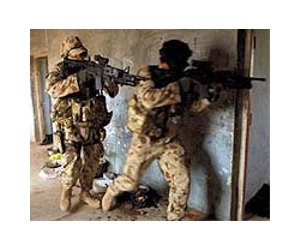
Australian soldiers fighting in Afghanistan will have new lightweight combat body armor by the end of the year, army chief Lt. Gen. Ken Gillespie said.
The tiered body armor system has up to three load carriers designed for multiple combat roles. The TBAS has a new ballistic plate system weighing less than the current modular combat body armor to give added protection, Gillespie said.
The TBAS package also has a new ammunition pouch system designed for a more rapid access.
Gillespie said the body armor is expected to be issued to crucial elements of the next deployment of Australian troops in Afghanistan from the start of 2011.
"The first batch of TBAS will be issued to the soldiers for trial at the end of 2010. We will also incorporate soldiers' recommendations into the new tiered system once the trial is complete."
Last October, Gillespie announced that Australian Defense Apparel was designing new body armor to make it more flexible, lighter and modular.
The Modular Combat Body Armor System project was set up August 2005 to supply the next generation of body armor.
Australian Defense Apparel, founded in 1912 by the Australian government and privatized in 1995, won the contract in 2008. It manufactures the armor at its facility in Bendigo, in the state of Victoria.
The MCBAS five-year contract more than doubled ADA's turnover in 2008-09, the company said at the time. ADA also has a partnership with British body armor specialist Aegis and supplies all types of military and emergency services clothing from body armor to parade dress. Clients include the U.K. military, Indonesian army, Thai army and the Papua New Guinea military.
The decision to make body armor more flexible and lighter was made after concerns by Australian troops in Afghanistan that the armor was more suited to soldiers in Iraq on mechanical operations such as manning tanks and driving vehicles in logistics.
In Afghanistan most soldiers operated on foot and needed armor that allowed more physical movement and was lighter to wear.
"Originally designed for use in Iraq where the majority of operations were mounted, it is now being adapted to better deal with the dismounted operations increasingly being conducted in Afghanistan," Gillespie said in a ministry of defense statement at the time.
"The weight and mobility trade-off in these modular options is a key determinant for commanders in assessing which combination is best suited for particular threat scenarios."
MCBAS is part of the larger, more encompassing Land 125 Soldier Combat Systems project started in mid 2005 to modernize all the equipment used by infantrymen when in close combat.
Land 125 SCS is looking to improve a soldier's personal radio, helmet, carrying equipment and protective padding.
Thales Australia, as part of Land 125 SCS, recently designed a special mount for a thermal weapon sight. The sight is for use with the standard-issue gas-operated F88 Steyr assault rifle made by Australian Defense Industries in Lithgow, New South Wales.
In May Australia's ministry of defense said it will boost spending on its 1,550 troops in Afghanistan by an extra $391 million up to the end of 2011.
The money, announced as part of the new defense budget, is for increased fire power and improved rocket-detecting technology mostly for soldiers fighting the Taliban in Afghanistan's Oruzgan province.
Apart from improved body armor, the government's shopping list includes upgraded technology to clear roads of improvised explosive devices and increased firepower for Bushmaster light patrol vehicles, additional explosives detection dogs and better capabilities for intelligence and reconnaissance work.
Share This Article With Planet Earth