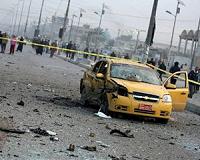
A car bomb targeting Shiite pilgrims killed at least 14 people in southern Baghdad on Monday, security and medical sources said.
An Iraqi security command said a suicide bomber detonated the explosives-rigged vehicle, while other officials said it was a car bomb.
At least 14 people were killed and at least 41 others wounded, security and medical officials said.
They said several women and children were among the victims.
There was no immediate claim of responsibility for the explosion, but such attacks are usually carried out by the Islamic State jihadist group.
IS perpetrated a similar attack against pilgrims on the outskirts of Baghdad on Saturday, killing at least 23 people.
Many of the main thoroughfares in the city are closed in the days leading up to the annual commemoration of Imam Musa Kadhim's death, an important date in the Shiite Muslim calendar.
Kadhim, the seventh of 12 imams revered in Shiite Islam, died in 799 AD. The pilgrimage to his shrine in northern Baghdad has in recent years turned into a huge event that brings the capital to a standstill for days.
The main commemoration at the shrine in Baghdad's Kadhimiya neighbourhood will take place on Tuesday.
Conditions in Iraq detention centre 'shocking': Amnesty
Baghdad (AFP) May 2, 2016 –
The Iraqi authorities are holding often innocent "terror" suspects in dire conditions across the country and have no ability to process cases, Amnesty International said on Monday.
A delegation from the rights group, including its secretary general Salil Shetty, was able to visit one such centre in Amriyat al-Fallujah, west of Baghdad, on Saturday.
"We visited a detention centre in Amriyat al-Fallujah… where we found 700 people confined, locked up there for months, so-called terror suspects," Shetty told AFP in Baghdad.
"The conditions under which they are kept there were quite shocking, some one square metre or so per person, with no place to even lie down," he said.
"The toilets are in the same room, they get… very minimal food, the conditions are just shocking overall," Shetty said.
Donatella Rovera, Amnesty's senior crisis response adviser, said the centre — run by Iraqi anti-terrorism forces — had only four investigators to process cases and was overwhelmed.
Amriyat al-Fallujah is in the western province of Anbar, where security forces have been battling the Islamic State group since 2014.
Military operations have displaced huge numbers of civilians in the province. Thousands of Sunni men have been detained on suspicion of terrorist activities and held incommunicado.
"Not even one of them has been formally charged. They are there for months and months because the local authorities don't have any capacity to investigate these cases," Shetty said.
"Even the authorities themselves said they don't even know how most of those people have ended up there — they think that most of them are innocent," he said.
The Amnesty team members said they had no prior knowledge of the detention centre's existence or of the 700 men held inside it.
"It is symptomatic of a much bigger problem because we met 700 of them but there are many, many such places across the country," Shetty said.
"It's a really bad example of how the criminal justice system in this country simply does not function."
Amnesty argues that strengthening the justice system should be one of the priorities in Iraq, where serious rights abuses continue to go routinely unpunished.