North Korea has previously boasted of possessing thermonuclear weapons, or H-Bombs. Their claims were not taken seriously by most boffins in the past. North Korea has demonstrated the ability to build relatively simple "fission" weapons (A-Bombs), which split the atoms of a heavy element (uranium or plutonium) into smaller atoms, thus releasing energy.
By contrast, a thermonuclear weapon is a "fusion" device. Light atoms (such as hydrogen or helium) are "fused" to make heavier elements, thus releasing energy.
Thermonuclear "fusion" weapons have a "fission" device inside, similar to a basic A-Bomb. Detonating this device produces the tremendous blast of pressure and heat that triggers the "fusion" reaction in the lighter elements. Thus, the H-Bomb is really a two-stage weapon.
North Korea's has tested nuclear weapons six times as of Sunday. The first three tests are judged to be simple A-Bombs, and had fairly low yields. North Korea made no claims that the weapons were any more sophisticated than this.
The fourth and fifth tests are contested. North Korea claimed that these devices were thermonuclear fusion devices, but analysts outside the DPRK disagree. The yields were relatively low for a thermonuclear weapon, but in theory, it is still possible to build an H-Bomb with a small bang.
A more likely explanation is that these devices were "boosted fission" weapons. Take a conventional fission bomb, but add a small amount of light fusionable material at its core. This acts like a fuel additive, providing a shower of subatomic particles inside the uranium or plutonium.
These particles stimulate more fission reactions, producing a "bigger bang" than a basic A-Bomb without the "fuel additive". Technically, you do get a thermonuclear fusion reaction, but the real explosive force from the weapon still comes from souped-up fission reactions.
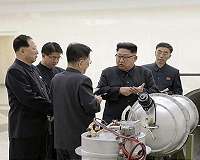
Over the weekend, North Korea claimed to have developed a true thermonuclear weapon, and released interesting photos of leader Kim Jong Un inspecting the device. Later, North Korea conducted its sixth nuclear test. After so much doubt and ambiguity in the past, can we really accept that the North Korea really has the H-Bomb?
Based on the information we have, the claim seems highly credible. A news release from the KCNA agency claims that the new device builds on experience with previous tests, hinting that the past two "fusion" devices tested in underground tunnels were really just boosted fission weapons.
But considerable technical experience must have been gained with these intermediate devices, including the production of fuel for the fusion reaction. Photography released by North Korea shows an elongated device that's consistent with the overall shape of a typical thermonuclear weapon. The lower portion contains the first-stage "fission" detonator, while the smaller segment atop it contains the "fusion" stage.
The power of the seismic tremor for the latest nuclear test is several times larger than that of the fifth North Korean nuclear test, suggesting a large increase in the power of the weapon tested.
The "big bang" is probably the most convincing piece of evidence in support of North Korea's claims. This is a thermonuclear fusion weapon, and that claim would probably be accepted even without the Dear Leader performing a photo shoot.
Trump keeps Iran deal, but threatens more sanctions
Donald Trump has backed away from a campaign promise to scrap a major nuclear security deal with Iran, with officials announcing the agreement and related sanctions relief will stay in place for now.
The Trump administration faced a new congressional deadline Monday to say whether Iran has curbed its nuclear weapons program in line with the accord.
Under the terms of the two-year-old agr … read more