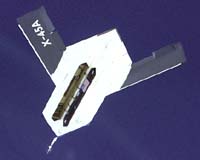
A Boeing X-45A unmanned aircraft was controlled by a pilot-operator in Seattle, Wash., after launching from NASA's Dryden Flight Research Center, Edwards Air Force Base, Calif., on Dec. 9.
"This shows our military can deploy unmanned combat aircraft from one location and control them from another," said Darryl Davis, Boeing Joint Unmanned Combat Air Systems (J-UCAS) X-45 vice president and program manager.
"We're moving quickly toward delivering a 24/7 strike and reconnaissance capability to complement America 's manned fighter and bomber force."
Using 'line of sight' command and control, the technology demonstrator aircraft departed in the morning with a pilot-operator controlling the jet from its home in Southern California. Once airborne, the pilot-operator handed control of the unmanned vehicle over to another Boeing pilot in Seattle.
Taking command of the X-45A using a UHF satellite communications (SATCOM) link, the Seattle-based pilot-operator demonstrated 'beyond-line-of-sight' control by commanding multiple altitude and airspeed changes, which were executed by the vehicle.
Operating from a systems integration lab nearly 1500 kilometers (900 miles) away, the pilot-operator managed the jet for approximately six minutes before turning command back to the California-based team, which returned it to Edwards AFB safely after nearly an hour in the air.
The test mission demonstrated safe and secure vehicle handoff from mission control to another control center through a SATCOM link. That capability will be critical when operating the X-45C, a more robust version of the aircraft being built in St. Louis.
Boeing was recently awarded $767 million in funding from the Defense Advanced Research Projects Agency (DARPA) to build and demonstrate three X-45C aircraft, two mission control elements, and to integrate a common operating system technology for the J-UCAS program. The first X-45C flight is scheduled to take place in early 2007.
The J-UCAS X-45 program is a DARPA/U.S. Air Force/U.S. Navy/Boeing effort to demonstrate the technical feasibility, military utility and operational value of an unmanned air combat system for the Air Force and the Navy. Operational missions for the services may include suppression of enemy air defenses; strike; electronic attack; intelligence, surveillance and reconnaissance; and persistent global attack. The two X-45A technology demonstrators are currently verifying the core functionality of the software necessary for these and related missions.