
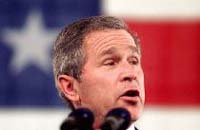
US President George W. Bush served notice on Russian President Vladimir Putin Monday that he will push ahead on his missile defense plan whether or not Moscow agrees to scrap the treaty that prohibits it.
"If we can't reach agreement, we're going to implement," he said, referring to talks with Moscow under a deal reached Sunday that links mutual nuclear arsenal cuts, which Putin backs, to his bid to void a Cold War arms control treaty prohibiting the missile defense system.
The US president, speaking at a joint press conference with Italian Prime Minister Silvio Berlusconi, insisted he would give Russia and skeptical allies "ample time" to come around to his position, but said "time is of the essence."
"But make no mistake about it … I would rather others come with us, but I feel so strongly and passionately on the subject about how to keep the peace in the 21st century, that we'll move beyond, if need be," said the US leader.
"It's, you know, months not years" until the administration's research to develop the system risks falling afoul of the 1972 Anti-Ballistic Missile treaty, said Bush's national security advisor, Condoleezza Rice.
On taking office, Bush told government officials looking at ways to blunt attacks by so-called "rogue states" like North Korea or Iraq to develop the most effective system, whether or not it was treaty-compliant, said a senior administration official who requested anonymity.
"The guidance will not change," said the official, who noted Bush's stance differed from former president Bill Clinton's policy command that design efforts only focus on systems that abide by the accord.
Since Bush took office in January, Russia has repeatedly denounced plans for a missile defense and especially taken umbrage at Washington's determination to effectively void the ABM treaty.
Rice was to head to Moscow this week to craft "an aggressive schedule" of consultations involving foreign and defense ministers from both sides.
Meanwhile, Putin in Moscow expressed cautious optimism that he and Bush might one day strike a deal on missile defense but said that talks a day earlier had not yielded any "breakthrough" on the matter.
"Of course there was no major breakthrough," said Putin. "We (Russia) reaffirmed our support for the 1972 ABM agreement.
"At the same time, there is movement," he added, in reference to his Sunday meeting with Bush in Genoa.
Bush until Sunday had resisted Putin's call for mutual cuts in the mammoth nuclear arsenals the former Cold War foes amassed over 50 years of global rivalry, preferring to seek unilateral US reductions.
Sunday's agreement suggested that each had moved somewhat closer to the other's position, though no specific details of what cuts were envisioned were available.
