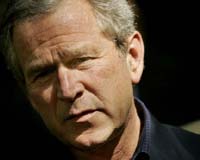
US President George W. Bush said Wednesday that the failure of a North Korean missile thought capable of hitting US territory did not lessen his concerns about Pyongyang's weapons programs.
The Taepodong 2 "didn't stay up very long, it tumbled into the sea, which doesn't, frankly, diminish my desire to solve this problem," Bush said in his first public remarks on Pyongyang's seven-missile volley in 14 hours Tuesday.
"We will hold them to account," said the president, who told reporters he would be personally involved "on the phone" in an effort to rally world leaders behind a unified reaction to the crisis.
Bush said that US officials were still analyzing data from the long-range Taepodong 2 missile launch but dismissed the other missiles launched as "pretty routine weapons" and said the immediate political impact was that North Korea was worse off.
"What these firings of the rockets have done is, they've isolated themselves further, and that's sad for the people of North Korea," Bush said as he met with his Georgian counterpart, Mikheil Saakashvili."
"I am deeply concerned about the plight of the people of North Korea. I would hope that the government would agree to verifiably abandoning its weapons programs," the US president said.
With China seemingly taking a softer line than other US partners in the six-nation nuclear talks with North Korea, Bush insisted that the Chinese "have played and will continue to play an important role" in those negotiations.
"It's my view that the best way to solve this problem diplomatically is through, for there to be more than one nation speaking to North Korea, more than America voicing our opinions," he said.
"Therefore, the five of us — Russia, South Korea, Japan, China and the United states — spoke with one voice about the rocket launches and we will work together to continue to remind the leader of North Korea (Kim Jong-Il) that there is a better way forward for his people," he said.
Bush said that US Secretary of State Condoleezza Rice had been in touch with her counterparts overseas and added: "I, of course, will be on the phone as well."
"We want to send — to continue to send — a clear message: That there is a better way forward for the leader of North Korea," he said. A senior aide confirmed that Bush meant he would be reaching out to world leaders.
Bush said US officials were still puzzling over Kim's intentions with the dramatic launches, which occurred while the United States was enjoying its Independence Day national holiday.
"It's hard to understand his intentions," said Bush. "So we're talking with our friends and allies on the subject."
earlier related report
Bush says US, allies, will hold NKorea to account
US President George W. Bush on Wednesday directed an all-out diplomatic counter-offensive to North Korea's seven-missile barrage as aides puzzled over Pyongyang's intentions and downplayed the crisis.
Bush said he would personally reach out to world leaders and that the failure of a long-range North Korean rocket thought able to strike US territory did not weaken his worries about Pyongyang's nuclear and missile arsenals.
The Taepodong 2 "didn't stay up very long, it tumbled into the sea, which doesn't, frankly, diminish my desire to solve this problem," Bush said in his first public remarks on the situation. "We will hold them to account."
As senior US officials urged China to be "very firm" with North Korea, Bush downplayed Beijing's mild response to the 14-hour rain of rockets and said the Chinese "have played and will continue to play an important role."
With US Secretary of State Condoleezza Rice in touch with her counterparts in China, Japan, Russia and South Korea — US partners in the six-country negotiations on North Korea's nuclear program — Bush told reporters: "I, of course, will be on the phone, as well."
Bush said that US officials were analyzing the Taepodong 2 missile launch but dismissed the other missiles as "pretty routine weapons" and said the immediate political impact was that North Korea was worse off.
"What these firings of the rockets have done is, they've isolated themselves further, and that's sad for the people of North Korea," Bush said as he met with his Georgian counterpart, Mikheil Saakashvili.
He also signalled a rejection of direct US talks with North Korea, saying that Washington and its four partners "spoke with one voice about the rocket launches, and we will work together to continue to remind the leader of North Korea that there is a better way forward for his people."
The senior US envoy on the North Korean nuclear crisis, Christopher Hill, was to travel to the region later, stopping in Beijing, then Seoul, Tokyo and finally Moscow, according to US State Department spokesman Sean McCormack.
Exact timings of the visits were still being worked out, officials said.
Rice met South Korea's national security advisor Song Min-Soon, in a meeting originally scheduled for Thursday but which was brought forward by one day — even as US officials said the situation fell well short of "World War III."
"There are attempts to try to describe this almost in breathless World War III terms. This is not such a situation," said White House spokesman Tony Snow.
Rice, meanwhile, warned Pyongyang had "miscalculated" if it thought the tests would divide Washington and its Asian allies.
"There has been a very strong response to their actions. So whatever the motivations, whatever they thought they were doing, they have gotten a strong reaction from the international community," Rice said, as the UN Security Council met to discuss its response to the tests.
Rice did not specify a response but said Washington and its friends had "a number of tools to make it more difficult for North Korea to engage in this kind of brinksmanship."
Bush seemed to echo past US statements that Washington will not use humanitarian aid as a lever, saying he was "deeply concerned about the plight of the people of North Korea."
Hill signalled the flavor of US diplomacy by warning in an interview with CNN International that Beijing, host of stalled six-party talks on North Korea, must now play a crucial role.
"We need China to be very, very firm with their neighbors and frankly with their long-term allies the North Koreans, on what is acceptable behavior and what is not acceptable behavior," said Hill, the assistant secretary of state for East Asian and Pacific affairs.
US officials have long pressed China, a major donor of economic and energy aid to the impoverished Stalinist state, to pressure Kim Jong-Il to dismantle missile and nuclear programs.
The UN Security Council, meanwhile, held emergency consultations.
"By the tenor of the statements of all of the council members, I think there is support for sending a clear signal to Pyongyang," said US ambassador to the UN John Bolton, who hoped for action "in the next few days."
Investors on Wall Street, meanwhile, were spooked by the tests, analysts said, sending the Dow Jones Industrial Average down 82.76 points (0.74 percent) to 11,145.26 and the tech-rich Nasdaq composite 37.69 points (1.72 percent) lower at 2,152.74 at 1600 GMT.