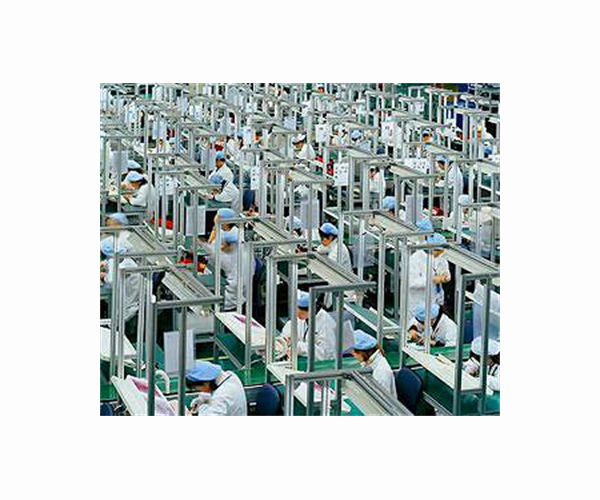
Chinese factory inflation rose more than expected in July, data showed Monday, as surging commodity prices offset government measures to temper costs.
The world's second largest economy has largely bounced back from strict coronavirus lockdowns last year but a fresh spike in cases of the highly transmissible Delta variant has raised concerns about the recovery.
That has raised concerns that inflation could spike further if lockdowns in parts of the country cause supply problems.
The producer price index (PPI), which measures the cost of goods at the factory gate, rose to 9.0 percent on-year, the same as May, which was a 13-year high, according to the National Bureau of Statistics.
That came despite moves by the government to temper the price increases by raising export tariffs on certain iron and steel products, temporarily exempting tariffs on pig iron and scrap steel, and canceling export tax rebates for some steel products, to increase supply in the domestic market.
"The price increase of industrial products expanded slightly, affected by sharp increases in the costs of crude oil, coal and related products," said NBS senior statistician Dong Lijuan in a statement.
While the PPI remains elevated, consumer inflation ticked down to 1.0 percent, with officials stressing their work to stabilise prices in the wake of recent disasters including floods in central China and with companies appearing to absorb the increases instead of passing them on to consumers.
The slight fall in the consumer price index (CPI), a key gauge of retail inflation, came on the back of easing food prices as pork prices fell 43.5 percent on-year, supported by China's pork reserves and rising supplies.
This was even as "extreme weather such as typhoons and heavy rainfall in some areas" bumped up the cost of fresh vegetable production, storage and transportation.
Asian markets rise but Fed taper talk, Delta keep traders on edge
Hong Kong (AFP) Aug 9, 2021 –
Asian markets rose Monday but investors remained cautious after a forecast-beating US jobs report reinforced optimism about the economic recovery but fanned speculation the Federal Reserve could begin tapering monetary policy this year.
Spiking infections around the world from the Delta Covid variant are also jangling nerves as governments reassess their growth outlooks with some — including China — forced to reimpose lockdowns and other containment measures.
Data on Friday showed the world's biggest economy created 943,000 new jobs in July, while the June reading was also revised higher to more than 900,000. The news provided some much-needed reassurance that the rebound was still on track despite Delta's spread.
However, it also renewed concerns that in a bid to prevent overheating, the Fed will start to wind down the ultra-loose policies — including record low interest rates and a vast bond-buying scheme — that have been integral to an equity market rally since April last year.
The bank has continuously stressed that it will maintain its accommodative stance for as long as the economy needs to recover but with inflation at multi-year highs and jobs returning, it is coming under increasing pressure to act.
"You have these concerns that if the economy is growing very, very strongly then that might bring forward the tightening or the tapering by the Fed," Shane Oliver, at AMP Capital, told Bloomberg Television.
"There is a good chance they might announce that tapering in September and it would start later this year."
And National Australia Bank's Rodrigo Catril added: "Overall, there is not a lot of disagreement on a taper announcement coming sometime between September-December followed by actual tapering sometime between November and January."
He said Fed chief Jerome Powell's speech to the Jackson Hole symposium of top finance and banking chiefs this month had taken on even more significance.
Still, US investors were broadly upbeat, with the Dow and S&P 500 ending at all-time highs, though the Nasdaq slipped with tech firms more sensitive to higher rates.
And Asian investors took up the baton.
Hong Kong, Shanghai, Sydney, Seoul, Wellington, Manila and Jakarta all rose, though Taipei slipped. Tokyo and Singapore were closed for holidays.
There was little major reaction to data showing growth in Chinese exports slowed last month, while inflation came in slightly above expectations.
However, oil prices extended Friday's losses as the fast spread of Delta raises concerns about the outlook for demand, particularly in China.
Investors are also keeping tabs on developments in Washington where lawmakers are close to a vote on Joe Biden's $1.2 trillion infrastructure bill, which will provide another massive shot in the arm for the economy.
– Key figures around 0230 GMT –
Hong Kong – Hang Seng Index: UP 1.0 percent at 26,424.22
Shanghai – Composite: UP 0.5 percent at 3,476.58
Tokyo – Nikkei 225: Closed for a holiday
Dollar/yen: UP at 110.24 yen from 110.21 yen at 2100 GMT Friday
Pound/dollar: DOWN at $1.3866 from $1.3877
Euro/dollar: DOWN at $1.1757 from $1.1765
Euro/pound: UP at 84.79 pence from 84.74 pence
West Texas Intermediate: DOWN 1.8 percent at $67.04 per barrel
Brent North Sea crude: DOWN 1.7 percent at $69.47 per barrel
New York – Dow: UP 0.4 percent at 35,208.51 (close)
London – FTSE 100: FLAT at 7,122.95 (close)
dan/gle
DELTA AIR LINES
AMP
NATIONAL AUSTRALIA BANK