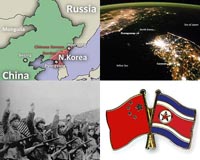
A Chinese state-run newspaper called on Beijing on Friday to "stay neutral" if North Korea strikes first in a conflict with the United States, despite a mutual defence pact between the Asian allies.
The nationalistic Global Times tabloid said in an editorial that Washington and Pyongyang were playing a "reckless game" that could lead to "miscalculations and a strategic 'war'".
"Beijing is not able to persuade Washington or Pyongyang to back down at this time," the Global Times said.
"It needs to make clear its stance to all sides and make them understand that when their actions jeopardize China's interests, China will respond with a firm hand."
The commentary came after Washington warned North Korea this week it faced "fire and fury like the world has never seen" if it continued to threaten the US with its missile and nuclear programmes.
That prompted a defiant Pyongyang to threaten a missile attack on Guam, a tiny US territory in the Pacific that is home to major US air and naval facilities.
China — which has been accused by the US of not doing enough to rein in its longtime ally — has maintained that political dialogue is the only solution.
China fought alongside the North in the 1950-53 Korean War and the two nations signed a mutual defence pact in 1961, but the Global Times suggested Beijing should remain on the sidelines if Pyongyang launches the first salvo in a new conflict with the United States.
"China should also make clear that if North Korea launches missiles that threaten US soil first and the US retaliates, China will stay neutral," the editorial said.
"If the US and South Korea carry out strikes and try to overthrow the North Korean regime and change the political pattern of the Korean Peninsula, China will prevent them from doing so."
Is China being left behind in US-N.Korea sparring?
Beijing (AFP) Aug 11, 2017 –
As the United States and North Korea exchange fiery words over the regime's growing weapons programme, China — the North's biggest ally and trade partner — has receded into the background.
Donald Trump had been publicly prodding China for months to use its influence on Pyongyang, but this week the US president pointed his verbal salvos directly at North Korea, warning of "fire and fury" if it endangered the United States.
That prompted a defiant Pyongyang to threaten a missile attack on Guam, a tiny US territory in the Pacific that is home to major US air and naval facilities.
The bellicose rhetoric overshadowed Beijing's calls for restraint and political dialogue.
"Beijing is not able to persuade Washington or Pyongyang to back down at this time," the state-run Global Times tabloid conceded in an editorial on Friday.
Here are three questions and answers on China's conundrum:
What is the best-case scenario for China?
China has consistently sought the resumption of the "six-party talks" (alongside Russia, Japan, South Korea, North Korea and the US), which collapsed in 2009 but could trumpet Beijing's role as a mediator.
"Beijing could play the role of a chairman at these talks and boost its influence not only regarding North Korea but also South Korea and Japan," political analyst Willy Lam told AFP.
"This would bolster its claim to semi-superpower status."
China responded Friday to the US and North Korea's latest provocations by once again urging "caution."
The US and North Korea should avoid "going down the old path of alternately showing strength and continuously escalating the situation," foreign ministry spokesman Geng Shuang said in a statement.
But China's repeated proposals for peaceful dialogue appear to have fallen on deaf ears as the United States and North Korea ramp up the rhetoric.
Not long after Geng's statement, Trump launched another salvo on Twitter Friday, warning that a military option was "locked and loaded, should North Korea act unwisely".
"China has no real effective leverage to deescalate the situation if both Trump and North Korea's Kim (Jong-un) are reckless," Xu Guoqi, a foreign relations expert at the University of Hong Kong, told AFP.
How much sway does China really hold?
Before his verbal barrages this week, Trump had been complaining that China was not doing enough to use its considerable economic leverage on North Korea.
On Monday, China's foreign minister pledged to "implement…100 percent" new and wide-sweeping UN Security Council sanctions that could cost the authoritarian regime $1 billion in annual revenue.
But China, which accounts for 90 percent of the North's trade, has said it would not cut off humanitarian aid to the country's poverty-stricken population.
The US, Japan and South Korea would have to offer additional concessions to prompt China to consider using aid as a bargaining chip, analysts said.
"If Trump wants China to do more in terms of sanctions, Washington has to make significant concessions — for example, in regards to the deployment of the THAAD missile defence system, trade issues or the South China Sea," Lam said.
"In theory, China could cut off aid tomorrow."
Would China defend North Korea in a conflict?
A cornerstone of Sino-North Korean ties is a mutual defence pact signed in 1961, eight years after the end of the Korean War.
Still, analysts said it was a "mystery" whether either side would uphold the military treaty should conflict really break out.
Beijing has long feared that a collapse of the North Korean regime would bring a flood of refugees across its border.
An editorial in the Global Times, a nationalistic tabloid, said Friday that China's actions should depend on who fires first.
"China should also make clear that if North Korea launches missiles that threaten US soil first and the US retaliates, China will stay neutral," the column said.
"If the US and South Korea carry out strikes and try to overthrow the North Korean regime and change the political pattern of the Korean Peninsula, China will prevent them from doing so."
Tillerson's Thai stop spotlights country's North Korea ties
US Secretary of State Rex Tillerson made a pit-stop in Bangkok on Tuesday with a plea to the kingdom to curb business ties with North Korea, as Washington rounds up allies for its bid to halt Pyongyang's nuclear ambitions.
Tillerson is the highest level American diplomat to visit Thailand since a 2014 coup strained ties between the longtime friends and saw China court Bangkok with massive ar … read more