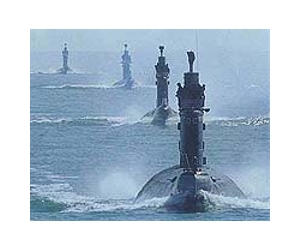
US military chief Admiral Mike Mullen said on Friday that China had adopted an increasingly aggressive stance on the high seas, with Beijing pushing territorial claims.
Mullen also repeated criticism of Beijing for breaking off military contacts with the United States earlier this year, and for a lack of "transparency" in its military build-up.
During a visit to New Delhi, Mullen said Indian officials shared US concerns about China's approach and agreed on the need to ensure open access to vital sea lanes across the Pacific and Indian Oceans.
"China seems to be asserting itself more and more with respect to the kinds of territorial claims in islands like the Spratlys," said Mullen, the US military's top officer, referring to the island chain in the South China Sea.
"They seem to be taking a much more aggressive approach" in waters Beijing deems of economic and strategic interest, he told reporters.
The chairman of the US Joint Chiefs of Staff said he has also moved from "being curious about where China is headed (militarily) to being concerned about it".
US officials worry that China's more assertive stance in the Pacific Ocean and its anti-ship missile arsenal, capable of striking aircraft carriers, could undercut America's long-dominant naval power in Asia.
US Secretary of State Hillary Clinton meanwhile said at security talks in Hanoi on Friday that resolving disputes over the South China Sea was "pivotal" to regional stability.
Beijing's claims over potentially resource-rich archipelagos in the South China Sea conflict with those of some members of the Association of Southeast Asian Nations (ASEAN).
ASEAN favours a united front on the South China Sea issue but Beijing prefers to deal with individual claimants, and was not happy that Clinton and 11 other delegates raised the matter in Friday's talks, diplomats said.
earlier related report
Russia insists on tech transfer in French warship deal
Moscow (AFP) July 24, 2010 –
Russia's top naval commander Saturday insisted the purchase of French warships would only go ahead if it included a transfer of technology, warning otherwise there was "no point" to the deal.
The comments by Admiral Vladimir Vysotsky came a day after French President Nicolas Sarkozy assured workers at a French shipyard that the decision to seal the deal with Russia was "certain".
"What is important here is to obtain the possibility of a transfer of key, fundamental technologies… not just in ship building but in several other areas," Vysotsky told the Echo of Moscow radio.
"This is without doubt the main condition for this transaction. If this does not happen then there is no point in undertaking this," he added.
"We do not need the ship but we do need its possibilities.
"We need its equipment. The point of the ship is in its absolute multi-functionality," he said.
Russia has been negotiating with France for months to buy the Mistral-class helicopter carriers but the deal has yet to be finalised, with the issue of technology transfer apparently the main sticking point.
Russian Prime Minister Vladimir Putin told AFP last month that Moscow would only go ahead with the deal if it included a transfer of the technology that makes the Mistral one of the most powerful in the French fleet.
However Vysotsky's statement is the bluntest yet from a Russian military official about where Moscow sees its interests in the deal.
The deal would be the first sale of advanced military hardware to Russia by a NATO country and the sale has worried ex-Soviet states who now have tense ties with Russia, as well as some lawmakers in the United States.
Vysotsky said that other countries possessed technologies which Russia does not have and officials were "being crafty" if they claimed that Russia could develop these on its own.
Purchase of the ships and their equipment is seen as a major pillar in Russia's strategy to transform its armed forces from a structure inherited from the Soviet Union into a modern and dynamic fighting force.
The ships cost around 500 million euros (600 million dollars) each and Russia would purchase up to four of the vessels and also obtain the right to manufacture more at its own shipyards.
Vysotsky confirmed that the deal was now being overseen by one of Russia's most powerful figures and close Putin ally, Deputy Prime Minister Igor Sechin, who media expect to drive a hard bargain on the issue.
Share This Article With Planet Earth