
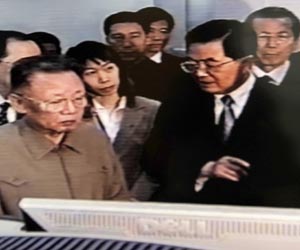
Chinese state television on Friday broadcast rare footage of North Korean leader Kim Jong-Il, clearing up days of mystery over the reclusive ruler's highly secretive visit to his nation's closest ally.
Looking tired and elderly, the 68-year-old leader was shown meeting with Chinese President Hu Jintao this week during a trip which fuelled speculation that negotiations on ending his country's nuclear programme could soon resume.
Kim's trip to China on his luxurious armoured personal train — he is said to dislike flying — began Monday, prompting a guessing game by foreign news media attempting to follow the progress of a trip kept under tight wraps.
Finally Friday, Kim was shown for several minutes on Chinese TV in talks — apparently taped earlier in the week — with Hu and Premier Wen Jiabao, who chatted cheerfully to the expressionless North Korean leader.
Kim was later shown smiling as he shook hands with other top officials in some of the lengthiest footage in years of the diminutive "Dear Leader".
The North Korean leader is said to have suffered a stroke in mid-2008, prompting intense speculation about his succession, and Friday's footage appeared likely to back claims that his health had declined.
Wearing his trademark zipped-up khaki tunic with matching pants, Kim looked wan and every bit his 68 years. His hair appeared to be thinning and he showed little sign of physical vigour.
It was hard to gauge his mobility from the television footage, which mostly showed him sitting or standing still as he shook hands with Chinese officials. At one point, he clinked wine glasses with Hu.
In line with previous highly choreographed visits, China's communist rulers had kept this trip under wraps even though Kim stopped in the northeastern port cities of Dalian and Tianjin before reaching Beijing.
There were various sightings of Kim and what was believed to be his motorcade, but China's foreign ministry spokeswoman refused to comment on Kim's visit while it was under way.
State media in both China and North Korea remained silent until Friday, when Kim was said to have returned home.
Kim has visited China four times since 2000, each time by train and each time under similar hush-hush circumstances.
Some North Korea watchers believe the secrecy is due to fears by Kim or his inner circle of an assassination attempt aimed at ending a hardline style of rule that has made his country one of the world's poorest.
Such concerns were spotlighted by an April 2004 train accident in North Korea near China's border that left at least 161 people dead and 1,300 hurt.
It occurred just hours after Kim's train passed through. Some believe it was an attempt on his life.
Kim's health problems have fuelled speculation he was grooming his 26-year-old son and heir apparent Kim Jong-Un to succeed him in the family's latest dynastic handover.
Little is known about the younger Kim. A Japanese newspaper last month published what it said was a rare photograph of him but South Korean officials cast doubt on the identification.
earlier related report
Kim vows to work to revive N.Korea nuclear talks: Xinhua
Seoul (AFP) May 7, 2010 –
North Korean leader Kim Jong-Il vowed during a visit to China this week to try to revive stalled nuclear disarmament talks, Beijing media said Friday in a first confirmation of the secretive trip.
"Kim said that the DPRK (North Korea) will work with China to create favourable conditions for restarting the six-party talks," Xinhua news agency reported, without saying whether he made a commitment to return to dialogue.
Kim's five-day visit, which ended Friday, was shrouded in secrecy but was seen as an attempt to secure aid to shore up his country's crumbling economy.
China, which hosts the nuclear negotiations, was expected in return to press its ally to come back without preconditions to the forum which Pyongyang angrily abandoned in April 2009.
Xinhua, reporting Kim's meeting with President Hu Jintao, said they agreed that "relevant parties" in the negotiations "should demonstrate sincerity and make positive efforts for pushing forward the six-party talks".
Pyongyang's official media separately confirmed that Kim had ended his visit but made no mention of the meeting with Hu or nuclear issues.
"Party and state leaders and people of China accorded with utmost sincerity warm welcome and cordial hospitality (to Kim)," the Korean Central News Agency (KCNA) said.
In a separate statement carried on KCNA, Kim sent a personal message of thanks to Hu, describing China as a "friendly neighbour".
"It is my belief that the DPRK-China friendship deeply enshrined by the peoples of the two countries would grow stronger and develop generation after generation," he said.
A month after quitting the nuclear negotiations, the hardline communist North staged its second atomic weapons test — incurring toughened UN sanctions which further damaged its economy.
It is desperate to improve living standards and ease food shortages — worsened by a bungled currency revaluation — in advance of a possible power handover.
Kim, who suffered a stroke in August 2008, is widely thought to be preparing for an eventual transfer of power to his youngest son.
Chinese state television broadcast footage of the Kim-Hu meeting, showing the 68-year-old Kim looking frail and elderly with thinning hair.
South Korea's food aid to its neighbour has largely halted amid the nuclear standoff.
But the North has said it wants a lifting of UN sanctions and a US commitment to discuss a formal peace treaty before it returns to the talks grouping the two Koreas, Russia, China, Japan and the United States.
Prospects of negotiations have been further clouded by the sinking of a South Korean warship near the disputed border with the North on March 26.
Suspicions are growing that a North Korean torpedo sank the Cheonan with the loss of 46 lives.
South Korean and US officials say Seoul's investigation into the sinking must be wrapped up before any moves to restart nuclear dialogue.
Xinhua reported that China's foreign ministry, at a briefing on Kim's visit, rejected suggestions China may have shown "partiality" by welcoming Kim to Beijing before the Cheonan probe had ended.
Xinhua quoted spokeswoman Jiang Yu as saying Kim's "unofficial visit" had been arranged long before the Cheonan incident, and that the visit and the corvette's sinking were two separate events.
Koh Yu-Hwan of Seoul's Dongguk University said Kim's trip came at a sensitive time.
"The resumption of talks depends on the outcome of the investigation into the sinking," Koh told AFP. "But I believe North Korea is saying it is ready to return to the six-party forum any time."
China has given South Korea a detailed briefing on Kim's trip, a Seoul official said without elaborating.
Xinhua's report made no mention of new aid pledges, saying only that Chinese leaders promised to continue supporting North Korea economically.
The North's regime has resisted Chinese-style free-market reforms but it wants to boost foreign trade and attract overseas investment to its Rason free-trade port zone on the border with China.
KCNA confirmed that Kim visited China's booming northeastern port cities of Dalian and Tianjin and that he was "deeply impressed" at Dalian's development.
South Korea's Yonhap said Kim's train crossed the border at 4:55 pm (0755 GMT) on his way home.
Share This Article With Planet Earth
