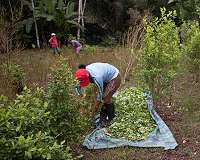
Colombia is moving towards peace, but in the coca fields whose narcotic produce have fueled decades of conflict, villagers fear they are being abandoned to a new kind of war.
A historic deal signed by the government and FARC rebels aims to demobilize the leftist force and replace the drug crop that has funded it with something safer.
But in Narino, a jungle-covered region on Colombia's southwestern coast, people that live off the sparkling fields of green coca plants say the deal takes away their livelihood and leaves them at the mercy of a new gang turf conflict.
– Safety –
Locals used to pay the Revolutionary Armed Forces of Colombia (FARC) for protection from other forces in the conflict, and from authorities looking to stamp out coca.
Over the past half-century of conflict, the Narino region has suffered violence involving rebels, drug gangs, illegal miners and human traffickers.
"There was a war between various groups for control of the area," said Jesus Ramos, a 42-year-old coca grower in the village of Policarpa.
"As soon as the FARC gives up and this village is left alone, the same thing that happened in past years will happen again."
For the authorities, the FARC were a murderous rebel force. But for locals here, they were protectors.
With the FARC around, "there was respect. They punished anyone who was disorderly," says shopkeeper Roberto Delgado, 42.
"We are afraid that when the FARC leave, there will be no more security."
– Livelihood –
Colombia ranks as the world's biggest coca and cocaine producer, according to the United Nations.
Coca leaves produce the paste that forms the base ingredient for the drug.
Under the peace deal, the FARC has agreed to abandon the coca trade and disband, transforming into a political party.
The state has pledged to help plant alternative crops.
"It is a cause for hope in this process that they have committed to honoring their historic debt to overcome the poverty that so affects this area," local FARC commander Ramiro, 44, told AFP.
"Now we must seek alternative ways of making a living."
But locals do not trust that will happen without the FARC to stick up for them.
"When the FARC aren't there, people will come and tear out the crops and there will be no work for us," says Delgado.
"If the coca goes, there will be nothing. People live off it."
– Earnings –
Locals do not believe that they can earn the same living from planting other crops in this isolated, impoverished region.
"We make a living from coca because other crops do not yield as much," says Alexandra Matitui, 30, a grower with ragged clothes and callused hands.
Coca is the only crop she has seen grown successfully in this region.
A one-hectare (2.5-acre) field of coca can bring in $330 a month, she says.
A similar field of peanuts, avocados or cocoa would yield just half that.
Matitui was raised on the proceeds of coca and is now raising her own children on it, living in a mud house.
It does not make you rich, she says, but it earns you a living.
Coca "is easy because it is a very light crop. After six months, it yields the first harvest and it keeps on doing so every three months after that," she said.
"What's more, there is no need to transport it to the city. The buyers come right here."
– Stigmatized –
Local people are facing a "critical" situation, said the mayor of Policarpa, Claudia Cabrera.
"If the government does not reach a negotiated agreement with the local farmers about crop eradication, there will be a social problem," she said.
Cabrera carries a pistol wherever she goes, having received death threats from armed groups.
"The national government has no excuse. It has always stigmatized us as a conflict hotspot," she says.
"Now there must be investment here."
Colombia FARC rebels start demobilization process
Bogota (AFP) Jan 31, 2017 –
Colombian FARC rebels gathered in demobilization zones on Tuesday to start a historic disarmament process to end Latin America's last major armed conflict, authorities said.
The Revolutionary Armed Forces of Colombia (FARC) are due to disband with UN supervision under a peace deal with the government after 52 years of conflict.
Meanwhile, the country's last active rebel group, the smaller National Liberation Army (ELN), was taking the final steps towards its own peace talks with the government.
The government's top delegate for the peace process, Sergio Jaramillo, said a total of 6,300 FARC fighters were due to reach the disarmament zones by Wednesday, and thousands had already arrived.
"What is happening is really most extraordinary. This is the peace process in action," he told a news conference.
He said there had been no major incidents in what the government has called the FARC's "last march."
Fighters traveled by boat, canoe, bus, truck and on foot as they headed to 26 zones where they will disarm and eventually re-enter civilian life.
But a monitoring group warned that only one of the camps was fully ready.
"The preparation of the disarmament zones is at 30 to 35 percent," said Leon Valencia, head of the Peace and Reconciliation Foundation.
The ELN, meanwhile, said Monday the government had begun releasing certain detainees to clear the way for peace talks.
In return, the ELN is to release a former lawmaker it is holding hostage, Odin Sanchez, on Thursday.
The government is due simultaneously to release two other imprisoned ELN members and grant them a pardon.
The ELN announced Tuesday that it was also holding another hostage, a Colombian soldier previously reported missing by the army, whom the rebel force seized last week.
It said it was willing to release him, too.
ELN negotiators are gathered in the Ecuadoran capital Quito, where talks with the government are scheduled to start on February 7.
After last year's contested peace accord with the Marxist FARC, President Juan Manuel Santos says he wants a deal with the ELN to seal a "complete peace" in Colombia.
The Colombian conflict grew out of a crushed uprising over land rights in the 1960s.
It has killed more than 260,000 people and left 60,000 missing, according to authorities.
The conflict has drawn in not only the Colombian armed forces, the FARC and the ELN, but also drug gangs, right-wing paramilitaries and other leftist rebel groups that have since disbanded.