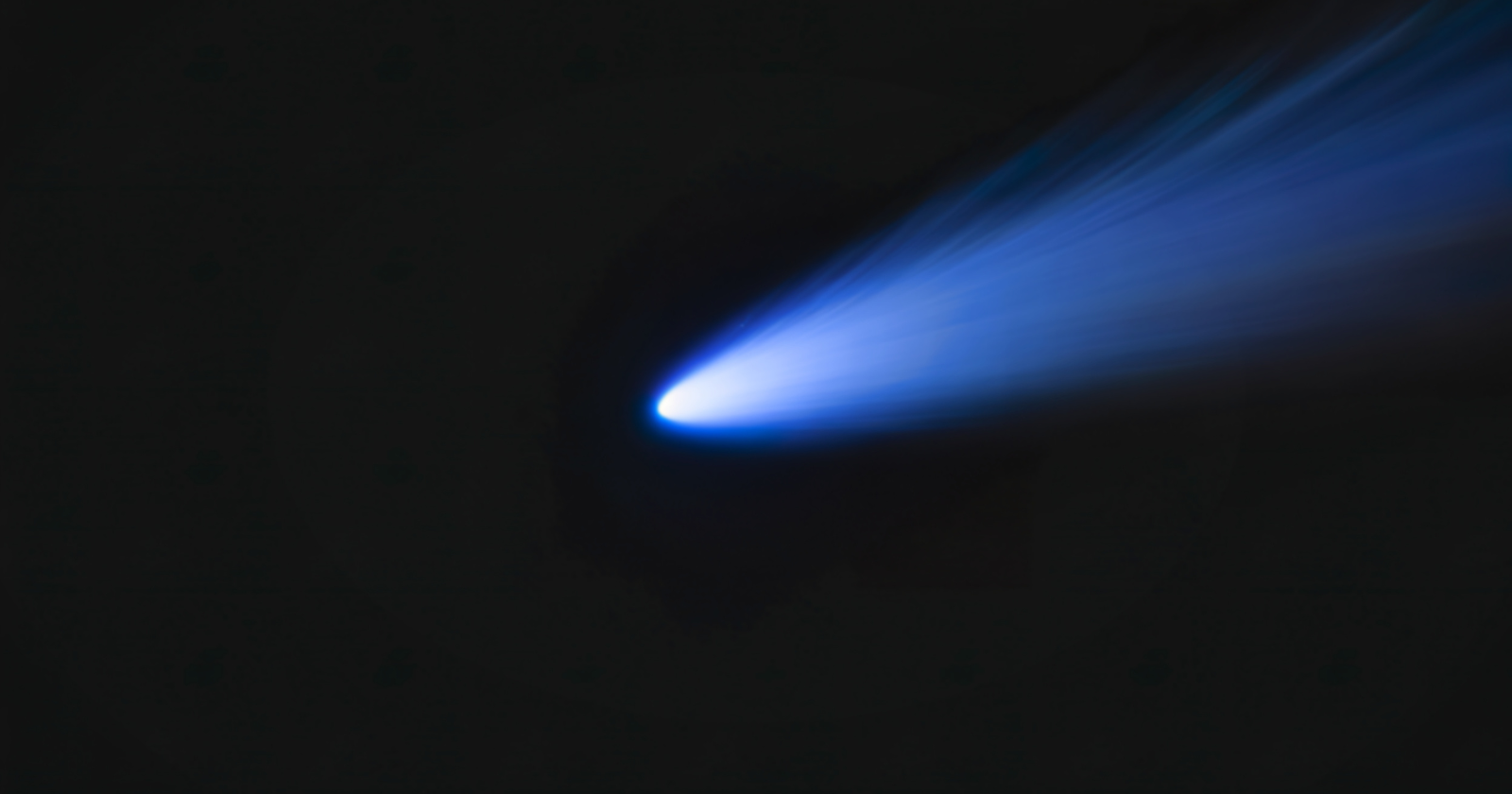
A half-metre telescope in the Chilean hills caught it during a routine sweep, a faint smudge moving far too quickly to be a local.
That smudge became 3I/ATLAS, picked up on 1 July 2025 by the ATLAS survey at Rio Hurtado, only the third object ever seen entering the solar system from outside it. The previous two, ‘Oumuamua in 2017 and Borisov in 2019, prompted little argument about their age. This one arrived at roughly 58 kilometres per second, on a path tilted well out of the flat plane where the Sun orbits. The tilt turned out to be the interesting part.
What the speed says about the age
Matthew Hopkins had defended his doctoral thesis on predicting interstellar objects about a week before one showed up. The University of Oxford physics department recounts how his quiet Wednesday collapsed into a day of matching incoming data against his own predictions. Hopkins called the comet a fantastic opportunity to study a distant, possibly long-dead planetary system.
Those predictions come from the Ōtautahi-Oxford model, built by Hopkins with colleagues in Britain and New Zealand. It feeds star positions and motions from the Gaia spacecraft into models of comet formation, then works out what sort of interstellar wanderers should be passing through, and how fast. Speed is the tell. Older stars have been jostled by the galaxy for longer, so they travel on wilder, faster orbits, and anything flung out of their systems inherits that motion.
Run 3I/ATLAS through it and the numbers point to the Milky Way’s thick disk, a population of ancient stars that sits above and below the thin pancake where the Sun lives. In a paper published in The Astrophysical Journal Letters, the Hopkins team put the implied age above 7.6 billion years, comfortably older than the 4.5-billion-year-old solar system.
One paper, one method. Aster Taylor and Darryl Seligman, working from the same velocity, landed on a far looser range of three to eleven billion years, which shows how much room for argument there is.
Why old stars look different
Galaxies get grubbier with age. Every generation of stars fuses light elements into heavier ones and scatters them on dying, so clouds forming stars late in the day are richer in carbon, iron and the rest than clouds that formed early. Astronomers track that enrichment as metallicity, and it works as a rough clock. Metal-poor material means old material.
Thick-disk stars are metal-poor.
If 3I/ATLAS really came from there, its ices should carry a chemical signature from a chapter of galactic history that closed long before the Sun switched on.
The chemistry arrived at a similar answer
Which is more or less what turned up. After the comet swung past the Sun in late October 2025, a team led by Martin Cordiner at NASA’s Goddard Space Flight Center turned the James Webb Space Telescope on its gas cloud. Radio measurements from ALMA in Chile backed the work up. They went looking for isotopes, versions of the same element carrying different numbers of neutrons. Their proportions record the temperature and chemistry of the place where a molecule was assembled.
Both readings came back strange. Writing in Nature, the Cordiner team reported water enriched in heavy hydrogen by more than a factor of ten compared with local comets, plus carbon ratios higher than anything measured in the solar system. Set against models of how galactic chemistry has shifted over time, the carbon figures point to material that came together as long as 11 or 12 billion years ago, at temperatures below about minus 243 Celsius.
The authors are careful about the caveats. The SETI Institute’s explainer on the result is blunter: the study does not pin down where the comet formed, and the models it leans on carry real uncertainty. Two independent methods agreeing on “very old indeed” is encouraging, but it falls well short of a measured birthday.
Three objects is not a population
The comet also refused to sit still. Early observations showed a gas cloud dominated by carbon dioxide. Water took over near the Sun, then carbon monoxide led the way out. In January 2026 the Subaru Telescope found a much lower carbon dioxide to water ratio than space telescopes had seen earlier. The outside of the nucleus, baked by billions of years of cosmic rays, appears to differ from whatever sits underneath.
All of which rests on a sample of three. Nobody can say whether 3I/ATLAS is a typical emissary from the early galaxy or a freak that wandered past while everyone had their instruments warmed up.
That should change soon. The Vera C. Rubin Observatory in Chile began its decade-long survey of the southern sky in June 2026, and on SETI Institute estimates the discovery rate should climb to one interstellar visitor a year or better. At that point 3I/ATLAS stops being a singular marvel and becomes an entry in a catalogue, with something to compare it against at last. Most astronomers would take that trade without blinking.