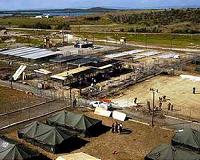
A Guantanamo Bay inmate who pleaded guilty to helping plan a 2002 attack on a French oil tanker has been transferred to Saudi Arabia, the Pentagon said Wednesday.
The move marks the first time under President Donald Trump that a detainee has left the military prison.
"The Department of Defense announced today the transfer of Ahmed Mohammed Ahmed Haza al-Darbi from the detention facility at Guantanamo Bay to the government of the Kingdom of Saudi Arabia," the Pentagon said in a statement.
Darbi entered a plea deal in February 2014 that saw him admit to planning, aiding and supporting an attack on the MV Limburg, which killed a Bulgarian sailor, injured a dozen and caused a large oil spill in the Gulf of Aden.
As part of his plea, Darbi provided evidence against another Saudi Guantanamo detainee — Abd al-Rahim al-Nashiri, who faces the death penalty on charges he masterminded the MV Limburg attack and the 2000 attack against the USS Cole in Yemen that left 17 dead.
Darbi was sentenced to 13 years in prison, starting from the date of the plea.
But the deal included a provision that after four more years at Guantanamo, he could serve the remainder of his term at a luxurious rehab center in the Saudi capital Riyadh, where former extremists are given counseling and ideological detoxification.
The remaining population at Guantanamo is now 40, but Trump has vowed to send more detainees to the prison, which is located on a US naval base on the southeastern tip of Cuba.
Pentagon crafts guidance on prospective Guantanamo inmates
Washington (AFP) May 2, 2018 –
Defense Secretary Jim Mattis has sent the White House new guidance on how US troops can consider detainees for possible transfer to the Guantanamo Bay military prison, an official said Wednesday.
The move comes after President Donald Trump in January signed an executive order reversing his predecessor Barack Obama's ultimately fruitless 2009 directive to shutter the facility that has drawn global scorn.
Mattis's recommendations provide "our warfighters guidance on nominating detainees for transfer to Guantanamo detention should that person present a continuing, significant threat to the security of the United States," Pentagon spokeswoman Commander Sarah Higgins said.
The Pentagon did not provide any additional details on the recommendations, and it was not clear what impact they would have.
The president's National Security Council declined comment.
Guantanamo has not received any new inmates since 2008, but on the campaign trail Trump vowed to load the facility with "bad dudes," and said it would be "fine" if US terror suspects were sent there for trial.
Any attempt to send new inmates to Guantanamo would likely run into a plethora of legal challenges.
"Given the history of torture, unlawful detention and complete lack of justice provided there, no new detainees should ever be transferred to Guantanamo," Daphne Eviatar, a director at Amnesty International USA, said in a statement.
Trump's January executive order gave Mattis and the heads of other agencies 90 days to recommend policies on wartime detainees and whether they should be sent to Guantanamo.
US military officials have been openly discussing the fate of Islamic State group detainees, mainly foreign fighters, held by US-backed militias in northern Syria.
Mattis on Monday said the US-backed Syrian Democratic Forces, who have been fighting IS, had more than 400 prisoners.
The Pentagon chief added that he was "absolutely certain that there is not one thing going on down there (at Guantanamo) that would not be in accordance with" the Geneva Conventions on the treatment of prisoners of war.