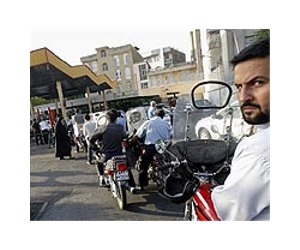
Iran has taken steps to blunt possible future global and US sanctions, notably seeking out new sources of gasoline in China and Venezuela, the top US intelligence official said Tuesday.
US Director of National Intelligence Dennis Blair told key lawmakers that Tehran was "keeping open the option to develop nuclear weapons" but that existing sanctions had harmed the Islamic republic's struggling economy.
And Blair said Iran's leaders weighed "Iran's security, prestige and influence" in deciding how to proceed on the country's nuclear program and said the world still had leverage in the standoff.
"We continue to judge Iran's nuclear decision making is guided by a cost-benefit approach, which offers the international community opportunities to influence Tehran," he said.
But "Iran has made contingency plans for dealing with future additional international sanctions by identifying potential alternative suppliers of gasoline — including China and Venezuela," said Blair.
"Tehran also has resorted to doing business with small, non-Western banks and dealing in non-US currency for many financial transactions," he told the Senate Intelligence Committee in a hearing on global threats to US interests.
Blair said Iran's opposition press had reported Iranian forces were involved in smuggling in crude oil "as a way of both skirting and profiting from sanctions.
"Despite these activities and Iran's gasoline subsidy cuts, which could in part serve to mitigate some effects of the embargo, we nonetheless judge that sanctions will have a negative impact on Iran's recovery from its current economic slowdown," he said.
His comments came as the US Congress weighed a sweeping package of sanctions aimed at forcing Iran to freeze its suspect nuclear program, including steps meant to hurt Tehran's ability to import refined petroleum goods like gasoline.
The United States and its Western allies fear Iran is secretly developing fissile material for nuclear weapons under the cover of its uranium enrichment program — a charge denied by Tehran.
As a close ally of Iran with oil interests in the country, China — a permanent member of the UN Security Council — is reluctant to support sanctions.
earlier related report
Iran slams US missile deployment in Gulf
Tehran (AFP) Feb 2, 2010 –
Parliament speaker Ali Larijani Tuesday slammed plans by the US to beef up defences in the Gulf against potential Iranian missile attacks, insisting the Islamic republic is no threat to its neighbours.
"America's new puppet show for protecting and implementing security in the region is nothing but a new political trick to pave the way for its presence at others' expense," Larijani said in comments to the house carried by the state broadcaster.
"American officials do not realise that they are the problems in the region. The more equipment you bring in, the more it worries the countries where they are deployed," he added.
"Has Iran ever committed any aggression against any neighbours or the region?" he asked.
Larijani was responding to reports that the US administration is placing specialised ships with missile-targeting capabilities off Iran's coast, and anti-missile systems in at least four Gulf states — Bahrain, Kuwait, Qatar and the United Arab Emirates.
Iranian President Mahmoud Ahmadinejad, meanwhile, accused the West of seeking to weaken Gulf countries in a meeting on Tuesday with the visiting Qatari crown prince, Sheikh Tamim bin Hamad al-Thani.
"Westerners do not want the region to be secure or the regional countries to have friendly ties," he was quoted as saying by the state broadcaster.
"They have always tried to keep the region's countries weak. Their life depends on creating division and insecurity," he said. But "fortunately there is a common perception by Tehran and Qatar of the enemies' plots."
ISNA news agency said Iran's Defence Minister Ahmad Vahidi also met the Qatari prince and said Tehran was ready to "expand its defence and military cooperation with Qatar and other Persian Gulf countries."
"Iran's desired model is maintaining security collectively and we believe that all regional countries should be committed to preserving stability and security in the sensitive region of the Persian Gulf and Strait of Hormuz."
ISNA said Sheikh Tamim also expressed a desire to expand military ties with Tehran.
Iran has carried out frequent war games in the Gulf and threatened to hit Western targets if Iran's nuclear sites come under attack by the United States or Israel.
The country is locked in a standoff with the West over its controversial nuclear programme, which many world powers believe is masking a weapons drive. Iran has vehemently denied this.
Share This Article With Planet Earth