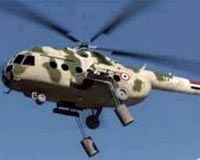
Islamic State group jihadists demolished a notorious government prison in the historic Syrian city of Palmyra on Saturday, as barrel bombs dropped by regime helicopters killed more than 70 civilians in Aleppo.
In neighbouring Iraq, government forces retook an area west of the city of Ramadi, which IS overran earlier in May.
The Syrian Observatory for Human Rights said IS planted explosives that "largely destroyed" the Palmyra jail, which was for decades a symbol of abuses meted out on regime opponents.
Opponents of President Bashar al-Assad welcomed on social media the destruction of the long-feared prison at Palmyra, which IS seized 10 days ago after government forces pulled out.
In rebel-held areas of Aleppo province including the city itself, "at least 71 civilians were killed, and dozens wounded when regime helicopters dropped barrel bombs," the Observatory said.
In the worst carnage, 59 civilians, all male, were killed at a market in the jihadist-controlled town of Al-Bab, the Britain-based monitoring group's director Rami Abdel Rahman told AFP.
"People often gather on Saturday mornings at the Al-Hail market in Al-Bab, which is why the number of dead was so high," explained Abdel Rahman.
He said 12 people were also killed in barrel bomb attacks on Aleppo's rebel-held Al-Shaar neighbourhood, including eight members of a single family.
Victims' bodies were laid out on the streets of the neighbourhood, the limp blood-covered hand of one of them protruding from under a blanket, said an AFP correspondent at the scene.
– Rapid retreat –
Barrel bombs — crude weapons made of containers packed with explosives — have often struck schools, hospitals, and markets in Syria.
But Saturday's death toll was among the highest.
"This is one of the biggest massacres that regime planes have committed since the beginning of 2015," said the Syrian Revolution General Commission activist group.
The Observatory said regime forces also dropped barrel bombs Friday in Idlib province, now under the de facto control of rebels after regime forces withdrew, leaving Al-Qaeda and its allies to capture the city of Ariha and surrounding villages.
The tactic of carrying out air attacks on built-up areas after battleground losses has become common practise for Syria's regime, which ceded swathes of territory in May.
Following defeats in Idlib's provincial capital and at a massive military base nearby, government forces also lost the ancient city of Palmyra to IS jihadists on May 21.
In northeast Syria on Saturday, IS launched an assault on Hasakeh city, which has a large Kurdish population.
The Observatory said at least 10 pro-government forces and 10 jihadists were killed.
In a provincial town to the north, Kurdish militia executed at least 20 civilians Friday, including two children, after accusing them of being IS supporters, the Observatory reported.
– Curbs on fleeing Anbar –
In Iraq on Saturday, government troops and allied paramilitary forces retook an area west of Ramadi, captured by IS two weeks ago.
"The Iraqi army and the Hashed al-Shaabi liberated the Anbar traffic police building in the 5K area west of Ramadi after a fierce fight," an army officer said.
Hashed al-Shaabi is an umbrella term for mostly Shiite militia and volunteers, and it has played a key role in Iraq's anti-IS fight.
But Human Rights Watch accused Iraqi authorities of blocking thousands of families from escaping violence in the mainly Sunni province of Anbar.
"Since April 2015, the government has imposed restrictions on entry into Baghdad and Babylon provinces affecting just under 200,000 people fleeing fighting" in Ramadi, the group said.
It said the restrictions effectively discriminated against Sunni Arabs.
"Prime Minister (Haider al-)Abadi should immediately order these restrictions lifted so that all Iraqis can seek refuge in Baghdad, regardless of origin or religious affiliation," said HRW.
And in Turkey, Prime Minister Ahmet Davutoglu described as an election ploy the release of images allegedly showing Turkish intelligence trucks delivering weapons into Syria last year.
"The release (of the video footage) right now is an effort aimed at affecting the (June 7) elections," he told AFP.
In January 2014, security forces searched trucks near the Turkish-Syrian border on suspicion of smuggling arms into Syria and found Turkish national intelligence personnel on board.
Truck bombs: the Islamic State's 'air force'
Baghdad (AFP) May 29, 2015 –
They're easy to drive and hard to stop, can be made on a farm and destroy a city block: the Islamic State group's monstrous truck bombs are reshaping the battlefield.
The jihadists used about 30 explosives-rigged vehicles in the Iraqi city of Ramadi this month, blasting their way through positions government and allied fighters had managed to hold for more than a year.
IS fighters have used looted armoured personnel carriers, pick-ups, tankers and dump trucks. They pack them with tonnes of explosives and weld steel cages around them.
When a position is too well defended for a more conventional advance, a suicide driver steers a truck bomb, protected by the makeshift armour, through enemy fire and straight to his target.
"They are protected from 12.7mm (heavy machinegun) fire and even some RPGs (rocket-propelled grenades). There's so much explosives (inside) that it's still effective at 50 metres (yards)," an Iraq-based military expert said.
Videos of the truck bomb attacks, which IS has also used in the battle of Kobane in northern Syria and on other fronts, show huge explosions that are visible from miles away.
"The damage is bigger than that of a half-tonne bomb dropped by a fighter jet," the Western expert said. "Truck bombs are their air force."
Responding to US accusations that his troops dodged battle in Ramadi, Prime Minister Haider al-Abadi defended them by saying the impact of a truck bomb blast was akin to that of "a small nuclear bomb".
– Unprecedented –
IS did not invent what is now known as an SVBIED, or suicide vehicle-borne improvised explosive device.
It is unclear who holds that dubious distinction, and rigged horse carts were used more than two centuries ago, such as in a failed 1800 assassination attempt against Napoleon in Paris.
The vehicle-borne bomb's formidable potential as a weapon was put on display with the 1920 Wall Street bombing carried out by Italian anarchist Mario Buda, said Mike Davis, author of "Buda's Wagon: A Short History of the Car Bomb".
The Islamic State organisation has used suicide car bombs in Baghdad for similar purposes — to sow terror in the population and paint the authorities as powerless to control and govern.
The group's previous incarnations in Iraq had already detonated 18-wheelers stuffed with explosives during the US military presence, but IS commanders are taking the use of truck bombs to a new level.
"The (IS) offensives in Iraq may be the first time that VBIEDs have been used as part of the order of battle of a large attacking force in Middle Eastern warfare," said Andrew Terrill, professor at the US Army's Strategic Studies Institute.
The Tamil Tigers had integrated suicide car and truck bombs with an infantry assault before IS, but Davis points out they were mostly "solo attacks" to initiate battles.
"The Ramadi attack was shock and awe on a wholely different scale," he said.
A US State Department official said nearly a dozen truck bombs used in Ramadi carried explosives to cause a blast the size of the 1995 Oklahoma City bombing.
– 'New paradigm' –
Davis said a van bomb such as that used in Oklahoma City were "the explosive equivalent of the bomb load carried by a B-24 in the Second World War. A poor man's air force, so to speak."
"But the truck bombs in Ramadi… were obviously far more powerful and probably the equivalent to an air attack with 1,000-pound bombs," he said.
After the fall of Ramadi, Washington sent 2,000 AT4s to equip Iraqi forces with firepower able to take out the jihadists' lethal truck bombs.
"It's good in the open but it's unguided so if (the truck) is coming at you, you have to stand in front of it," the military expert said of the Swedish-developed anti-tank weapon.
"When the truck is within 100 metres, it's almost too late already," the military expert said. "And in a city, in Ramadi for example, it's almost impossible to avoid the truck bombs."
Thousands of security forces members and allied militiamen are trying to seal Ramadi off as part of an operation to retake it, but Abadi admitted that entering the city was risky.
"We have decided not to fight into the cities… because of those truck bombs, which you cannot see inside the city because there are small roads," he told the BBC this week.
By fully integrating suicide truck bombs carrying huge payloads in ground attacks, IS has already forced a tactical rethink from Baghdad and its allies.
"The greatest military myth of the previous century, of course, was that airpower alone could defeat insurgents," Davis said, adding that truck bombs had helped make IS a "new paradigm".