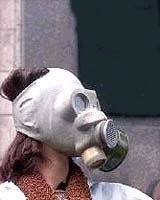
Israel will next month stage its first-ever nationwide drill simulating a nuclear and chemical missile attack on its cities, rescue services said Monday. The exercise was initiated by the army's homefront corps in the wake of last summer's war in Lebanon and Iran's calls for the destruction of the Jewish state and its controversial nuclear programme. Israel suspects is Iran is aiming to develop an atomic bomb, but Tehran insists its programme is for civilian energy purposes.
The main scenarios which will be simulated are a massive rocket attack on cities as well as a "conventional and non-conventional missile attack," Magen David Adom rescue services spokesman Yerucham Mandola told AFP.
During the drill — which will include army rescue forces, police, medical and firefighting services — air-raid sirens may be sounded across the entire country.
The Hezbollah militia fired over 4,000 rockets against northern Israel during the war last summer, killing more than 40 civilians and paralysing the region's industry and economy.
During the 1991 Gulf War, Israeli citizens were equipped with gas masks out of fear of a chemical attack. None of the missiles fired from Iraq against Israel were equipped with chemical warheads.
earlier related report
Stand-off with Iran like 'height of the Cold War': British naval officer
London (AFP) Feb 26 – The West's stand-off with Iran over its contested nuclear programme is like "the height of the Cold War", Britain's most senior naval officer said in an interview with The Daily Telegraph published on Monday.
Commodore Keith Winstanley's comments come ahead of a meeting of the UN Security Council's five permanent members plus Germany, who will discuss more possible punitive measures against Iran, after imposing sanctions on the country late last year.
"There are extra challenges facing us," Winstanley told the newspaper.
"There have been a series of Iranian exercises in the northern Gulf to the point that it's a bit like with the Russians at the height of the Cold War.
"We just have to hope that's not a recipe for miscalculation," he was quoted as saying by the Telegraph.
On Sunday, Iranian President Mahmoud Ahmadinejad defied Western threats to impose more sanctions, saying that Iran's atomic drive was like a "train with no brakes".
Winstanley told the newspaper that Britain has nearly doubled its naval deployments in the region since October, saying: "If you look at the UK component we have almost doubled it … Most of these ships are here on training missions but there is no doubt that we could use the warfighting capabilities they possess."