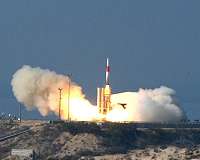
Israel and the United States have successfully carried out tests of a ballistic missile interceptor that Prime Minister Benjamin Netanyahu said Sunday provides protection against potential threats from Iran.
The tests of the Arrow-3 system were carried out in the US state of Alaska and it successfully intercepted targets above the atmosphere, Israel's defence ministry said in a statement.
"The flight tests were conducted in Alaska in order to test capabilities that may not be tested in Israel," the statement said.
Netanyahu said "today Israel has the ability to act against ballistic missiles that could be launched against us from Iran or anywhere else".
"This is a great achievement for the security of Israel," he added.
US ambassador to Israel David Friedman joined Netanyahu at a cabinet meeting in Jerusalem on Sunday to watch video footage of the tests.
In January, Israel said it also carried out a successful test with the United States of the Arrow-3 in Israel.
A series of tests were also conducted before the missiles being deployed in 2017 to Israeli air bases.
Officials said that the one deployed was an older version and the upgraded system will provide more advanced protection.
The Arrow system, partly financed by the United States, was developed and produced by Israeli Aerospace Industries in partnership with Boeing.
Arrow-3 is intended to serve as Israel's highest-altitude missile interception system.
Systems for intercepting incoming missiles at lower altitudes also exist.
Since 2015, Israel's main enemy Iran has continued developing and testing ballistic missiles which it says are for defensive purposes only.
Israel has the most powerful military in the Middle East and is widely considered to be its sole nuclear-armed power, though it has never acknowledged the capability.
The tests come with tensions high between the United States and Iran.
Those tensions followed Washington's sanctions against Tehran after US President Donald Trump's withdrawal from a nuclear deal between the Islamic republic and world powers.
Erdogan says Russian S-400 operational by April 2020
Ankara (AFP) July 26, 2019 –
Turkey's President Recep Tayyip Erdogan said Friday that it planned to start using the Russian S-400 missile defence system — a bone of contention with the United States — in April 2020.
"In the coming spring, God willing in April 2020, we will be able to start using this system," he told a gathering of his Justice and Development Party (AKP) in Ankara.
Washington has reacted to Turkey's purchase of the S-400, which was delivered this month, by kicking the country off its F-35 fighter jet programme.
The US says Russia will be able to glean sensitive technical knowledge about the new fighter if it is operated alongside the S-400.
"You won't give the F-35? Very well, excuse me, but we will take measures in this regard and will turn towards others," Erdogan said.
He threatened that rising tensions in the relationship could also put at risk a multi-billion-dollar order for Boeing airliners.
Erdogan said he raised the issue with US President Donald Trump during their meeting at the G20 summit in Japan last month.
"I told Trump in Osaka… Even if we are not buying the Patriots, we are buying Boeings… We are good clients. But if things continue like this, whether we want to or not, we may have to reconsider."
Turkey and the US have also held talks this week on establishing a buffer zone in northern Syria to prevent clashes between Turkish and Kurdish forces.
Ankara sees the Syrian Kurdish YPG militia as a "terrorist" off-shoot of Kurdish insurgents in Turkey, but the YPG has been a key ally for the US in its fight against the Islamic State extremist group.
"However the talks with America on setting up a safe zone on Syria's border end, we are determined to destroy the terror corridor east of the Euphrates," Erdogan said.