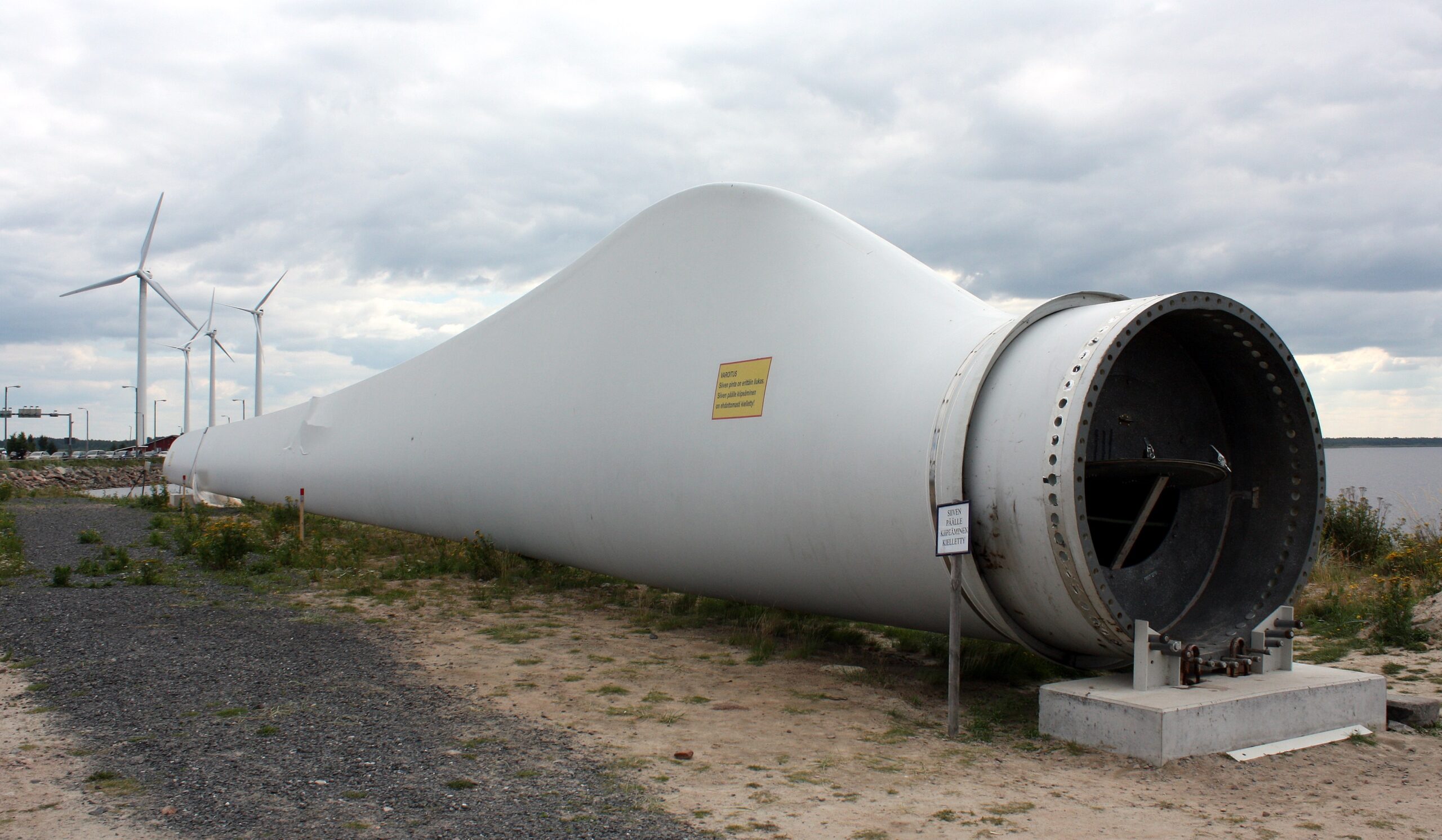
At the Port of Aalborg in northern Denmark, a section of decommissioned wind-turbine blade sits on steel supports with its concave face turned toward the ground, and bicycles are parked beneath it. The blade is not shredded, not co-processed into cement, not stacked in a field awaiting a market — it is still a blade, still curved the way the mold made it, now doing weather work instead of aerodynamic work. Baltic Transport Journal, in its account “Under a wing,” describes the port’s bicycle shelter as an intact-shell reuse of a blade supplied courtesy of nearby Siemens Gamesa, and the detail that matters technically is the one that is easiest to miss: the piece kept is a midsection, a substantial length of the outer composite shell, rather than the small fragments that most end-of-life blade pathways produce. That distinction — whole shell versus feedstock — is the whole point of the object.
A bike shed problem, solved with cardboard first
The shelter began, by the account translated and relayed in CleanTechnica’s writeup of Danish reporting, with an ordinary port need: a new bike shed. Brian D. Rasmussen, a civil engineer who works with the port’s constructions and environment, had access to something most designers do not — a retired blade nearby — and no design documentation for it. There were no original blade drawings to consult, no laminate schedule, no map of where the spar caps and shear webs ran inside the shell.
So the problem was approached the way structural intuition gets tested when the data is missing. Rasmussen spent a weekend building a model in cardboard and wood to see what would happen to stiffness once openings were cut into a closed, curved, hollow section. His summary of the behavior, as reported in the Danish coverage relayed by CleanTechnica, is the sentence any engineer who has worked with thin-walled tubes will recognize: “as soon as you start cutting a hole in a pipe, it becomes very lively.” A blade shell is exactly that — a stiff, closed tube whose rigidity depends on being closed. Remove material for entrances, sightlines, and drainage, and the remaining structure begins to move.
The execution stayed local. Kærsholm Diamond Drilling handled the cutting, working through thick composite laminate rather than concrete, and cut away what was not needed. Brunø Stål, a blacksmith, fabricated the bearings the shell now rests on and is tethered to — tethering being the second half of the structural answer, since a large lightweight curved surface in a windy port is a sail before it is a roof. What emerged is not a shed clad in blade material; it is the blade, load path rearranged, holding itself up over a bike rack.
Why a blade resists ordinary recycling
The reason this counts as more than a design flourish sits in the material. Turbine blades are laminates of glass or carbon fibers bound in thermoset resin — and as BGR and The Cool Down both note in their coverage of the problem, thermosets do not behave like metals. A steel tower or a copper conductor can be melted and separated back into a usable stream. A cured thermoset cannot simply be remelted; the resin is chemically locked, and the fibers it holds are not easily liberated in a form worth as much as new fiber. The available routes — shredding for filler, co-processing in cement kilns, various pyrolysis and solvolysis approaches, or storage and landfill where permitted — tend to move down the value ladder rather than up it.
Siemens Gamesa enters the Aalborg story in a bounded way, and it is worth keeping the boundary. The blade came courtesy of the nearby Siemens Gamesa operation, per Baltic Transport Journal. Secondary coverage additionally reports that Danish authorities had asked the manufacturer to look into reuse options for retired blades, a request that helped create the conditions for projects of this kind. The manufacturer is not credited with designing the port’s shelter, and no such claim is made here. The design work described in the Danish reporting is Rasmussen’s, with the port’s local contractors executing it.
Rasmussen’s framing of the material, as relayed in that reporting, is the argument in miniature: the shells are strong to the point of being nearly indestructible, and they are — in their own way — attractive objects. If a piece is that durable and that shapely, chopping it up to be burned as fuel discards the two properties that took energy and engineering to create.
What one shelter settles, and what it doesn’t
It settles one blade. Denmark generated close to 60 percent of its electricity from wind in 2023, a larger share than any other country on Earth, and it has been decommissioning turbines for years as machines pass through the usual twenty-to-twenty-five-year service window. The scale of what comes off those towers is documented rather than guessed at: a 2017 study by Pu Liu and Claire Barlow of the University of Cambridge, published in Waste Management, projected 43 million tonnes of blade waste worldwide by 2050. A bicycle shelter does not absorb a stream like that.
What the Aalborg piece demonstrates is narrower and more useful: that a blade section can be cut, stabilized, mounted, and tethered by a port’s own local contractors, without factory drawings, into something that carries load. Research efforts such as the Re-Wind Network have highlighted this class of structural reuse — blades as bridges, poles, shelters — as a path that keeps the laminate intact instead of grinding it down. At the Port of Aalborg, that path has one concrete result. The curved shell that once cut air over the North Sea coast still faces the weather. It just keeps bicycles dry now.