
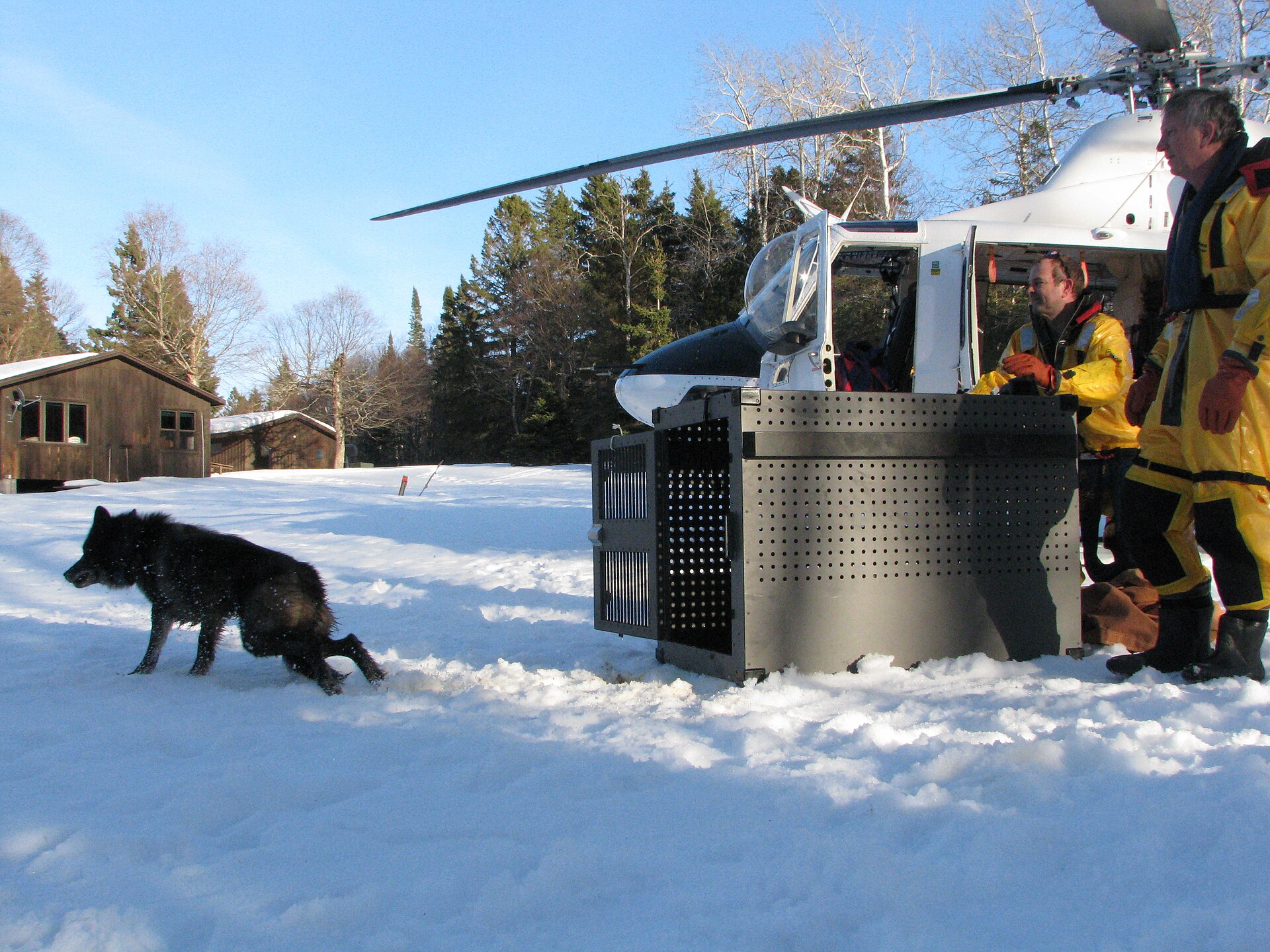
Ten wolves were counted on Isle Royale in the first monitored winter after relocation. By April 2023, the minimum count on the Lake Superior archipelago stood at 27 — the outcome of a translocation effort that moved 19 gray wolves onto the island between September 2018 and September 2019, and the central finding of a five-year assessment of that effort published in Conservation Science and Practice.
The study, reported as “Five-year assessment of wolf translocation to Isle Royale National Park, 2018-2023,” tracks what happened after the National Park Service carried wolves from the Great Lakes mainland to an island where the native population had collapsed to a pair of closely related animals. Alongside the count, the assessment reports modelling that gives the relocated population a better than 80 percent chance of persisting for 20 years — a probability derived from population viability analysis, not a promise, and one the authors present even under scenarios of high inbreeding.
Why 19 wolves were carried to an island
Isle Royale is a roadless archipelago roughly 45 miles long, isolated by open water for most of the year and reachable by wolves historically only across winter ice. That isolation made it the setting for one of the longest-running predator–prey studies in ecology, and also made its wolf population structurally fragile. By the mid-2010s the island’s wolves had dwindled to two animals, closely related and not reproducing viably, while moose — their principal prey — continued to browse island vegetation without meaningful predation pressure.
The Park Service issued a Record of Decision in June 2018 authorizing the relocation of wolves to the park. The stated aim was to restore an apex predator to the island and, with it, the predator–prey dynamic that had shaped Isle Royale’s forests and moose herd for decades. The agency framed success not as a single release but around a viable population sustained over roughly a 20-year horizon.
Between September 2018 and September 2019, 19 wolves were captured on the mainland and in nearby island systems — sourced from Minnesota, Michigan, and Ontario — and moved to Isle Royale. Translocated wolves do not simply settle where they are placed. Some dispersed; some died. The Park Service notes that early mortalities included intraspecific aggression as animals contested and established territories, a familiar hazard when unrelated wolves are introduced into shared ground.
What the five-year assessment measured
The assessment covers 2018 through 2023 and evaluates whether the relocation produced a self-sustaining population rather than a temporary presence. Its core metrics are reproduction, pack structure, and projected persistence.
On reproduction, the study reports that wolves bred in every year of the assessment window, with at least 10 litters and 29 pups documented across the five years. That matters more than raw headcount: a translocated population that survives without reproducing is a holding action, while one that produces litters annually has begun to function as a population in its own right.
Pack formation followed. Wolves organized into family groups with defended territories, and the assessment identifies the family group originating from Michipicoten Island — animals moved after that population became stranded by declining prey — as a major contributor to the island’s reproductive output. That contribution is also the source of one of the study’s cautions, since a population’s genetic future depends on how many lineages actually breed.
The count trajectory was not a straight line. From 10 in the winter of 2019–2020, numbers moved through intermediate winters at 23 before reaching a minimum of 27 by April 2023. Independent winter counts from the long-running Michigan Technological University winter study tracked the same broad pattern of a wolf population holding and slowly climbing.
The viability modelling sits on top of these observations. The authors’ analysis returns a greater than 80 percent probability that the population persists for 20 years, and reports that this holds even when the model is loaded with high inbreeding. As a modelled result, it is sensitive to its assumptions about mortality, prey availability, and genetic load — a statement about the odds under specified conditions rather than a forecast of what the island will look like in 2038.
What the rebound settles, and what it does not
The clearest result is that predation is again a functioning process on Isle Royale. Wolves are hunting, denning, and dividing the island into territories, which is a different ecological condition from the near-absence of the mid-2010s.
What that has done to the island’s moose and its vegetation is a separate question, and the assessment does not close it. Browsing pressure and forest recovery operate on timescales longer than five years, and the effects of restored predation on moose numbers and plant communities remain under observation rather than settled. Reporting on the study by the Associated Press situates the work in that same open-ended frame.
The researchers also flag concerns that should be read as warnings rather than verdicts. Genetic diversity in a founded island population depends on which animals actually reproduce, and the outsized contribution of the Michipicoten lineage narrows that base. Isle Royale’s historical genetic rescue arrived on winter ice bridges from the mainland; warming winters make those crossings less reliable, which means natural immigration cannot be assumed as a future corrective. Whether managers eventually need to move additional animals is a question the assessment raises, not one it answers.
Twenty-seven wolves in five years, breeding annually, in packs, with modelled odds better than 80 percent of lasting two decades — that is what the record shows. It describes a predator population that took hold, not an ecosystem returned to some prior state. The monitoring that produced these numbers continues, and the next intervals of it, not this one, will show whether the island’s moose and forests follow.
