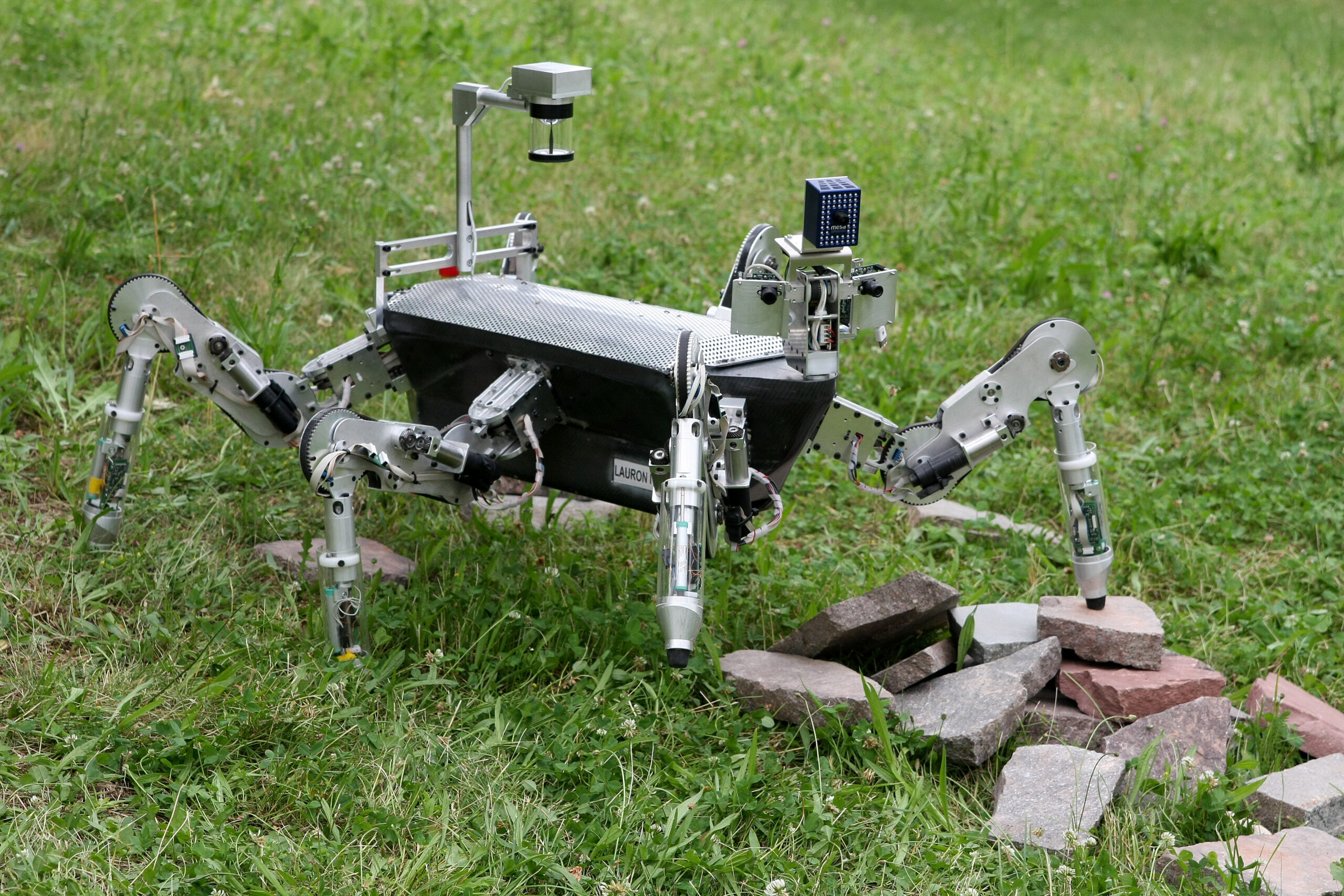
On burned slopes north of Lisbon, where the soil is loose, the grade is punishing and the machinery that usually does this work cannot climb, a legged robot named Trovador has been placing rooted saplings into the ground about 28 percent faster than human planters in early trials, with roughly 90 percent of those seedlings reported surviving afterward — figures that come from its two teenage builders and remain early-test claims rather than independently certified rates. The machine, developed by Portuguese students Marta Bernardino and Sebastião Mendonça, both around 19, began as a six-legged, spider-like walker and was profiled by Smithsonian magazine as an attempt to reforest terrain that defeats almost every existing method.
Bernardino and Mendonça grew up near Lisbon and started the project around 2023, while still in high school, after watching the same hillsides burn and then sit bare. The constraint they set themselves was narrow and physical: not how to plant more trees in general, but how to plant them on ground that tilts too steeply for a tractor and too dangerously for a crew carrying seedlings uphill by hand.
Where crews, tractors and seed drones run out of ground
The inventors describe a Portuguese landscape in which a large majority of forest — they put it at more than 60 percent — sits on steep, rugged terrain. That number is theirs, and the underlying land-cover statistics vary by definition and survey, but the operational point is less contested than the percentage. Above a certain slope, hand planting becomes slow and hazardous work, especially on post-fire ground where root structure is gone and the surface slides underfoot. Below that slope, mechanized planters can work, but heavy equipment compacts soil in exactly the places where compaction most undermines root establishment.
Aerial seeding has been the fashionable alternative, and it moves fast. Survival is the problem. Bernardino and Mendonça cite pilot results in which dropped seeds of some conifer species established at rates somewhere between essentially zero and about 20 percent — a range they attribute to published trials rather than their own measurements, and one that varies enormously with species, season and rainfall. A seed on the surface of burned soil has to find a crevice, hold moisture, escape predation and germinate before the next dry spell. A rooted sapling, planted properly, skips most of that gauntlet.
That is the gap Trovador is built for. It carries seedlings that already have root systems, walks to the planting point on legs rather than wheels or tracks, and performs what the pair call a dig-place-tamp sequence: open the hole, set the sapling, press the soil back around the stem. Onboard sensing, as they describe it, includes a depth camera and software that reads soil pH and moisture to choose or reject a spot, with GPS logging and cloud records so each planted location can be revisited. How mature that sensing stack is in practice — how well it performs in dense brush, in shadow, on wet ash — is not something the early coverage establishes.
A hexapod built from scrap, and what came after
The first working version was a six-legged frame the students assembled from recycled parts for something on the order of €15, roughly $17 by the figure reported in Smithsonian. That number describes a scrappy proof of concept, not a production cost; the point of it was to see whether a legged gait could keep a planting head level and stable on an incline where a wheeled platform would slide.
Their design claims scale up from there. The pair have described a system equipped to carry and set as many as about 200 saplings an hour and to work slopes reaching roughly 45 degrees. Both are best read as design targets or early-claimed capabilities rather than sustained field throughput — a planting rate measured over a good hour on favorable ground is a different animal from a rate held across a shift, a hillside and a battery cycle.
The leg count has also moved. While the six-legged, spider-like configuration is the identity Trovador became known by, an editors’ note appended to the Smithsonian piece in December 2025 clarifies that the latest prototype the magazine covered has four legs rather than six — a quadruped closer in silhouette to a robot dog. The two configurations are not interchangeable, and the shift suggests the usual prototyping arithmetic: fewer actuators, less mass to lift up a slope, simpler control, at some cost in static stability.
What the early numbers do and don’t prove
A 28 percent speed advantage and a survival figure near 90 percent are the kind of results that invite hardening, and they should resist it. Both come from limited early testing described by the inventors; Bernardino and Mendonça have separately framed their dig-place-tamp method as validated against roughly 85 to 90 percent survival in field trials and existing literature, which is a claim about a technique in favorable conditions, not a certified rate for a machine working unsupervised across a burn scar. The early report also noted saplings thriving without post-planting care, which is plausible on good sites in a wet year and much less so in a drought.
Landscape architect Miguel Jerónimo, of Renature and the Group for Studies on Spatial Planning and the Environment, told Smithsonian he is optimistic about the concept while pointing at the questions that decide deployment: whether the hardware survives repeated seasons outdoors, whether it can move through dense understory rather than open burned ground, what maintenance costs, and what the whole thing prices out at per tree planted.
The project has drawn recognition — a top finalist slot in National Geographic’s 2024 Slingshot Challenge with an accompanying grant of about $10,000, and a European robotics-for-sustainability award the pair say they are the youngest recipients of. What that recognition does not settle is durability, and the founders’ stated business model puts the burden squarely there: they want to sell planted trees as a service rather than sell robots, which means the machine has to keep walking long after the demonstration ends.