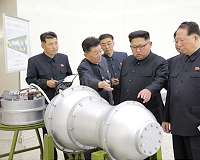
Japan Wednesday again upgraded its estimated size of North Korea's latest nuclear test to a yield of around 160 kilotons — more than ten times the size of the Hiroshima bomb.
This marked Tokyo's second revision higher after previously giving estimates of 70 and 120 kilotons.
Defence Minister Itsunori Onodera told reporters that his ministry's upward revision to 160 kilotons was based on a revised magnitude by the Comprehensive Nuclear-Test-Ban Treaty Organisation (CTBTO).
"This is far more powerful than their nuclear tests in the past," Onodera told reporters.
The US bomb that destroyed Hiroshima in 1945 carried a yield of 15 kilotons.
Japan's latest estimate far exceeded the yield of between 50 and 100 kilotons indicated by UN political affairs chief Jeffrey Feltman at the UN Security Council.
Early Wednesday, Onodera held telephone talks with US Defense Secretary Jim Mattis and both agreed to step up "visible pressure" on North Korea, the ministry in Tokyo said.
"North Korea's nuclear and missile development is at a new stage of grave and imminent threats," Onodera told Mattis, the ministry said, adding that his US counterpart shared the view.
Pyongyang's Sunday test of what it described as a hydrogen bomb designed for a long-range missile triggered global alarm and has divided the international community as it scrambles for a response.
US Ambassador Nikki Haley told the UN Security Council that Washington would present a new sanctions resolution to be negotiated in the coming days, but Russian President Vladimir Putin on Tuesday rejected US calls for more sanctions as "useless".
Putin's comments appeared to have widened a split among major powers over how to rein in Pyongyang, pitting Moscow and Beijing against Washington and its allies.
Japanese Prime Minister Shinzo Abe is expected to press Putin for his support over the North Korea's provocation, when the two leaders hold talks in the Russian Far East city of Vladivostok on Thursday.
"We have to make North Korea change its current policy and understand that there is no bright future if North Korea continues the present policy," Abe told reporters ahead of his departure.
Abe, who will separately hold talks with South Korea's leader Moon Jae-In in Vladivostok, said he wants to send a message to the North from his two talks with Putin and Moon.
US President Donald Trump tweeted on Tuesday that he would allow Japan and South Korea to buy more "highly sophisticated" US military equipment.
Pressed on this during a regular news conference, Japan's Chief Cabinet Secretary Yoshihide Suga declined to comment on the specific proposal, saying only that Tokyo would continue to purchase necessary equipment from the US and other countries.
N. Korea nuclear test more powerful than estimated: Japan
Tokyo (AFP) Sept 5, 2017 –
Japan's defence minister on Tuesday said North Korea's latest nuclear test was more powerful than initially estimated, with a yield that was around eight times the size of the bomb detonated over Hiroshima.
North Korea on Sunday triggered global alarm when it blasted what it described as a hydrogen bomb designed for a long-range missile.
Japan's defence ministry had earlier said the bomb had a 70-kiloton yield, based on an estimated magnitude by the preparatory commission for the Comprehensive Nuclear-Test-Ban Treaty Organisation (CTBTO).
But Defence Minister Itsunori Onodera told reporters Tuesday that his ministry had upgraded its estimate to around 120 kilotons in accordance with an upward revision by the CTBTO.
"We can figure out that the nuclear test displayed a fairly high capability," Onodera said.
At 120 kilotons, the blast yield would be around eight times more powerful than the 15-kiloton US bomb which destroyed Hiroshima in 1945.
The estimate also exceeded the yield of between 50 and 100 kilotons indicated by UN political affairs chief Jeffrey Feltman at the UN Security Council.
Earlier in the day, Japan's Prime Minister Shinzo Abe called on the international community to form a united front against Pyongyang's provocations.
"Whether we can contain North Korea's outrageous act or not depends on unity among members of the international community," Abe said when he met visiting Indian defence minister Arun Jaitley in Tokyo.
US Ambassador Nikki Haley told an emergency meeting of the UN Security Council that Washington will present a new sanctions resolution to be negotiated in the coming days, with a view to voting on it next Monday.
But comments by Russian President Vladimir Putin on Tuesday rejecting US calls for more sanctions as "useless" appeared to have widened a split among major powers over how to rein in Pyongyang, pitting Moscow and Beijing against Washington and its allies.
US warns N. Korea of 'massive military response' after nuke test
The United States warned it could launch a "massive military response" to any threats from North Korea following Pyongyang's provocative detonation of what it claimed was a miniaturized hydrogen bomb.
Defense Secretary Jim Mattis spoke out on Sunday after North Korea carried out an unexpectedly strong nuclear test, more powerful than the bomb that levelled Hiroshima in 1945.
President Do … read more