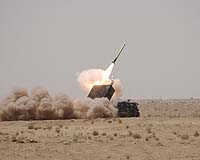
The newest addition to the Army's artillery arsenal was successfully fired this month during Operation Restoring Rights in Tal Afar, Iraq, and Operation Sayaid in Iraq's Al Anbar Province.
The Guided Multiple Launch Rocket System destroyed two insurgent strongholds from a distance of more than 50 kilometers away. Battery B, 3rd Battalion, 13th Field Artillery Regiment fired eight guided rockets in Tal Afar Sept. 9 and 10, killing 48 insurgents, said Maj. Jeremy McGuire, deputy of operations, Force Field Artillery, Multi-National Corps – Iraq.
Battery A, 3-13 FAR fired another six rockets Sept. 11, destroying the Mish'al Bridge and preventing its use for insurgent forces in the Al Anbar province in Western Iraq, McGuire added.
Battery tests GMLRS Unitary rockets
The 3/13th FAR conducted the first in-theater tests of GMLRS in June, and also this summer B Battery tested the weapon's new Unitary rockets. These rockets were designed to greatly reduce collateral damage, according to Lockheed Martin.
When the GMLRS was used in Tal Afar Sept. 9 and 10, damage to surrounding buildings was almost non-existent and the target's destruction was absolute, said Capt. Robert J. Hannah, 3-13th FAR.
"This system is something the artillery community has been working on for some time," McGuire said. "It was tested in the continental United States, and now we've demonstrated in Iraq that we're extremely effective with it.
Precision has psychological effects
"We can be accurate, we can be lethal and we can also have a very low collateral damage estimate," McGuire said. "We can engage the target without compromising the safety of the civilians nearby and also take out the terrorists or insurgencies that engage our forces."
Operation Restoring Rights' senior U.S. officer, Col. H. R. McMaster, commander, 3rd Armored Cavalry Regiment, weighed in on the combat effectiveness of the new system. "The GMLRS proved itself in combat in Tal Afar and provided the regiment with tremendous capability. It not only was able to hit enemy positions with a great deal of precision, but was able to limit collateral damage."
The physical and psychological effect the system had on the enemy in Tal Afar – who was trying either to successfully defend against an attack or goad the Coalition into destroying large portions of the city – was extremely valuable, McMaster said.
GMLRS better than smart bombs?
The first GMLRS weapons arrived at Fort Sill, Okla., about 18 months ago and 3rd Battalion, 13th FA Regiment has been training with the system since June 2004. GMLRS was designed to reduce the amount of collateral damage in combat, giving commanders on the ground the ability to take out a terrorist or insurgent target accurately and effectively without creating the excess damage other artillery and air-dropped munitions may cause, McGuire said.
"This (system) allows ground commanders to precisely attack small targets, even in an urban environment, with even lower collateral damage than precision bombs used by the U.S. Air Force," said Hannah.
If the aircraft are unable to support a mission because of communication or weather issues, ground commanders will still have access to the new MLRS system, which provides the same capabilities as the air power, McGuire said.
Urban combat requires precision
Before sending ground troops into Tal Afar during Operation Restoring Rights, there were a number of buildings that needed to be destroyed in preparation. Two separate targets were successfully destroyed by the guided MLRS system. The missiles were fired from an area more than 50 kilometers away.
The targets were two housing complexes that had been fortified and were known to contain at least 40 insurgents, McGuire said.
"Each of the targets (was) pre-planned," said Maj. James Daniels, Regimental Fire Support Officer, 13th FAR. "Before we fire on a target, we have to prove the structure is linked to the insurgency, using intelligence from units in the field that have been engaged from the structure or have made contact with the terrorists around the structure."
Troops on the ground engaging the enemy will also benefit from the missile system's small blast radius and effectiveness, improving their survivability and safety. The troops will be able to maneuver closer toward their aggressors to maintain a better visual of their targets, said Sgt. 1st Class Paul Luketich, senior fire control non-commissioned officer, FFA, MNC-I.
"Basically, it's a safer munition for our troops and nearby civilians, but a more deadly munition for the insurgents," Luketich said. "It's the best munition in the arsenal today."
'GMLRS can save lives'