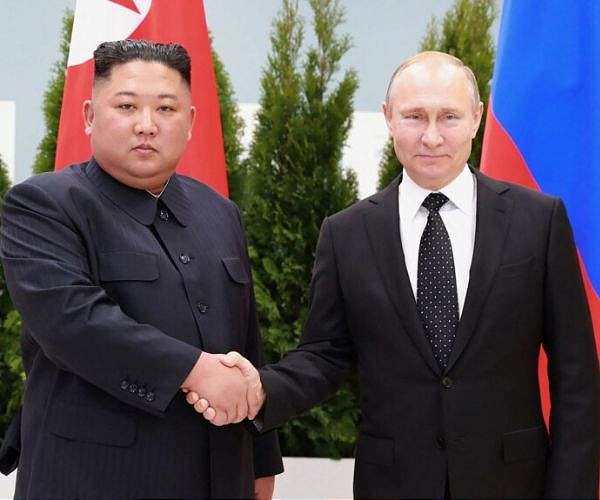
A treaty signed by Russian President Vladimir Putin and North Korean leader Kim Jong Un during their summit in Pyongyang called for extending military aid "without delay" if either country is attacked, according to the full text published by the North's state-run media Thursday.
"In the event that either party is in a state of war as a result of armed aggression by individual or multiple states, the other side shall provide military and other assistance without delay by all means at its disposal in accordance with Article 51 of the U.N. Charter," the agreement, published by Korean Central News Agency, said.
The U.N. Charter's Article 51 stipulates "the inherent right of individual or collective self-defense if an armed attack occurs against a Member of the United Nations."
The two leaders signed the treaty on Wednesday night during a brief visit by Putin, his first to North Korea in 24 years. The pact revives a 1961 mutual defense clause between the Cold War allies that expired when the Soviet Union dissolved in 1991.
The new treaty also promised "the expansion and development of cooperation in the fields of trade, economy, investment, and science and technology."
Following the summit, Kim said the declaration represented a "watershed in the history of Russian-Korean relations."
"Relations between our countries have risen to a new high level of alliance," he said at a press conference at Kumsusan Palace of the Sun in Pyongyang, according to a transcript by the Kremlin.
Putin stopped short of defining the partnership as an alliance but said that Russia "does not rule out developing military and technical cooperation with the Democratic People's Republic of Korea under the document signed today."
In his remarks, Putin also highlighted efforts to boost economic ties outside the reach of the international sanctions imposed on both countries.
"We will also keep opposing the very practice of cutthroat sanctions as a tool that the West [applies] for preserving its hegemony in politics, the economy and many other areas," he said.
Putin's visit followed a trip by Kim to Russia in September, which launched a new era of cooperation between the Cold War allies centered around Pyongyang's shipment of munitions to Moscow for its war in Ukraine.
Earlier this week, U.S. State Department spokesman Matt Miller said that North Korea has transferred "dozens of ballistic missiles and over 11,000 containers of munitions to aid Russia's war effort."
Washington and its allies claim that Russia is providing fuel, raw materials and advanced space and weapons technology to North Korea in exchange.
South Korea's Foreign Ministry on Thursday condemned the growing relationship between the isolated regimes.
"We express our regret that, despite repeated warnings from the international community, Russia and North Korea have signed a comprehensive strategic partnership treaty and openly mentioned military-technological cooperation, which directly violates U.N. Security Council resolutions," ministry spokesperson Lim Soo-suk said at a press briefing.
South Korea "will work with the international community, including our allies and friends, to respond to any act that threatens our security in a correspondingly stern and resolute manner," Lim said.
After a state reception in Pyongyang, Putin flew to Vietnam late Wednesday for a two-day visit to the Communist state — a longtime ally that has grown closer to Washington in recent years.
On Thursday, the Russian leader met with Communist Party General Secretary Nguyen Phu Trong and new President To Lam and signed a series of strategic partnership agreements.
Putin arrives in Vietnam as Russia courts support amid war in Ukraine
Washington DC (UPI) Jun 20, 2024 –
President Vladimir Putin of Russia arrived in Vietnam on Wednesday as he continues to court support from communist-led Asian nations amid his war against Ukraine.
Russia has been ostracized from much of the democratic world, which has steadily and increasingly severed ties with Moscow since February of 2022 when it brought war back to Europe with its invasion of Kyiv.
The severing has been accompanied by a plethora of sanctions targeting Russia and its war-making capabilities that together have damaged the nation's economy and have forced it to seek weapons from North Korea and Iran to replenish its armories. Fears are also rising over assistance to the Kremlin from China, another communist nation.
Putin's visit to Hanoi comes after his trip to Pyongyang, his first to the secluded nation since 2000. In North Korea, he signed a NATO-styled defense agreement that they would come to one another's defense if attacked.
In Hanoi on Thursday, Putin and President To Lam of Vietnam signed 15 documents that, according to a statement from the Kremlin, cover an array of areas of cooperation, from education to investment.
"I would like to emphasize that Russia places great importance on the further strengthening of the traditionally friendly, comprehensive strategic relations and strategic partnership with Vietnam," Putin told Lam during a press conference, a transcription from the Kremlin said.
"These relations continue to progressively develop in the spirit of equality, mutual respect and consideration of each other's interests."
The press conference was held following the completion of negotiations, which Putin described as "constructive and business like."
The topic of Ukraine did not appear to be directly referenced, with Putin stating that their positions on a number of regional issues "largely coincide" or were close together.
Lam congratulated Putin on his re-election this spring, which has been widely panned for being illegitimate, while stating Vietnam was "very pleased" to see political and social stability strengthening in Russia.
"Our state, our people, and I, personally, always attach great importance to the development of relations between our countries, and we are also very grateful for your support of the relations between our countries and towards Vietnam," Lam said, according to a transcription from the Kremlin.
He added that Vietnam is pursing an independent and peaceful foreign policy but at the same time attaches "great importance to the development of traditional friendship and a comprehensive strategic partnership with Russia."
"We consider Russia one of Vietnam's foreign policy priorities," he said.