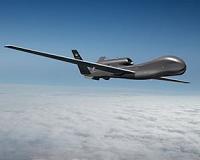
Northrop Grumman began flight testing its RA-4 Global Hawk unmanned aircraft system equipped with a UTC MS-177 multi-spectral sensor.
The demonstrations, slated to continue through the first half of 2017, mark the first time the sensor has taken flight aboard a high-altitude long-range autonomous aircraft. Company officials say the tests are intended to verify the MS-177's intelligence, surveillance and reconnaissance capabilities.
"The MS-177 is the new benchmark in imaging intelligence, surveillance and reconnaissance sensors and its integration into the Global Hawk platform expands the mission capability we can provide," program manager Mike Jaggers said in a press release. "This successful flight is another milestone in an aggressive effort to demonstrate Global Hawk's versatility and effectiveness in carrying a variety of sensor payloads and support establishing OMS compliancy."
The flight test, performed at the company's facility in Palmdale, Calif., follows a series of earlier demonstrations with two sensors not previously used with the RQ-4 platform.
The Global Hawk is an ISR platform used by the U.S. Air Force. Unlike other military unmanned aircraft systems such as the General Atomics MQ-1 Predator and MQ-9 Reaper, the Global Hawk is unarmed, and used explicitly for providing intelligence and additional data to support combatants.
The MS-177 sensor is marketed as being able to provide the longest-range combat identification imaging in the U.S. military's airborne arsenal. The product was developed by United Technologies subsidiary UTC Aerospace Systems.
AirMap $26M Series B Led By Microsoft Ventures
AirMap has announced a $26 million Series B funding round led by Microsoft Ventures, with additional participation from Airbus Ventures, Qualcomm Ventures (the investment arm of Qualcomm Incorporated), Rakuten, Sony, Yuneec, and existing investors General Catalyst and Lux Capital. The new investment brings AirMap's total funding to more than $43 million.
The Series B funding round will bri … read more