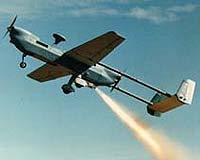
Northrop Grumman recently demonstrated, through a series of ground and flight tests here, the capabilities of its new Hunter II unmanned system, the company's proposed system solution for the U.S. Army's Extended Range/Multi-Purpose (ER/MP) program.
The company completed the test series, which included more than 50 hours of flight time over 14 separate flights, on February 16 as part of the program's Systems Capabilities Demonstration (SCD) phase.
"Our Hunter II demonstrator air vehicles successfully completed a series of prescribed ground and flight mission scenarios for the ER/MP program including auto landing and take-off capabilities under both day and night conditions," said Bill McCall, Northrop Grumman's ER/MP program director.
"We also demonstrated how easy it is to assemble, disassemble and perform maintenance tasks on the air vehicle, which will simplify logistic support for the Hunter II system."
Over a six-day flight period that included a discretionary day, Northrop Grumman demonstrated Hunter II's capabilities to take off and land autonomously; fly at the required speeds and altitudes; perform relay missions (using a second Hunter II demonstrator air vehicle); and deliver high-quality data and video imagery through its communications system.
All the SCD missions were performed carrying a mission-ready sensor payload. The company also demonstrated air vehicle performance ranges in excess of 300 km and endurance in excess of 12 hours.
As part of the discretionary day, the company conducted several demonstrations to highlight Hunter II's complete system capability. These demonstrations included:
test flights carrying an electro-optic/infrared payload and an advanced synthetic aperture radar payload to perform ground moving-target tracking;
integration of a weapons simulator followed by a simulated weapons drop;
an advanced information architecture that allows dissemination of live or archived sensor data to multiple dispersed ground users using legacy communications systems;
a demonstration of Hunter II's ability to exchange critical information with the Army's Battle Command System; and
a demonstration using Northrop Grumman Cyber Warfare Integration Network sites in Huntsville, Ala; Melbourne, Fla. and Ft. Huachuca, Ariz. to show how Hunter II data can be integrated in real-time with other battlefield intelligence, both real and simulated.
"The Hunter II system builds on the battle-proven Hunter systems and infrastructure to provide a low-risk, easy-to-use, easy-to-maintain system that allows soldier-operators to focus on performing the mission, not flying the air vehicle," said McCall.
"It includes an advanced communications architecture that supports the Army's transition from dedicated, centralized operations to a distributed command, control, communications and computer integration (C4I) network. It also offers significant life-cycle cost savings by taking advantage of existing Army doctrine, organization, training, material, logistics, personnel and facilities."