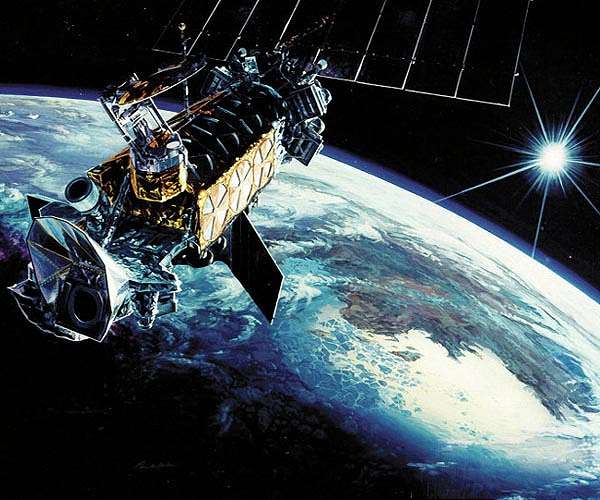
Pentagon spokesman Maj. Gen. Pat Ryder said Russia "likely" has launched a "counter space weapon" capable of threatening U.S. government satellites.
Responding to a question from ABC News, Ryder said that Russia launched the satellite on May 16, adding it was deployed "into the same orbit as a U.S. government satellite."
"Assessments further indicate characteristics resembling previous deployed counter space payloads from 2019 and 2022," Ryder said. "Obviously, that's something that we'll continue to monitor. Certainly, we would say that we have a responsibility to be ready to protect and defend the space domain and ensure continuous and uninterrupted support to the joint and combined forces."
Counter space satellites have the potential to use lasers to "blind" satellite sensors with overwhelming light, preventing them from taking images. They can also listen in on communication satellites. France has charged that Russia has already tried to snoop on conversations bounced off its Athena-Fidus satellite.
The Pentagon also has accused Moscow of trying to develop a nuclear anti-satellite weapon.
On Monday, the United Nations Security Council for a second time voted down a resolution to ban weapons in space. Monday was a proposal led by the Kremlin while the failed attempt in April came from a United States proposal.
Pentagon says Russia launched space weapon in path of US satellite
Washington (AFP) May 22, 2024 –
Russia has launched a likely space weapon and deployed it in the same orbit as a US government satellite, the Pentagon said.
"Russia launched a satellite into low Earth orbit that we assess is likely a counter-space weapon presumably capable of attacking other satellites in low Earth orbit," Pentagon spokesman Air Force Major General Pat Ryder told a press briefing late Tuesday.
The Russian "counter-space weapon" launched on May 16 was deployed "into the same orbit as a US government satellite," he said.
Ryder added that Washington would continue to monitor the situation and was ready to protect its interests.
"We have a responsibility to be ready to protect and defend the domain, the space domain, and ensure continuous and uninterrupted support to the Joint and Combined Force," he said.
Kremlin spokesman Dmitry Peskov declined to comment when asked about reports that Moscow had launched a space weapon.
"I can't comment on this in any way. We act absolutely in accordance with international law, do not violate anything, and have repeatedly advocated banning any weapons in space," he told a regular press briefing in Moscow.
"Unfortunately, these initiatives of ours were rejected, including by the USA."
Earlier Tuesday, Moscow accused the United States of seeking to weaponize space after Washington vetoed a Russian non-proliferation motion at the United Nations.
"They have once again demonstrated that their true priorities in the area of outer space are aimed not at keeping space free from weapons of any kind, but at placing weapons in space and turning it into an arena for military confrontation," Russian foreign ministry spokeswoman Maria Zakharova said in a statement.
– Rival UN motions –
The world powers have traded accusations over weaponizing space in recent months.
They have proposed rival non-proliferation motions at the UN as part of the spat.
Russia vetoed the US initiative last month, while Moscow's proposal was blocked by the United States, Britain and France on Monday.
US envoy Robert Wood said Russia's proposal, which called on all countries to "take urgent measures to prevent for all time the placement of weapons in outer space", was a distraction and accused Moscow of "diplomatic gaslighting".
He said that Russia's "likely" counter-space weapon was "presumably capable of attacking other satellites in low Earth orbit".
"Russia deployed this new counter-space weapon into the same orbit as a US government satellite," he said in remarks ahead of Monday's vote.
"Russia's May 16 launch follows prior Russian satellite launches likely of counter-space systems to low Earth orbit in 2019 and 2022."
In February, the White House said Russia was developing an anti-satellite weapon, the existence of which was confirmed after lawmakers warned of an unspecified but serious threat to national security.
Space has been a rare area where the two countries have maintained a degree of cooperation despite a swathe of Western sanctions and dire relations after Russia's invasion of Ukraine.
Both countries ferry each other's crew members to and from the International Space Station (ISS), where their astronauts are jointly stationed.
The space weapon spat between Moscow and Washington resurrects the spectre of space being militarized despite the 1967 Outer Space Treaty which forbids countries from deploying "any objects carrying nuclear weapons or any other kinds of weapons of mass destruction" into orbit or outer space.