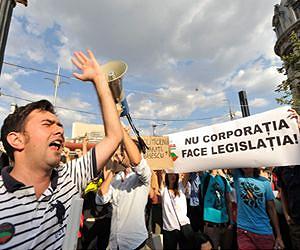
Romania's Senate on Tuesday rejected a controversial bill that would have cleared the way for a huge Canadian gold mine project that has sparked massive protests in the last two months.
A total of 119 senators voted against the draft law, three voted for and six abstained.
The House of Representatives will have the final say, however.
Canadian miner Gabriel Resources, which is backed by American billionaire John Paulson and the Israeli Benny Steinmetz Group, hopes to extract 300 tonnes of gold in the picturesque village of Rosia Montana in Transylvania.
The open-cast mine would be the biggest in Europe, but use thousands of tonnes of cyanide and damage Roman-era mining galleries.
Despite the setback in parliament, Gabriel Resources local subsidiary Rosia Montana Gold Corporation said it will go on trying to get approval for the mine.
Draft legislation in Romania is often submitted to the Senate before being sent to the House of Representatives. Despite the Senate's rejection, the gold mine bill could still become law with the lower chamber's approval.
However, analysts expect the House of Representatives to follow the upper chamber's lead and reject the bill.
Romania's PM pushes for contested decentralisation plan
Bucharest (AFP) Nov 19, 2013 –
Romanian Prime Minister Victor Ponta on Tuesday asked for a confidence vote in parliament on a draft law decentralising public services despite rights groups warning of the increased risk of influence peddling.
The decentralisation bill would transfer power and resources from central to local authorities in the fields of health, agriculture, environment, culture, sports and tourism.
"This is an important step to modernise Romania (…) that will make us break with the centralised communist state of the past," social-democrat Ponta told lawmakers.
But rights groups and commentators have said the move could reinforce "local political barons" and have damaging consequences for the environment and the protection of Romania's heritage.
"Local barons are rejoicing as huge assets will now be directly under their control", editorialist Ioana Lupea wrote in Adevarul, one of Romania's top newspapers.
More than 80 prominent environment and anti-graft rights groups have asked Ponta to withdraw the proposed decentralisation law which they claim violates some European legislation.
The activists fear local bodies in charge of issuing crucial environment permits for industrial or tourist projects will be under pressure since they would depend directly on the county councils that initiate these projects.
The decentralization would encourage "graft and abuses", Dan Trifu, the vice-president of rights group Eco-Civitas told the Mediafax news agency.
EU member Romania is closely monitored by the European Commission to step up the fight against graft. Last year, 50 public officials from local administration were put on trial over high-level corruption charges, according to prosecutors.
Archeologists and historians also fear local authorities will easily allow the destruction of historical monuments to give way to real estate projects.
"Once destroyed, Romania's heritage cannot be recreated," Roxana Wring, the president of the ProDoMo foundation, warned.
The opposition in parliament is not expected to gather enough signatures for a confidence vote and the draft law was likely to be adopted as the ruling centre-left coalition controls 70 percent of the seats.