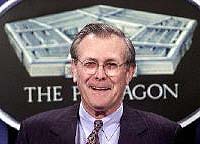
US Defense Secretary Donald Rumsfeld has told the general in charge of the Pentagon's missile defense organization to "press on" with development of a national missile defense system, the Pentagon said Tuesday.
Rumsfeld has met three times with Air Force General Ronald Kadish to review the funding, timelines and test objectives of the anti-missile shield that was being developed under the previous administration, said Rear Admiral Craig Quigley, a Pentagon spokesman.
"And his guidance to General Kadish at this point is to press on," Quigley said.
Rumsfeld told NATO allies over the weekend that the new administration intends to deploy a missile defense system and offered to help US friends and allies deploy their own missile defenses.
The kind of system the administration ultimately intends to pursue "is still a work in progress," Quigley said.
But he said the national missile defense system that has been under development by the Pentagon was still on track.
That system involves using a network of early warning satellites and ground radars to track and target up several dozen incoming missiles, and then to shoot them down with interceptor missiles based in Alaska.
So far, the system has failed to hit its target in two of three attempted intercepts.
related report
Minister says Russia seeks no rift between EU, NATO
Moscow (Interfax) Feb. 5, 2001 – Russia does not seek to drive a wedge between the European Union and NATO, Russian Defense Minister Marshal Igor Sergeyev said on Monday.
"We never set ourselves goals that are practically impossible to attain," Sergeyev said after talks with his Swedish counterpart, Bjorn von Sydow.
"Russia seeks cooperation both with the European Union, with the OSCE [Organization for Security and Cooperation in Europe] and with NATO within the framework of the Joint Permanent Council for strengthening security and stability in Europe.
"The main point is that the voice of Europe should be given priority in dealing with European problems.
"Russia has already shaped its proposals on cooperation with the European Union in the military field. [Russia] is putting its emphasis on the main area, the prevention of possible conflicts in Europe.
"I have asked the defense minister of Sweden, the country that holds the presidency in the European Union, to bring our proposals to the attention of the defense ministers of the member countries of that organization in order to move these initiatives into the area of expert work," Sergeyev said.
He also said the majority of countries in the world share Russia's concern over U.S. plans to withdraw from the 1972 Anti-Ballistic Missile (ABM) Treaty and set up a national missile defense.
"It is unlikely that there are those in the world who are against preserving the entire system of agreements, which has led to strategic stability in the world, and instead want these agreements to be scrapped," he said.
Sergeyev and von Sydow signed a 2001 program to build up contacts between the Russian and Swedish armed forces. One of the measures included in the program is an exercise to train for rescuing submarines and surface sea ships.
All rights reserved. ¿ 2001 Agence France-Presse. All information displayed on this section (dispatches, photographs, logos) are protected by intellectual property rights owned by Agence France-Presse. As a consequence, you may not copy, reproduce, modify, transmit, publish, display or in any way commercially exploit any of the content of this section without the prior written consent of Agence France-Presse.
Copyright 2001