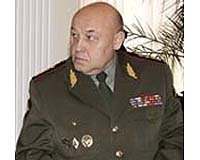
General of the Army Yury Baluyevsky, Russia's chief of staff, has written an article entitled "U.S. NMD: What Next?" It was published by the Russian national defense weekly Voenno-Promyshlenny Kuryer 10 days after the G8 summit in St. Petersburg. Leaders as senior as the chief of staff, who is also deputy defense minister, seldom write articles for the Russian press.
They prefer writing articles and giving interviews to the foreign media before official visits abroad, and seldom reach out to the people via the Russian media. When they do, it is usually for a very serious reason.
Baluyevsky, the No. 2 man in the Russian defense establishment, could not keep silent when the Pentagon accelerated the U.S. National Missile Defense project, and his article can be considered a policy statement by the Russian defense establishment.
He writes that Washington has taken a turn towards unilateral global superiority, although "the time when Russia and the Untied States regarded each other as adversaries or a strategic threat is past" and their defense departments have been promoting cooperation in the last few years.
The idea of military superiority was incorporated into the Nuclear Posture Review, submitted to the U.S, Congress on Dec. 31, 2001, and was described in the U.S. National Security Strategy, which President George W. Bush put forth in March 2006.
In the chapter entitled "Prevent Our Enemies from Threatening Us, Our Allies, and Our Friends with Weapons of Mass Destruction," the document states: "Our deterrence strategy no longer rests primarily on the grim premise of inflicting devastating consequences on potential foes.
Both offenses and defenses are necessary to deter state and non-state actors, through denial of the objectives of their attacks and, if necessary, responding with overwhelming force… Safe, credible, and reliable nuclear forces continue to play a critical role.
We are strengthening deterrence by developing a New Triad composed of offensive strike systems (both nuclear and improved conventional capabilities); active and passive defenses, including missile defenses; and a responsive infrastructure, all bound together by enhanced command and control, planning, and intelligence systems."
Baluyevsky writes that U.S. withdrawal from the Anti Ballistic Missile Treaty in 2002 was part of a crucial step in U.S. defense policy. This allowed it to use modern technologies for more intensive research into and tests of ground- and space-based ballistic missile defense systems, which had been limited by its international commitments, as well as to develop its nuclear forces and infrastructure.
The Americans acted consistently within the framework of their strategy. An analysis of the current and prospective stages of the NMD project shows that its direction and nature have not changed much, whereas U.S. military and political leaders' interest in it and allocations for it have grown dramatically.
The U.S. Ballistic Missile Defense Organization, a structure within the Department of Defense, was upgraded to the Missile Defense Agency. The promise to limit the capabilities of the NMD system to protect the national territory from a limited number of incoming missiles has been withdrawn.
In accordance with the approved allocations for defense, the MDA is to receive $7.88 billion in 2006 and expects to get $9.3 billion, or 17 percent more, next year. Another $1 billion will be channeled into the project through other items in the Pentagon budget.
The majority of additional funds will go into research and development of mobile and sea-launched anti-missiles for intercepting strategic missiles and fragments, as well as ASAT weapons, which had been limited by the ABM treaty. The Americans have also stepped up the program to test the future system's components.
From 1998 to the present, they have held a series of experiments and trials of NMD elements, with a varying degree of success, to check the progress of the development of information and strike systems.
(Part 2 will focus on possible Russian reactions to the U.S. program.)