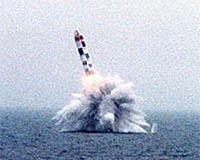
"If you don't succeed at first, try, try and try again." That old saying could be the motto for the Russian navy, which is pushing ahead with at least three more test launchings of its much-troubled Bulava submarine-launched ballistic missile this year.
"We are planning three test launches of the Bulava missile from the Dmitry Donskoi submarine. If the tests are successful, they will continue on board the new Yury Dolgoruky nuclear-powered submarine," Vice Adm. Oleg Burtsev, deputy chief of the navy general staff, announced March 19, according to the RIA Novosti news agency.
The solid-fuel Bulava is an adaptation from the reliable and successful road- and rail-mobile, land-based Topol-M intercontinental ballistic missile. But its designers at the Moscow Institute of Thermal Technology had no previous experience in designing ICBMs to be launched by submarines while underwater, and they have had great trouble in ensuring that the missile retained its aerodynamic stability as it exited the ocean.
The Bulava has now racked up five test failures in its last 10 firings — a failure rate of 50 percent. Some Russian analysts have called for the Bulava to be scrapped and the new generation of Borey-class Project 955 strategic nuclear submarines to be adapted to carry the far older, liquid-fuel but extremely reliable and longer-range Sineva SLBM instead. However, former president and current Prime Minister Vladimir Putin remains committed to the Bulava.
RIA Novosti reported that the Russian navy is still determined to deploy the Bulava operationally on its submarines before the end of this year.
The three-stage Bulava-M — NATO designation SS-NX-30 — SLBM can carry up to 10 multiple independently targeted re-entry vehicle warheads and can hit targets at a distance of 8,000 kilometers, or 4,800 miles.
The first Borey-class Project 955 nuclear submarine, the Yury Dolgoruky, is scheduled to begin its sea trials this summer in the White Sea off Russia's Arctic northern coast.
"The tests of the Bulava missile will coincide with the sea trials of the Yury Dolgoruky submarine after the thawing of ice floes in the White Sea. As a rule, this is in the second half of June," Burtsev said, according to the report.
RIA Novosti said the Russian navy is currently building its second and third Borey-class Project 955 nuclear subs, the Alexander Nevsky and the Vladimir Monomakh, at the Sevmash shipyard in the Arkhangelsk region of Russia's far north. The Alexander Nevsky is due to be finished this year, and the Vladimir Monomakh in 2011. In all, Russia's naval shipyards have the ambitious task of completing eight of the new super subs by 2015.
Share This Article With Planet Earth