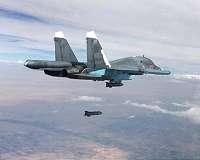
Air strikes against Syrian rebels have gone up 150 percent since Russia intervened in the conflict in 2015, helping the regime triple the territory under its control, a report published on Tuesday showed.
The analysis by IHS Jane's Terrorism and Insurgency Centre (JTIC) also found that just 14 percent of the strikes were against the Islamic State group.
It found that the Syrian state had increased the area under its control from 16 percent of the country in September 2015 to 47 percent in March 2018.
Russian intervention not only ensured the survival of Syrian President Bashar al-Assad's regime, it changed the course of the war.
"Russian intervention has provided the Syrian government with the space and time to concentrate forces at key strategic areas and use overwhelming force to recapture opposition-held territory," said Matthew Henman, head of JTIC at IHS Markit.
"JTIC's recorded data underlines the key role airstrikes have played in this strategy, with opposition forces largely unable to defend against, let alone replicate, the threat posed by airpower."
IHS Jane's said Assad's forces have successfully recaptured large urban centres such as Aleppo and Homs, as well as securing the border with Lebanon and containing the threat from Islamist rebels in Idlib.
Between September 2015 and March 2018, the number of Russian and Syrian strikes rose to 6,833 from 2,735.
Of these strikes, 960 were targeted the Islamic State group — around 14 percent — but the majority were against other rebel groups, the report found.
The strikes were "particularly concentrated in areas where the Islamic State had little or no operational presence," it said.
Diplomatic efforts on Syria sag in Kazakh capital Astana
Astana, Kazakhstan (AFP) May 15, 2018 –
Talks on Syria spearheaded by Russia in Astana failed to edge the seven-year conflict closer to a political settlement Tuesday and cast the future of diplomatic efforts to end the crisis into uncertainty.
Backed by regime-allied Russia and Iran as well as rebel-supporting Turkey, the negotiations in Astana began in January last year, running parallel to talks overseen by the United Nations in Geneva.
The two-day talks involving both the Syrian regime and the opposition were the ninth round of Syria negotiations held in Kazakhstan to date.
But with Geneva talks stillborn and no notable gains made during the latest Kazakhstan round, the diplomatic push to end Syria's crisis appears to have entered a lull.
A joint resolution produced by the three guarantor countries Tuesday said the next high-level meeting on Syria would take place in the Russian city of Sochi in July.
But members of Syria's armed opposition present in Astana immediately ruled out attending the event in Russia.
"We want negotiations to take place in Astana and only in Astana. If the guarantor countries want to hold another meeting in another country that is up to them," said Ahmed Tomeh, a member of the opposition delegation, after the talks.
Russia's chief negotiator Alexander Lavrentyev responded by saying the country where the talks take place in "isn't important" and that other groups might attend the Sochi meeting.
"The Astana process lived, is alive and will continue to live," he said, while refusing to confirm whether or not Sochi would now displace the Kazakh capital as the major venue for negotiations.
Lavrentyev upbraided the United States for breaking form by failing to send a delegation to observe the latest round of Syria peace talks.
He also declared IS "practically destroyed" in Syria.
Since negotiations on Syria in Astana began at the beginning of last year, they have mostly focused on attempts to keep Syrian regime forces and their rebel opponents at arm's length.
United Nations envoy on Syria Staffan de Mistura was also present at the talks looking to end a multi-sided conflict that has claimed over 350,000 lives to date.