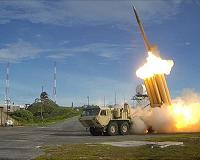
South Korea on Sunday rejected China's criticism over the planned deployment in the South of a US anti-missile system, saying Beijing's failure to curb its ally North Korea had created the situation.
Seoul's decision to deploy the powerful US system, to counter a growing threat from North Korea's nuclear and missile programmes, threatens to damage relations with its largest trading partner Beijing.
China has condemned the Terminal High Altitude Area Defense (THAAD) system as a move against its own national security interests and said it would further heighten regional tension.
The People's Daily even warned Seoul Thursday Seoul of the potentially costly "domino effect", saying the South would "inevitably be the first target" in any conflict between China and the US.
The South's presidential office however urged China to work harder to tame its neighbour North Korea, saying THAAD would have been unnecessary had there been no threat from it.
"Chinese media recently put the cart before the horse in insisting that our decision to host the THAAD was the cause of the North's series of provocations including ballistic missile launches," the presidential Blue House said in a statement.
Tension has been running high since the North staged its fourth nuclear test in January and a series of missile launches since then — most recently last Wednesday.
"We believe that China, before taking issue with our purely defensive move, should raise the issue more strongly with the North, which… is disrupting the peace and stability of the Korean peninsula and Northeast Asia," it said.
China is the sole major ally of the impoverished and isolated North, which relies heavily on food and oil imports from its neighbour.
The Blue House also urged a group of six Seoul lawmakers from the main left-leaning opposition party to scrap a plan to visit Beijing, after they had announced the August 8-10 trip aimed at discussing ways of mending ties.
"No matter what the intention of these lawmakers is, their trip would eventually help strengthen the Chinese government's stance and deepen division within South Koreans," it said.
The decision to host THAAD in the South has met opposition from left-leaning Seoul lawmakers and activists who argue it will imperil diplomatic and economic ties with China.
China is South Korea's largest trading partner and accounts for one quarter of its exports.
Concerns have grown particularly in the South's vast entertainment industry about the possible loss of a key market for the pop music and dramas which have taken China by storm for the past decade.
A number of events scheduled in China involving South Korean stars — including TV appearances or "fan meetings" with Chinese fans — were abruptly cancelled recently.
N. Korea accuses US of seeking 'pre-emptive nuclear strike'
Seoul (AFP) Aug 6, 2016 – North Korea has accused Washington of planning a pre-emptive nuclear strike, after the US announced it would deploy its B-1 bomber in the Pacific for the first time in a decade.
The strategic aircraft were to be deployed on Saturday on the US island of Guam, the US military said last month, describing the operation as a routine rotation with the B-52 bomber.
Tensions have been running high since North Korea carried out its fourth nuclear test in January, followed by a barrage of missile launches that this month reached Japanese waters directly for the first time.
Pyongyang accused Washington of "becoming all the more pronounced in their moves to topple down the DPRK by mobilizing all nuclear war hardware," using North Korea's official title.
"The enemies are bluffing that they can mount a pre-emptive nuclear strike on the DPRK by letting fly B-1B over the Korean peninsula within two-three hours in contingency," said an English-language statement on state media.
"Such moves for bolstering nuclear force exposes again that the US imperialists are making a pre-emptive nuclear strike on the DPRK a fait accompli."
North Korea has threatened "physical action" over the planned deployment of a sophisticated US anti-missile system in South Korea, known as THAAD.
Tensions on the divided Korean peninsula are also building ahead of an annual South Korea-US military exercise later this month.
On July 29, the US Air Force said it would upgrade its hardware on Guam, a US territory in the western Pacific, by sending the B-1 for the first time since April 2006.
"The B-1 will provide US Pacific Command and its regional allies and partners with a credible, strategic power projection platform," it said in a statement.
Pyongyang has repeatedly warned it may carry out pre-emptive nuclear strikes against the South and US targets, domestic and abroad. Ultimately, the North wants to be able to strike on the continental US.
The secretive state, led by supreme leader Kim Jong-un, warned Saturday it would respond to any aggression by reducing the US to a "sea of flames".
"The ever-mounting moves of the US imperialists to ignite a nuclear war are pushing the situation on the Korean peninsula into the uncontrollable and catastrophic phase," said the KCNA statement.