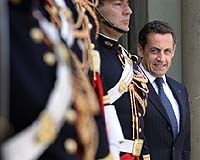
French President Nicolas Sarkozy has called for "increasing sanctions" against Iran, saying previous action had forced Tehran to be more open about its nuclear programme. Sarkozy's comments were made in an interview with the official Russian daily Rossiyskaya Gazeta, ahead of his trip to Moscow on Tuesday and Wednesday. Unlike France Russia is reluctant to impose new UN sanctions against Iran over its uranium enrichment activities.
"Between resignation and war, two words which do not belong in my dictionary, there is a responsible attitude — increasing sanctions to bring Iran to reason, but also the opening of dialogue if Iran chooses to respect its obligations," Sarkozy said in the interview to appear Tuesday.
"Sanctions have yielded the first results in pushing the Iranians into greater transparency. That is the proof that they make the regime think," he said according to quotes in French provided by the Russian journal.
He added: "I will not compromise on such a serious subject."
Sarkozy is due to meet Russian President Vladimir Putin during his two-day trip, and Iran is likely to be a major topic of discussion.
Western powers have accused the Islamic state of seeking to develop nuclear weapons. Tehran denies the charges declaring its nuclear activities are aimed at producing energy.
Elsewhere in the interview, Sarkozy stressed the importance of close ties between Russia and the rest of Europe.
"The world has much to gain from deeper and more systematic ties between Europe and Russia, notably in the areas of defence and security," he said.
The French president said Russia's newfound power "should be welcomed" because it meant the country could take on responsibilities that came with it.
"I am thus waiting for a significant and positive contribution from Russia in dealing with the challenges of our time," he told the paper.
earlier related report
Britain's Brown leaves all options open on Iran
British Prime Minister Gordon Brown refused Monday to rule out any options in the West's nuclear standoff with Iran, but stressed that the priority remains the diplomatic track.
"We take very seriously what the Iranians are trying to do in building up nuclear capability for nuclear weapons," he said at his monthly press conference.
"This can't go unchallenged…. We believe, however, that this matter can be resolved by diplomatic means, by the resolutions that have been passed by the United Nations, by sanctions if necessary."
He declined to comment specifically on the threat of military action against Tehran, accused notably by the United States of seeking to develop nuclear weapons under the guise of a civilian atomic programme.
But Brown said: "What I am prepared to say is that we take very seriously what Iran is proposing and we are prepared to use the methods that we have used in diplomacy and sanctions to deal with this problem.
"I do not rule out anything," he added.
Brown also reiterated a warning that Tehran must now be allowed to foment violence in Iraq.
"They must not intervene in Iraq in a way that is breeding further violence and supporting terrorism and causing the loss of life in what is an infant democracy trying to make its way forward," he said.
"Interference in another country's affairs, as they have done, without any support from the United Nations or other international organisations, is unacceptable," he added.