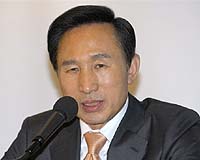
South Korean President Lee Myung-Bak Saturday called for talks with North Korea aimed at ridding the Korean peninsula of nuclear weapons as well as making cuts in conventional weapons.
"Nuclear weapons do not guarantee North Korea's security. They only cloud its future," Lee said in a speech to mark Korea's 1945 liberation from Japanese rule.
"Together with the denuclearisation of the Korean peninsula, reduction of conventional weapons of the North and the South must be discussed," he said, urging the North to enter talks.
If the two Koreas reduce their arms and troops, Lee said, they will be able to save a lot on defence spending and use the money instead to develop their economies.
"I hereby make it clear that this government is ready to start dialogue and cooperation with the North over any issue, at any time and at any level," he said.
Lee reiterated that the South would help Pyongyang end its isolation and prosper if the communist state gave up its atomic weapons.
"If the North comes to such a decision, the (South Korean) government will push for a new programme for peace on the Korean peninsula," Lee said.
An international programme aimed at helping develop the North's devastated economy and improving the living standards of North Koreans would then be put into practice, he added.
An unidentified top aide to Lee said it was the first time that a South Korean president has publicly called for cuts in conventional arms.
"This is an ultimate prescription for building peace on the Korean peninsula," the aide was quoted as saying by the Yonhap news agency.
"It is hardly any more than a shenanigan to talk about humanitarian aid and dialogue between the two Koreas while they are aiming heavy weapons at each other… The North must remove the guns out of our face," he said.
Lee has previously offered huge long-term aid to the North in return for full nuclear disarmament — a linkage which Pyongyang angrily rejects.
Professor Kim Yong-Hyun of Dongguk University said the North was highly likely to dismiss the new offer and demand the South stop an annual US-South Korea joint military exercise due in the coming week.
The annual Ulchi Freedom Guardian (UFG) exercise, scheduled for August 17-27, will involve 10,000 US soldiers and an unspecified number of South Korean troops, the US military said here.
"It has some significance for the president to touch on arms reduction, which is a sensitive issue that the South has so far been reluctant to talk about," said Kim, adding that discussion on conventional arms cuts cannot be avoided in the long term.
The two Koreas are still technically at war since the Korean War of 1950-53 ended in an armistice, not a peace treaty.
More than 600,000 South Korean soldiers, backed by 28,500 US troops, are deployed on the Korean peninsula, confronting a potential threat from the North's 1.1 million-strong military.
Relations have been frosty since the conservative government in Seoul took office in February last year and pursued a firmer line with the North following a decade of engagement and two summits under his liberal predecessors.
earlier related report
Returning North Korea to talks complex: State Department
Returning North Korea to negotiations on halting its nuclear program would be complex but is still possible, State Department spokesman Philip Crowley said Friday.
"This can be technically, you know, a complex process, but it doesn't necessarily… have to be a lengthy one," Crowley said.
"It requires a political commitment by North Korea to meet its obligations and to join in a dialogue and eventually an agreement with… others in the region who have concerns about North Korea and its provocative behavior and its track record as a global proliferation risk," he said.
"I think there's no mystery here as to what we expect North Korea to do. We are just waiting to see if North Korea is actually going to follow the path that the international community has laid out for it."
Negotiations over North Korea's nuclear program — the so-called Six Party talks with participation by North and South Korea, China, the United States, Japan and Russia — effectively ended May 25 when Pyongyang carried out a second nuclear test.
The test prompted the unanimous passage on June 12 of United Nations resolution 1874, which contains a reinforced inspection system for all air, land and sea cargo destined for or coming from North Korea.
It also expanded existing financial sanctions and an arms embargo and prevented the supply of any aid that Pyongyang could use to develop its nuclear program.
North Korea had already raised tensions with the international community in April, when it launched a ballistic missile.
Share This Article With Planet Earth