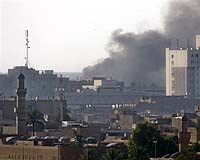
Sunni insurgents are maneuvering for advantage against a US crackdown in Baghdad, but US defense officials said Tuesday they discern no new strategy despite some unusual tactics in the latest violence. The tactics included a rare coordinated attack on a US military outpost, and the detonation of a chlorine tanker truck, as well as car bombings and suicide attacks that claimed the lives of dozens of civilians.
Although no helicopters were downed in the latest violence, the US military is also concerned that a recent spate of shootdowns means that a key cog in the US military machine is suddenly at greater risk.
But US defense officials here and in Iraq said it was too early to tell whether insurgents are pursuing a new strategy, or reacting to opportunities they perceive as US and Iraqi forces mount a new security operation in Baghdad.
A US military official in Baghdad, who asked not to be identified, said there was "no common thread."
"It is not unusual to see some changes in tactics. We have seen that the entire time we have been in Iraq and other places as well," he said.
"It is a constant, action, reaction, counteraction, counter-counteraction when you have a thinking enemy like we have here," he said.
Despite the violence, officials said the number of attacks and sectarian death squad killings have fallen somewhat in the week since US and Iraqi forces launched the crackdown in Baghdad.
But while Shiite militias appear to be laying low, Sunni insurgents have resurfaced with a vengeance over the past three days to shatter a brief lull in the violence.
A US defense official, who spoke on condition of anonymity, said Sunni insurgents seemed to be maneuvering within and outside the city in search of weak links in the US and Iraqi defenses.
"There seems to be some movement outside of Baghdad, but only because it seems they're looking for a vulnerable spot," the official said.
On Monday, two US soldiers were killed and 29 injured in a coordinated attack on a military outpost in Tarmiya, 30 kilometers (19 miles) north of Baghdad. The US military on Tuesday said five of the soldiers suffered serious injuries.
Insurgents opened a breach in the perimeter with two rocket propelled grenade explosions and then drove an explosives laden vehicle into the former police station while small arms and rocket-propelled grenade fire was being directed at those inside, officials said.
"The US soldiers defending the outpost were able to maintain security of the compound, evacuate the wounded and elements of the unit successfully detained seven suspected insurgents in the wake of the attack," the US military said Tuesday.
Although not unprecedented, direct, coordinated attacks on US military bases are unusual, they said.
The attack underscored the heightened risk to US troops as they are dispersed among similar "joint security stations" in Baghdad as part of a strategy to curb violence through a more overt military presence on the street.
"I wouldn't take one of these attacks at one of these outposts to state there is some sort of new trend or new strategy. Time will tell," said Bryan Whitman, a Pentagon spokesman.
In another surprising tactic, insurgents blew up a truck with two tanks of chlorine outside a Shiite restaurant in the northern suburb of Taji, showering the area with shards of metal.
The tanks did not explode but did leak poisonous gas, injuring 100 people, the US military said Tuesday.
"That's pretty unusual," said the defense official, who knew of no other case like it.
Where a trend has emerged is in the downing of at least six helicopters by enemy fire since January 20.
Defense officials said insurgents are using combinations of different types of heavy caliber small arms fire that are not detectable by normal heat-sensing counter-measures to bring down helicopters.
One helicopter was brought down by a surface-to-air missile but it too was in combination with small arms, the defense official said.
"It's the same kind of tactic that has been used before. It's just more attempts and more success in what they're doing," the official said.
It might also be because there are more helicopters flights ferrying troops for the Baghdad surge, the official said.
The New York Times reported over the weekend that captured insurgent documents indicate that at least some of the downings were the result of a carefully planned strategy to target US aircraft in Iraq.