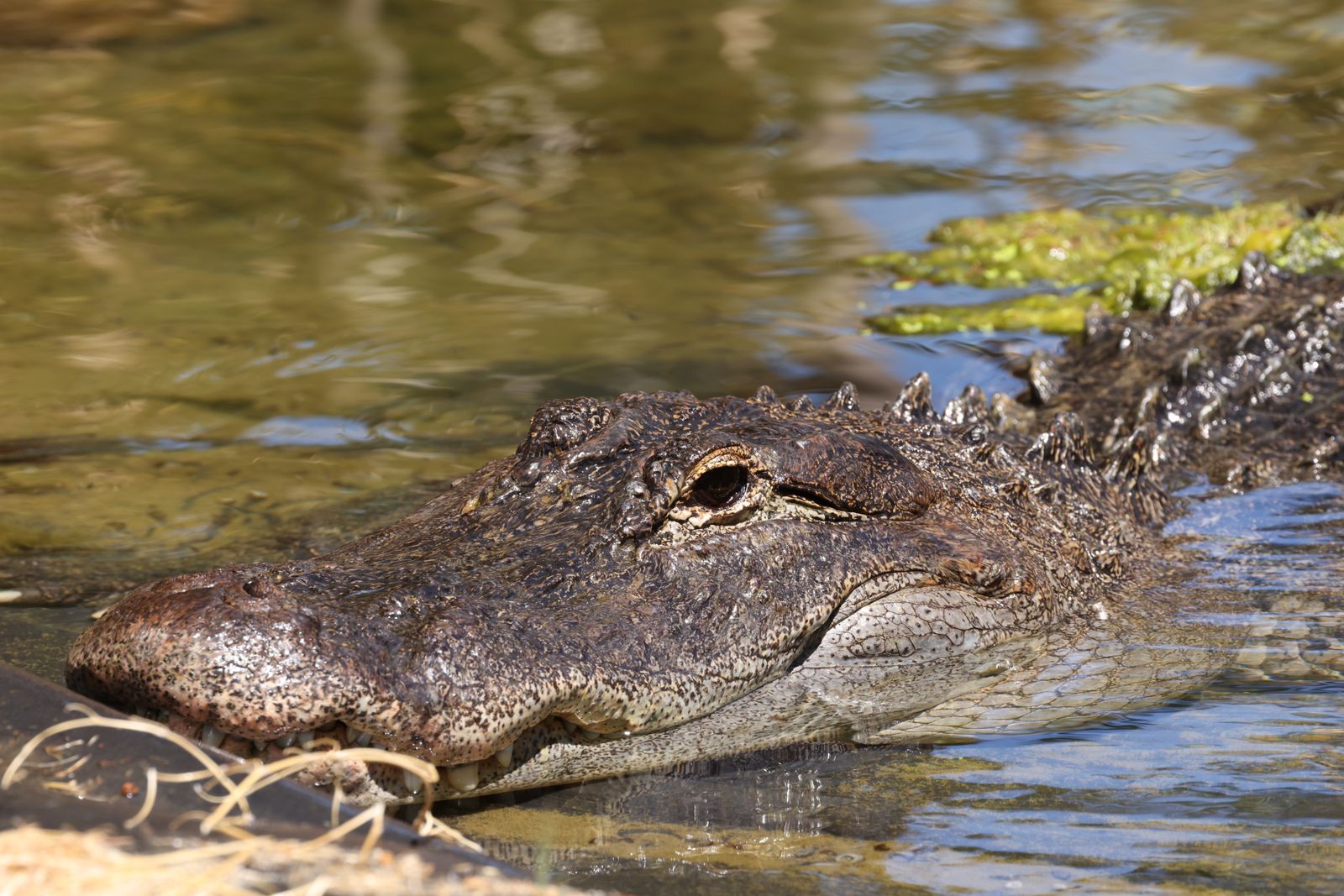
In the Everglades, the winter dry season turns small differences in water depth into major ecological differences. As water retreats from the surrounding marsh, alligators maintain deeper pockets that can keep holding water after nearby shallows have dried. The National Park Service describes these “alligator holes” as dry-season refuges for other animals as well as habitat used by the alligators themselves.
The substrate matters. Alligators are not normally carving basins directly out of solid limestone. A U.S. Geological Survey overview of Everglades alligator ecology says the holes are excavated from the muck and peat that form the wetland soil, often down to the limestone bed beneath it.
The hole is maintained, not simply dug
The ecological effect does not end once a depression exists. Alligators use their snouts, claws and tails to disturb sediment and keep vegetation from taking over the open-water area. That repeated maintenance helps distinguish an active alligator pond from a random low spot in the marsh.
As the dry season progresses, the surrounding landscape becomes increasingly patchy. An A-Z Animals guide to Everglades wildlife viewing describes the same dry-season bottleneck visible to visitors: water retreats from sawgrass margins while lingering in deeper sloughs, holes, canals and ponds. Fish, turtles, birds and alligators consequently become easier to find in the remaining water.
What the 2023 study actually found
The strongest recent evidence comes from work led by ecologist Bradley Strickland. A 2023 Florida International University summary describes research on 10 active alligator ponds in Shark River Slough and Taylor Slough, where scientists compared ponds, their vegetated edges and the surrounding marsh.
The underlying Journal of Animal Ecology study found that the ponds were phosphorus-enriched hotspots and that alligator-engineered habitats altered plant and animal community structure. Pond sediments showed stronger phosphorus enrichment than the surrounding marsh, while fish and invertebrate communities varied with habitat and season.
There is an important limit to the finding. Water-column total phosphorus did not show a consistent significant increase in the ponds, so it is too strong to describe every gator hole as a continuously operating nutrient pump. What the study demonstrates more securely is that alligator activity creates nutrient and habitat heterogeneity in an otherwise nutrient-poor wetland.
Why the dry-season refuge matters
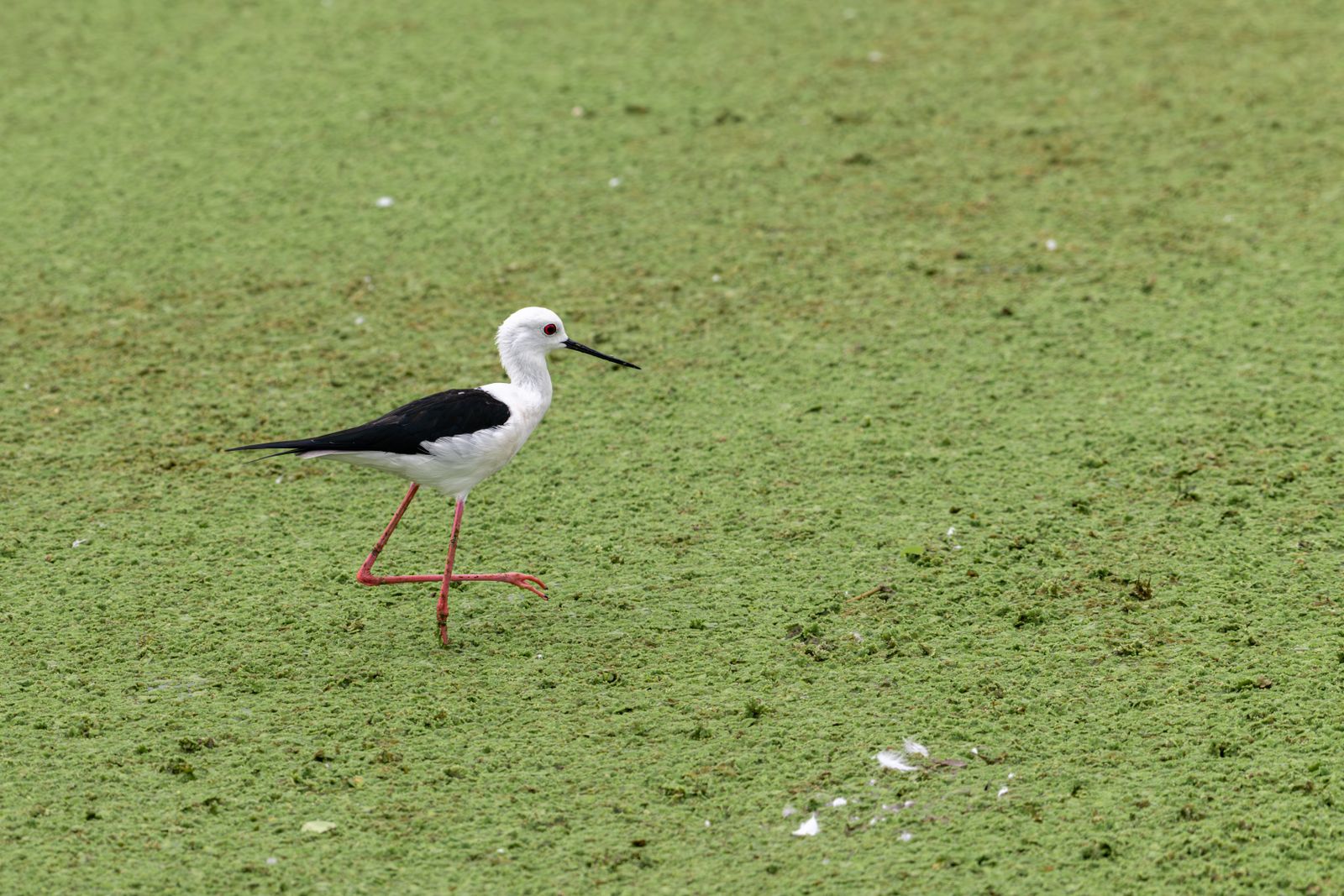
The physical refuge is still the most straightforward part of the story. USGS has long identified alligator holes as foraging areas for wading birds, turtles and snakes and as potential dry-season refuges for fish. Fish that survive a severe dry-down in one of these deeper pockets can help repopulate the marsh when water returns.
That refuge comes with obvious danger. The alligator that maintains the hole is also a predator, and concentrated fish or other animals can become easier prey. The National Park Service nevertheless notes that the ecological value of the remaining water outweighs that risk for wildlife faced with a drying marsh.
This is why “refuge” is more accurate than “sanctuary.” A gator hole keeps aquatic habitat available during the dry season, but it also creates a place where predators and prey are brought into unusually close contact.
Wading birds get another kind of help
Alligators can influence birds in ways that are separate from concentrating fish. A 2021 study in Scientific Reports examined long-legged wading-bird colonies and found evidence that alligator presence can make nesting sites safer by deterring mammalian nest predators.
The researchers found that when alligators were unlikely to be present, birds selected nesting islands farther from the mainland and from other large landmasses. Where alligators were likely, that geographical isolation was less important, consistent with the reptiles providing a protective effect against mammals trying to reach nesting colonies.
That relationship should not be confused with the gator-hole mechanism itself. One involves an engineered aquatic refuge; the other involves a large predator changing the risk faced by nesting birds. Together they help explain why alligators can affect the wetland community in more than one way.
Why ecologists call the alligator an engineer
“Ecosystem engineer” has a specific ecological meaning: an organism physically changes its environment in ways that alter resources or habitat for other species. The alligator fits that description especially well in shallow Everglades wetlands, where a maintained depression can remain aquatic while the surrounding surface dries.
A Mongabay overview of the American alligator similarly describes the species as a keystone animal that modifies wetland habitat by creating holes used by other organisms. The National Park Service also identifies the American alligator as a keystone species in Everglades National Park.
The distinction is worth keeping clear. Ecologists describe the alligator itself as a keystone species and its holes as important habitat or refugia. “Keystone infrastructure” is a useful metaphor, but it is not the formal classification used by the main ecological sources.
Carbon too, but with an important caveat
Another line of research has begun to ask whether alligators influence how wetlands store carbon. In 2025, Christopher Murray and colleagues published a Scientific Reports study of alligators and coastal wetland carbon using soil-core data from the Gulf and Atlantic coasts.
The researchers found positive correlations between alligator presence and recent soil-carbon stocks within the species’ native range, and between alligator abundance and carbon measures at a regional scale in Louisiana. But the pattern was not uniform: the continental analysis showed no overall significant effect, and the marsh habitat analysis did not show a significant alligator effect on recent carbon storage.
That makes the carbon result intriguing rather than a direct explanation of an Everglades gator hole. The study did not demonstrate that an individual alligator pond in the Everglades stores more carbon because a gator dug it. It instead adds to a broader question about how apex predators may influence coastal-wetland carbon through food webs and habitat effects.
Recovery restored an ecosystem engineer
The ecological role matters partly because American alligators came close to disappearing from large parts of their range. Federal protection began in 1967 after hunting, habitat loss and other pressures had driven populations sharply downward.
The recovery has been dramatic. The U.S. Fish and Wildlife Service reported in May 2026 that nearly five million American alligators now live across the southeastern United States, including about 1.25 million in Florida.
That does not mean every one of those animals digs a classic Everglades-style gator hole. The engineering behavior is especially important in shallow wetlands where seasonal water loss makes deeper refuges valuable. But where those conditions exist, the return of alligators also restored a physical process that helps shape the habitat around them.
What remains when the water returns
When wet-season water spreads back across the Everglades, fish and other aquatic animals can disperse out of the deeper refuges and into the surrounding marsh again. The alligator hole does not cease to matter. It remains a deeper feature in the landscape, maintained by the animal and ready to become disproportionately important when the next dry season arrives.
That cycle is the reason the alligator’s influence is larger than the space occupied by any single pond. The animal excavates muck and peat, maintains open water, creates a dry-season refuge, alters local nutrient conditions and changes where other species can feed or survive. In a wetland governed by the rise and fall of a few crucial inches of water, that is enough to make an alligator not merely a predator, but an engineer.