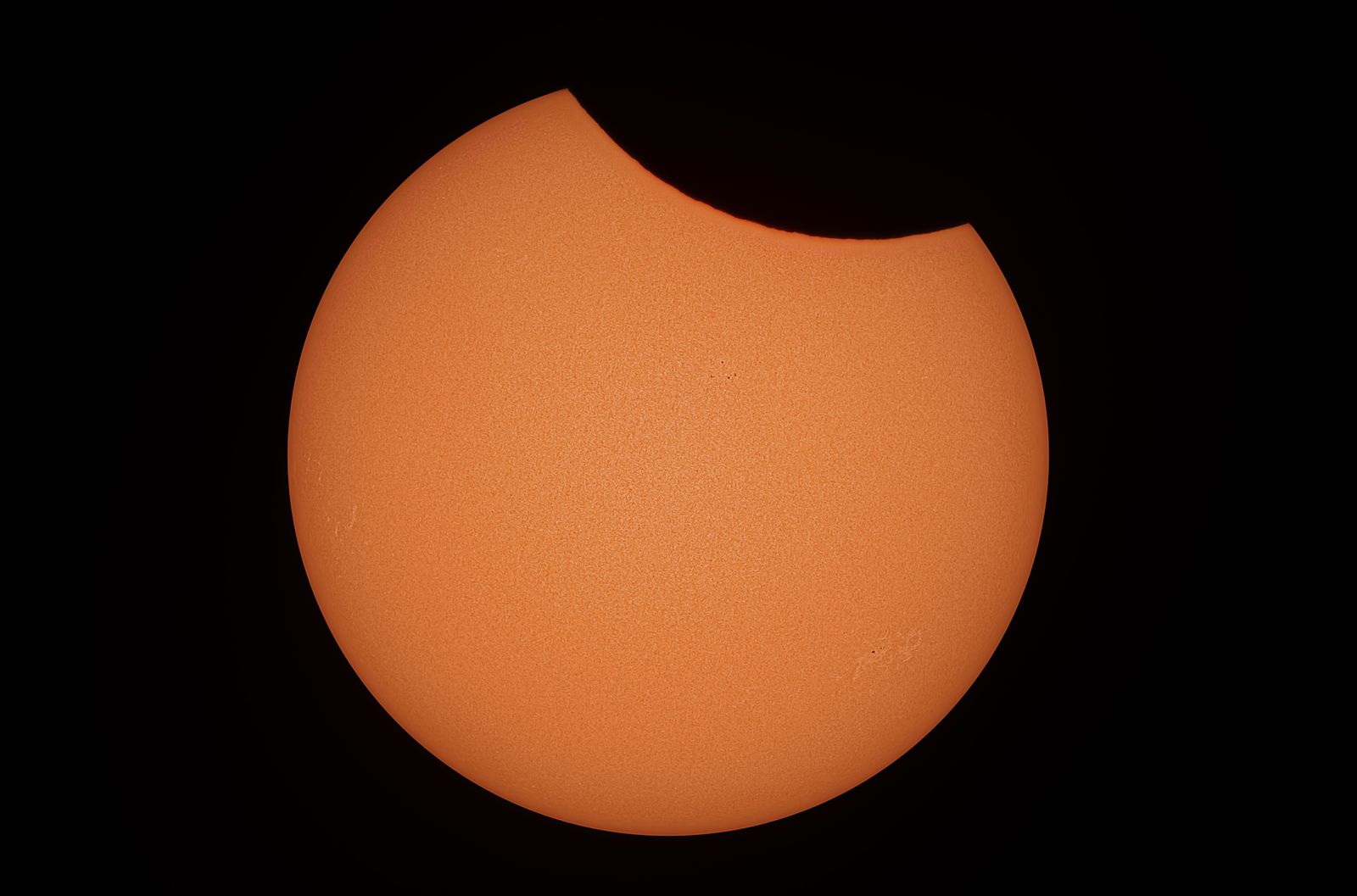
On 12 August 2026, NASA’s Perseverance rover pointed its Mastcam-Z camera up into the pale Martian sky and watched a lumpy shadow, roughly the shape and proportions of a russet potato, slide across the face of the Sun. The shadow was Phobos, the larger and closer of Mars’ two moons, a roughly 27-kilometre rock that circles its planet at low altitude and is spiralling, centimetre by centimetre, toward Mars.
The event lasted only seconds. Phobos is small and fast. It crosses the Martian sky multiple times every Martian day, so a solar transit, the moon’s silhouette crossing the solar disk from the rover’s line of sight, is short, sharp, and geometrically precise. German outlet astronews published the transit frame on 27 August, describing it as another entry in a catalogue Perseverance has been building since it landed in Jezero Crater in February 2021.
A potato-shaped moon, photographed on a schedule
Phobos is not spherical. It is a lopsided fragment of rock, pocked with craters and grooved with parallel scars, measuring roughly 27 kilometres along its longest axis and about 19 along its shortest. Astronomers still debate its origin. Its dark spectrum resembles primitive asteroids, which has long supported the theory that Mars captured it. But its nearly circular, nearly equatorial orbit is difficult to explain through capture alone. A rival hypothesis proposes that Phobos condensed from debris produced by a giant impact on early Mars.
Perseverance cannot settle that debate. What it can do is record the timing and geometry of Phobos transits, giving scientists repeated observations with which to refine models of the moon’s changing orbit.
Catching a transit requires advance planning. The rover must be available, Mastcam-Z must be pointed toward the Sun, and the observation sequence must coincide with the interval in which Phobos is predicted to cross the solar disk.
Why NASA keeps filming the same moon
Each transit adds another observation. By comparing recordings made at different times, scientists can refine their understanding of Phobos’s orbit and how it is changing.
Phobos orbits below synchronous altitude and circles Mars faster than Mars rotates. To an observer on the Martian surface, this means Phobos rises in the west and sets in the east, the opposite direction to the Sun. Because the moon moves faster than the planet turns beneath it, tidal interactions remove orbital energy from Phobos and draw it gradually closer to Mars.
The rate is small but relentless. Long-term observations indicate that Phobos descends by roughly 1.8 centimetres per year. That is slow on a human clock and fast on a geological one. Estimates commonly give it several tens of millions of years before it either strikes Mars or is pulled apart by tidal forces, potentially producing a temporary ring before much of the material reaches the surface.
The August 2026 transit in context
The 12 August transit was not Perseverance’s first. The rover has been observing Phobos solar transits for years, catching the potato-shaped silhouette crossing the solar disk. Curiosity, its older sibling in Gale Crater, has done the same, while Opportunity also photographed Phobos crossing the Sun. Each mission adds observations to the record.
The August event followed a separate, rarer observation made on 2 July 2026, when Perseverance captured Phobos passing directly in front of Earth. This was an occultation rather than a transit because Phobos completely hid the much more distant Earth. The sequence showed Earth as a single-pixel point of light briefly disappearing behind the moon. NASA described it as the first time humanity had recorded Earth disappearing behind another object from the surface of another planet.
Mastcam-Z deputy principal investigator Justin Maki described the composite as a unique Earth self-portrait taken from another planet, with Phobos passing through the scene. Mark Lemmon, a Mastcam-Z co-investigator at the Space Science Institute, planned that July observation and assembled the composite. He said catching Phobos directly in front of Earth required both planning and luck.
How big Phobos looks from Jezero Crater
From Perseverance’s position along the rim of Jezero Crater, Phobos appears much smaller than Earth’s Moon does from the ground. It is a much smaller object at a much closer distance, appearing as a bright, oblong body moving noticeably against the stars.
When it transits the Sun, the geometry produces a striking sight. The Sun appears smaller from Mars than from Earth because Mars is farther away. Phobos, though tiny in absolute terms, is close enough to cover a meaningful fraction of the solar disk. In Mastcam-Z frames, its silhouette is visibly irregular, with the moon’s real shape traced against the bright background. A German feature in Spektrum der Wissenschaft called it a space potato in front of the Sun, which is a fair description.
The physics of a doomed orbit
Tidal evolution also affects Earth’s Moon, but in the opposite direction. Earth’s Moon is above synchronous altitude, so tidal interactions transfer angular momentum to its orbit and it moves outward at about 3.8 centimetres per year. Phobos is below synchronous altitude, so tidal interactions draw it inward.
Phobos also has a low bulk density compared with solid rock, suggesting substantial internal porosity. Its long parallel grooves were visible in images returned by both Mariner 9 and the Viking missions, according to NASA’s Jet Propulsion Laboratory, and were later examined in greater detail by subsequent spacecraft. One published model proposes that some of the grooves could be surface fractures produced by tidal stresses acting on a weak interior beneath a more cohesive outer layer.
Some models predict that Phobos will begin breaking apart as tidal forces overwhelm its ability to hold together. Under that scenario, the disrupted material could form a ring around Mars, with part of the debris eventually descending toward the planet. NASA also presents a collision with Mars as another possible outcome. Which path dominates depends on the moon’s still-uncertain internal strength and structure.
The Japanese sample return that wants a piece
Interest in Phobos is not just observational. The Japan Aerospace Exploration Agency’s Martian Moons eXploration mission, or MMX, is designed to observe both Martian moons, land on Phobos, collect surface material, and return the sample to Earth. JAXA has scheduled MMX for launch on 20 October 2026, with arrival in the Martian system planned for 2027 and recovery of the return capsule targeted for fiscal year 2031.
The scientific prize is the origin question. If Phobos is a captured primitive asteroid, its material should preserve evidence of that origin. If it formed from debris after an ancient impact on Mars, the returned sample may contain material connected to the early Martian system. Either result could reshape part of the inner solar system’s early history.
Space War has covered adjacent questions of what deep-time cosmic accounting can tell us. An earlier piece on the missing antimatter of the Big Bang traced how tiny imbalances, patiently measured, can reshape physical models. Phobos is a smaller-scale example of the same discipline: watching a shadow, measuring its movement, and adjusting an orbital model.
What Perseverance is doing when it is not looking up
The rover’s primary mission is not moon photography. Perseverance has collected and sealed samples of Martian rock and regolith during its traverse through Jezero Crater, an ancient lake and river-delta environment, for possible return to Earth by a future mission. Its Mastcam-Z system, led by Arizona State University in collaboration with Malin Space Science Systems, is a stereoscopic zoom camera pair designed primarily for imaging and geological analysis of the terrain.
The transit observations use the same camera system with solar filters and carefully timed imaging sequences. NASA’s photojournal documents the 12 August transit imagery and explains that comparisons among Perseverance’s recordings help scientists refine their understanding of Phobos’s changing orbit.
These observations fit into the rover’s broader programme of atmospheric and astronomical imaging while requiring only a brief diversion from its surface work. Their value comes from repetition: each successfully timed transit extends the observational record.
The long horizon
Perseverance’s transit frames join decades of observations of Phobos made by orbiters, landers, and rovers. Together, those measurements allow scientists to refine the moon’s orbital evolution and improve estimates of its eventual fate.
Current estimates give Phobos several tens of millions of years. That is roughly comparable to the time separating the present from the extinction of the last non-avian dinosaurs, with the clock running forward instead of backward. It is a long horizon in human terms and a short one in planetary terms. Phobos may eventually strike Mars or break apart, leaving the planet temporarily ringed before much of the debris descends.
Until then, the potato-shaped moon keeps circling Mars several times a day, and a rover on the rim of a dry lake keeps its camera ready for the appointed moment, catching the shadow as it slides across the Sun.