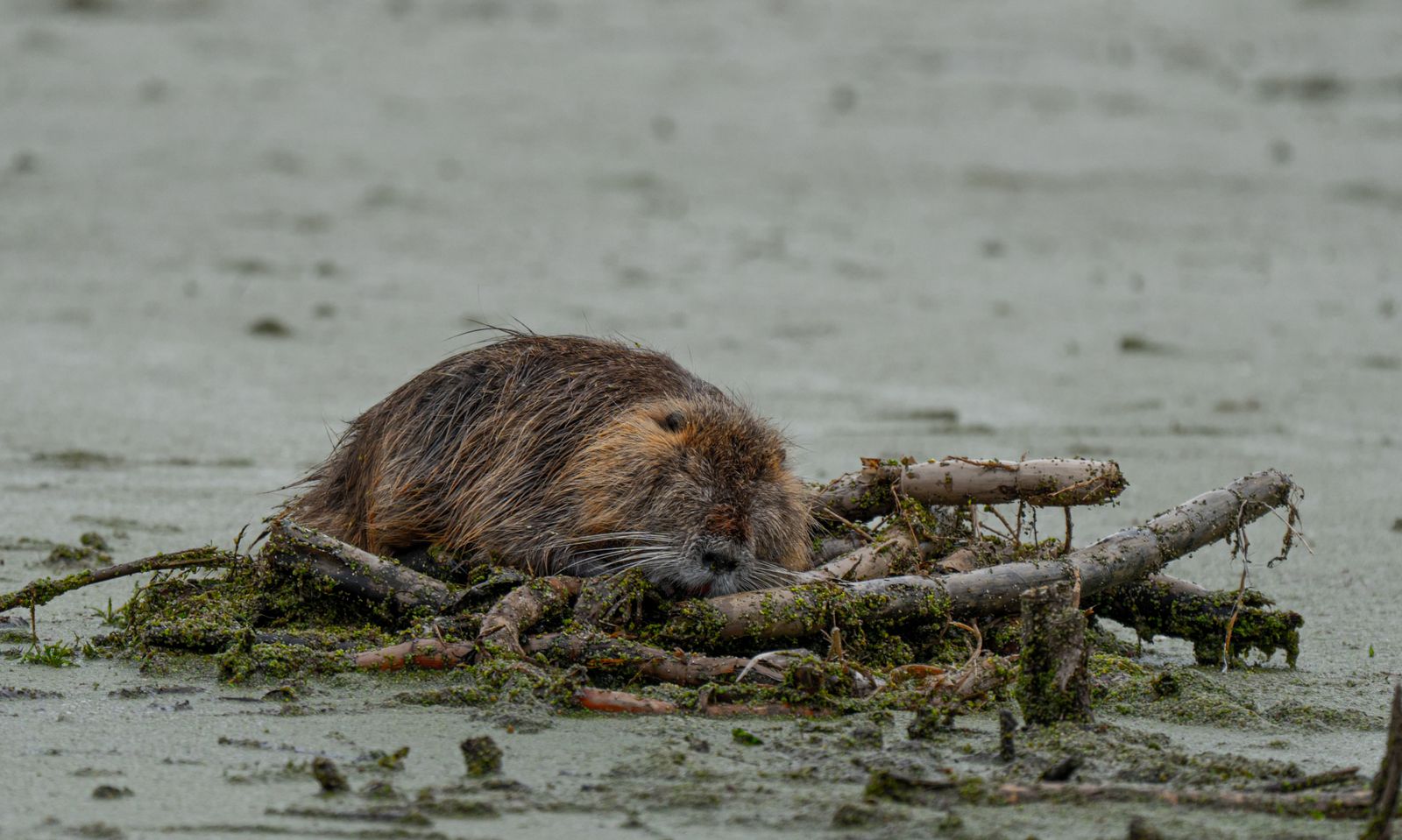
In a drought-cracked valley in Devon, a family of Eurasian beavers that recolonised the River Otter raised the local water table by close to a metre within a decade, turned a straight-drained farm ditch into a chain of ponds, and now appear to lock carbon into the sediment faster per hectare than typical oak woodland. The animals became the subject of a five-year licensed trial, the first of its kind in England, run by the Devon Wildlife Trust and monitored by the University of Exeter between 2015 and 2020. A single family group, incisors never ceasing to grow, does the work of a small hydrological engineering firm, for free, and without a planning application.
The mechanism is almost embarrassingly simple. Beavers fell willow and alder, drag the trunks across a stream, weave in brush and mud, and back up the water behind the wall. Each dam raises the upstream water surface, pushing water into the floodplain and saturating soils that had been drying out through a century of drainage. As research on beaver pond dynamics has shown, the biggest ponds form where conditions favour dam construction: longer dams, gentle stream power, and woody vegetation of moderate height, the very conditions of a temperate lowland valley left alone for a few seasons.
How one family becomes a wetland
Beavers do not build a single dam. They build complexes. On the River Otter, the trial began in 2015 with two founding breeding pairs; by the time it concluded in 2020, the population had grown to an estimated fifteen family groups spread along the catchment, each holding its own chain of ponds.
Each dam is short. A metre high, perhaps five metres across. But chained together, they behave like a stepped reservoir. Water that used to flash through the catchment in hours now takes days to move downstream. The saturated zone around each pond expands outward through the soil, and the water table, the invisible upper surface of the groundwater, rises with it.
Monitoring on beaver-restored reaches has recorded groundwater rising within a few years of dam construction. In some Devon fields beside the Otter dams, water tables that had sat well below the surface for decades climbed to within touching distance of the topsoil, close to a metre higher than before.
Why the water goes sideways, not down
A conventional reservoir loses most of its stored water to evaporation and controlled release. A beaver complex loses most of its water sideways, into the surrounding sediments. That lateral seepage is the point. It rehydrates alluvial aquifers, the loose gravels and silts that fringe every lowland river, and those aquifers then act as a slow-release sponge through the summer.
The physics is straightforward hydrostatic pressure. Raise the water level at the dam by a metre and you raise the hydraulic head across the whole floodplain. Water flows from high pressure to low, pushing outward through the porous sediments until a new equilibrium is reached. In a valley 200 metres wide, a single well-placed dam can influence groundwater for several hectares on either bank.
The Devon trial, run by the Devon Wildlife Trust and monitored by researchers at the University of Exeter, found that peak storm flows downstream of the beaver-dammed reach were cut by an average of around 30 per cent during heavy rain, while summer baseflows, the water still trickling in a dry August, ran noticeably higher than on comparable un-beavered tributaries.
A concrete dam is a barrier. A beaver dam is a filter. Water passes through the woven brush constantly, slowed but not stopped. That leakiness is what steadies the downstream flow: water is metered out rather than either held back completely or released in a pulse.
The ponds also behave like biogeochemical reactors. Nitrogen from farm runoff is denitrified in the anoxic sediments and vented as harmless nitrogen gas (N₂); phosphorus binds to iron minerals in the mud; suspended sediment settles out. A study of an enclosed Devon beaver site led by the University of Exeter recorded markedly lower concentrations of sediment, nitrogen and phosphate in the water leaving the site than in the water entering it. A pond that looks like a muddy nuisance to a farmer is, chemically, a water-treatment works.
Researchers at the University of Stirling, studying a beaver-engineered stream on the Bamff estate in Scotland, reported that the dams and ponds trapped diffuse farm pollution so effectively that peaks of pollutants fell by up to 95 per cent between the water entering and leaving the complex. The animals were, in effect, cleaning agricultural runoff for free.
The carbon arithmetic
The claim that a beaver wetland stores more carbon than an equivalent area of forest sounds like environmentalist hyperbole. It is not. It follows from where carbon actually accumulates.
A temperate forest holds most of its carbon above ground, in trunks and branches, plus a smaller pool in the topsoil. When a tree dies, most of that carbon returns to the atmosphere within a few decades as the wood decomposes in oxygen. The soil pool grows only slowly in mature broadleaf woodland.
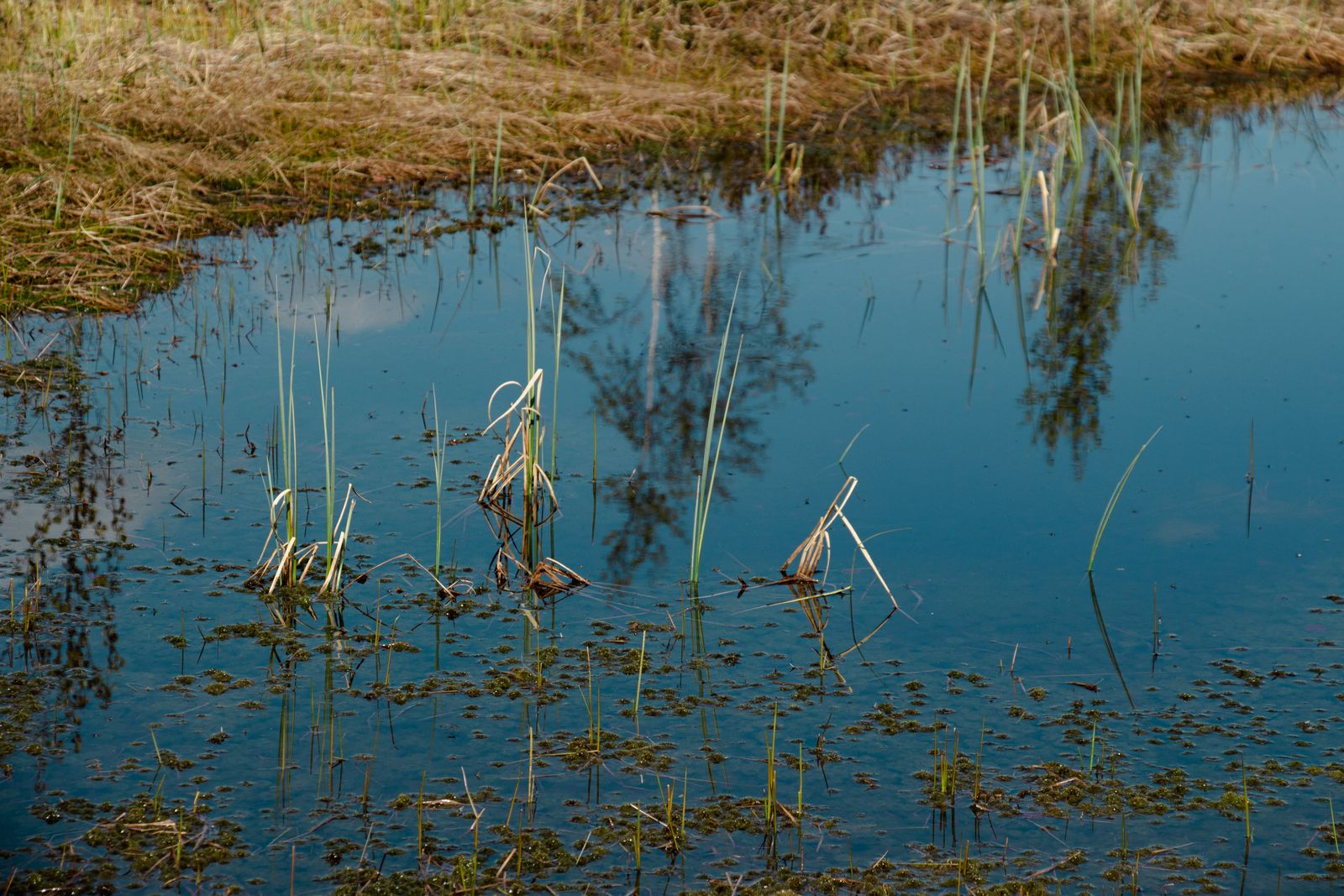
A beaver wetland stores its carbon under water. Organic material, leaves, drowned wood, algae, dead roots, sinks into anoxic sediments where decomposition slows to a crawl. Because the animals keep flooding new ground and drowning the vegetation on it, carbon piles up in the mud faster than it does in the soils of the forest next door.
A 2026 study in Communications Earth & Environment, led by researchers at the University of Birmingham with colleagues at Wageningen and Bern, put numbers on this. Tracking a Swiss beaver wetland for thirteen years, they found its sediments held up to eight times more organic carbon and around fifteen times more inorganic carbon than adjacent forest soils, and that the wetland was a net carbon sink of roughly 100 tonnes a year, storing carbon at rates up to ten times higher than comparable stream reaches without beavers.
The methane caveat
Wetlands also emit methane, a greenhouse gas roughly 28 times more potent than carbon dioxide over a century. Anoxic muds are exactly the environment in which methanogenic archaea thrive. Any honest accounting of a beaver pond’s climate impact has to set that methane flux against the carbon it buries.
In most temperate beaver wetlands the accounting still comes out positive. The carbon locked into the sediment tends to outweigh the methane released, especially over multi-decade timescales, because the buried carbon stays put while methane, once emitted, is oxidised in the atmosphere within about a decade. Coastal and tidal wetlands do better still: sulphate in seawater suppresses methane production while the sediments keep burying carbon, which is why salt marshes and mangroves are prized by the carbon-removal community.
The Nature Index summary of wetland carbon dynamics draws together dozens of papers pinning down these fluxes across biomes. The broad picture: freshwater beaver wetlands are a modest net sink, tidal wetlands a strong one, and drained wetlands a catastrophic source.
Why Devon looked the way it did
Before the beavers arrived, the Otter tributary they colonised looked like most English farmland streams. Straight. Deep. Cleared of woody debris. Bordered by grazed pasture right down to the bank. Drainage engineers had spent two centuries turning meanders into ditches so that water would leave the fields as fast as possible.
That geometry maximised productive acreage. It also stripped the valley of every mechanism it once had for holding water in dry summers. When drought hit southern England, the un-beavered tributaries ran dry. The beaver-dammed reach did not. The ponds shrank, but they held.
It is the same logic that has driven the Netherlands to unwind four centuries of flood-defence orthodoxy and give rivers room to spread rather than raising the dykes ever higher. In both cases, engineers ran the numbers on taller walls versus more room for water, and found the cheaper answer was the biological one.
What comes back with the beavers
Eurasian beavers, Castor fiber, were hunted to functional extinction in Britain by the sixteenth century. Across their range the survivors fell to around 1,200 animals by 1900, clinging on in a handful of relict refuges scattered from France to Mongolia. Coordinated reintroduction and natural spread have since pushed the species back above 1.5 million.
North America’s Castor canadensis has followed a similar rebound, though Emily Fairfax, of the University of Minnesota, estimates the continent still sits at only about 10 per cent of its pre-colonial population. Ten per cent. Which is another way of saying that the water-storage capacity of the North American landscape is running at a fraction of its evolved baseline.
Every family group that returns to a valley restores a small piece of that lost hydrology. On the Otter, two founding pairs had grown to roughly fifteen family groups along the catchment within five years, each territory representing somewhere between one and three hectares of new wetland. Multiply that across the plausible reintroduction range in England and Wales and the numbers become significant even at national scale.
Stand on the bank of the Otter tributary in a dry July and the difference is visible without any instrument. Above the first dam, the channel is a chain of dark pools fringed with reeds and drowned willow. Frogs. Dragonflies. A heron working the shallows. Below the last dam, the stream continues as a modest but unbroken flow, not the cracked bed of the un-beavered reach a kilometre away.
The water table beneath the adjacent field, measured by a shallow piezometer, sits far closer to the surface than it did before the dams. The grass is greener. The soil, when a spade goes in, is dark and damp rather than pale and dusty.
Somewhere under the second pond, in sediments that have been anoxic since 2016, roughly a decade’s worth of drowned leaves and branches lies compressed into a layer of black organic mud. That mud is carbon that will not return to the atmosphere for centuries, possibly millennia, unless someone drains the pond.
The engineer responsible for it weighs 20 kilograms, has orange teeth reinforced with iron, and is currently asleep in a lodge built of the willow it felled last November.