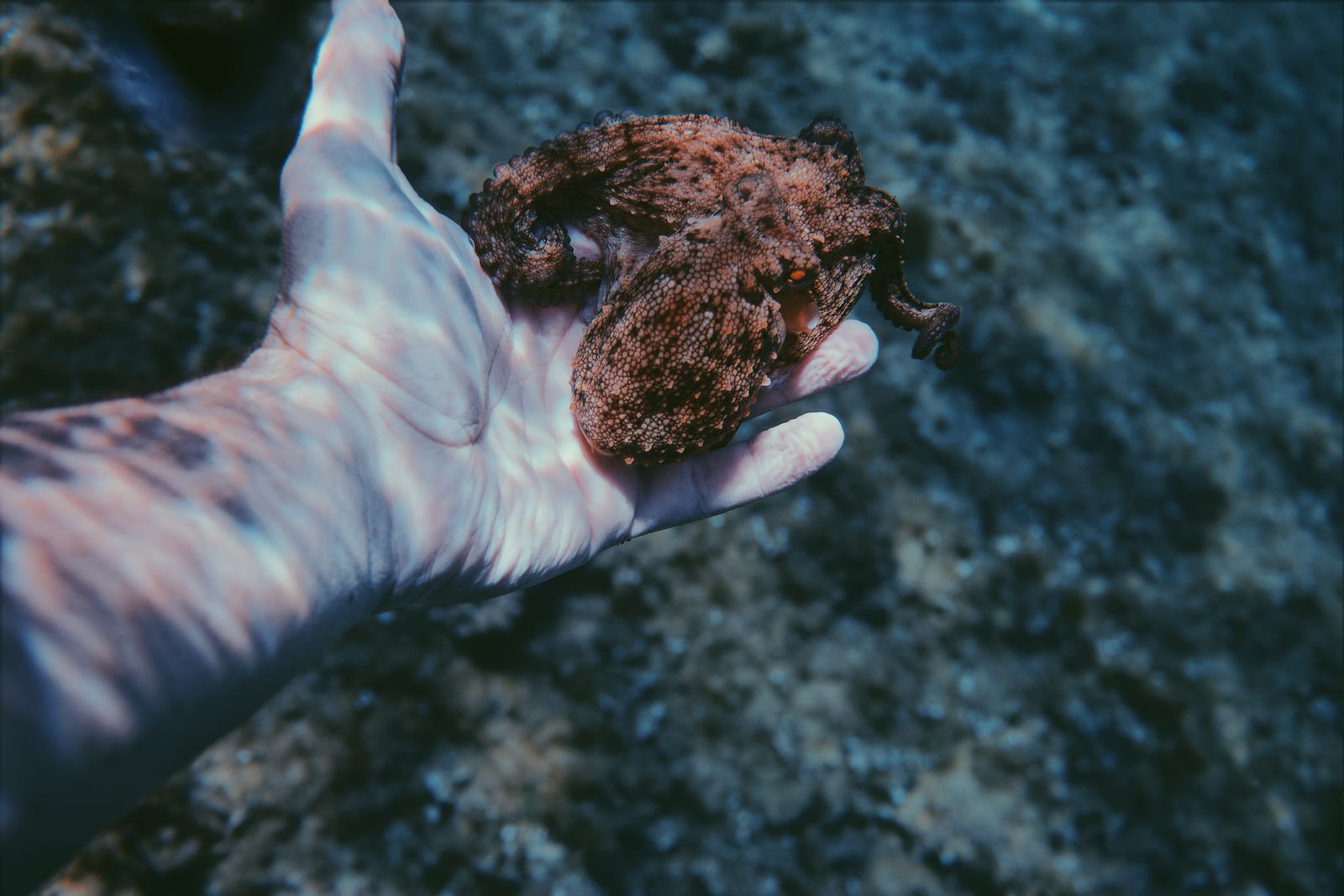
An octopus is a soft-bodied animal running eight limbs at once with no skeleton to lever against and no single command centre coordinating them. It manages this by pushing most of its brain out into the arms. Roughly 350 million of its 500 million neurons — about 66 percent — sit in the arms themselves, not in the central brain between its eyes.
The mechanism, described on January 15, 2025 in Nature Communications by Cassady Olson, Natalie Grace Schulz and Clifton Ragsdale at the University of Chicago, is a segmented axial nerve cord running down the centre of each arm. In their paper on neuronal segmentation in cephalopod arms, neuronal cell bodies are packed into repeating columns divided by gaps called septa, with nerves and blood vessels exiting through the septa to nearby muscles and suckers. Each segment handles a slice of the arm. The arm is, in effect, a chain of repeated processing units wired in series, and the animal’s small central brain sets high-level intent rather than micromanaging every twist.
What sits inside an octopus arm
Strip the skin off an octopus arm and you find no bone, no cartilage, no shell. What you find is a muscular hydrostat: a structure made only of muscle, connective tissue and nervous tissue, where muscle acts against muscle and incompressible tissue supplies the resistance a skeleton would normally provide. The human tongue is built on the same principle, as Olson noted to Popular Science.
Down the middle of that muscular tube runs the axial nerve cord, or ANC. Olson describes it as roughly equivalent to a spinal cord, with a cell body region, a neuropil region, and long tracts connecting the arm back to the brain. The cord snakes back and forth as it travels, swelling into a bulge over every sucker.
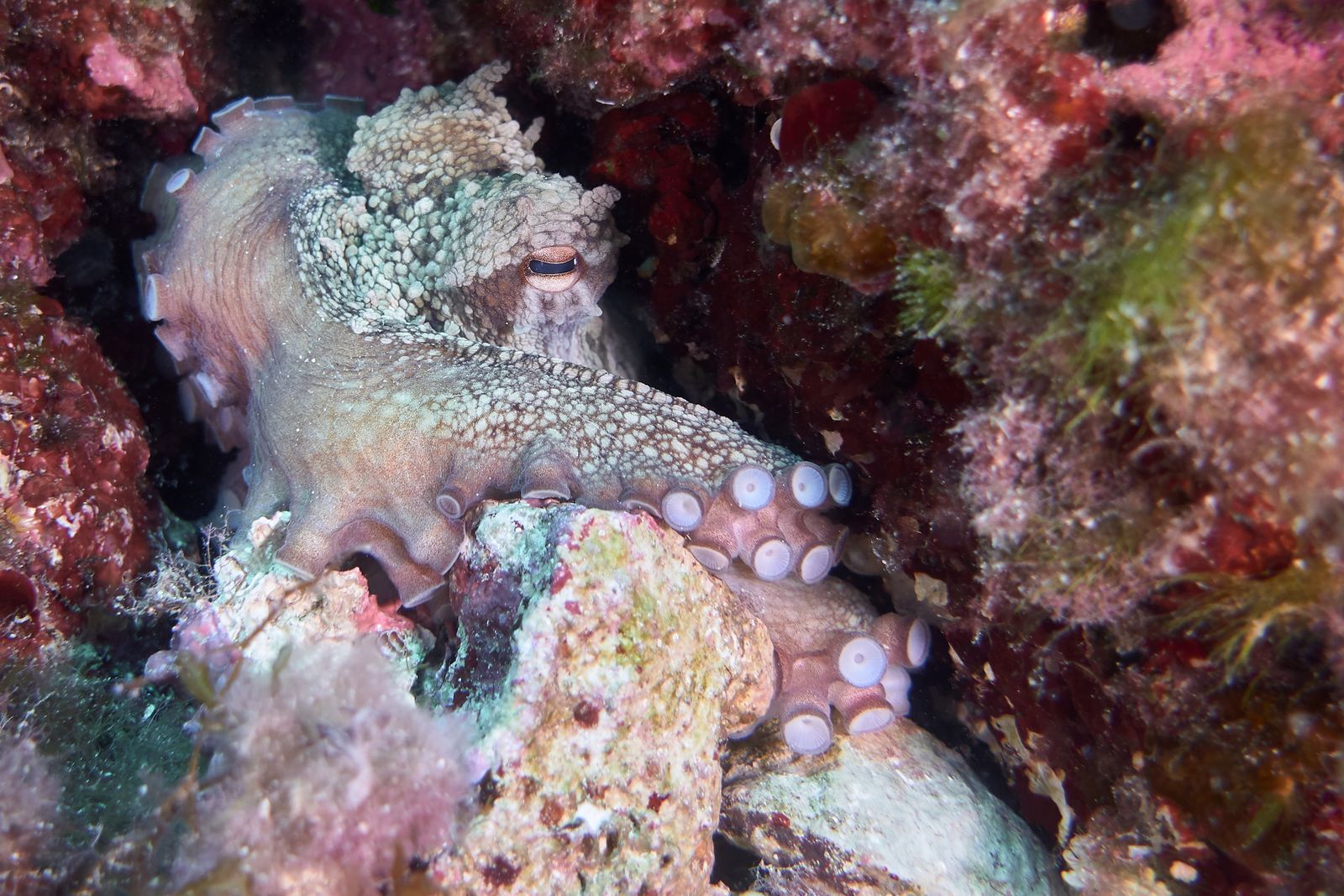
The California two-spot octopus (Octopus bimaculoides) the Chicago team studied carries hundreds of suckers across its eight arms. Each sucker can move and change shape independently. Each is also packed with sensory receptors, so the arm tastes and smells what it touches — combining, in the lab’s phrasing, a hand with a tongue and a nose.
The segmented cord discovery
Olson and Schulz found the segmentation almost by accident. They had been trying to image thin circular cross-sections of arms under a microscope, but the tissue kept sliding off the slides. They switched to lengthwise strips. In that orientation, under cellular markers, the axial nerve cord resolved into something no one had described: neuronal cell bodies packed into columns forming discrete segments, like a corrugated pipe.
Between the segments sit the septa. Nerves and blood vessels leave the cord through these gaps and fan out to nearby muscle blocks and to the suckers. Crucially, nerves from multiple segments reach overlapping muscle regions. That overlap is the wiring diagram for coordination — the segments do not act as isolated units, they hand movement off to each other along the length of the arm.
Olson put the logic plainly in the university’s announcement: for a very long, flexible arm, the best way to set up a control system “would be to divide it into segments,” with communication between those segments smoothing the movement out.
Why decentralising the brain works
A signal travelling from an octopus’s central brain out to the tip of an arm and back is slow compared with a signal that never has to leave the arm. Putting the circuitry local means the arm can respond to what it touches before the brain has finished thinking about it.
Galit Pelled, a professor of mechanical engineering, radiology and neuroscience at Michigan State University, told Ars Technica that each arm can process sensory input, start a movement and carry out complex behaviour without direct instruction from the brain — the arms, in her phrasing, have their own “mini-brains.”
Her group has put numbers on it. In a study published in February 2025 in Bioelectronic Medicine, carbon electrode arrays implanted in the octopus anterior nerve cord showed that the number of spikes in the first 100 milliseconds after stimulation predicted the movement that followed. Machine-learning models could tell whether a movement happened at all with 88.64 percent confidence, and whether it was a lateral sweep or a grasp with 75.45 percent confidence.
The behavioural evidence is easy to see in aquariums. An octopus will use two arms to hold a shell and pry it open, three more to walk across substrate, and another to reach into a crevice — all at once, all doing different jobs. The extreme demonstration is post-mortem: amputated octopus arms will still move on their own, reaching and grasping, until the local circuits run out of energy.
The division of labour is not random. A 2025 field study in Scientific Reports, which scored 3,907 arm actions from 25 wild octopuses across six sites in the Caribbean and Spain, found that the front arms did the reaching and exploring while the rear arms did the standing and walking. What it did not find was handedness: left and right arms were used with almost equal frequency, and the arms appeared to work in coordinated pairs rather than showing an individual favourite.
That is still a different concept of a body than a vertebrate carries around. A human brain owns the hands. An octopus brain, more accurately, negotiates with the arms.
A map of every sucker
The most striking pattern the Chicago team found is spatial. Nerves for the suckers also leave through the septa, connecting systematically to the outer rim of each sucker, which sets up a topographic map of sucker position inside the arm’s own nervous system. The researchers named it the suckerotopy.
Vertebrates have topographic maps too, in the brain — the famous cortical homunculus, where the hand and lips take up outsized real estate because they are densely innervated. The octopus builds its equivalent in the limb. The suckerotopy is what lets the animal know, without central processing, which sucker just tasted something interesting, and how to bend the local segment of arm to bring more suckers to the same spot.
The wiring, Olson told Popular Science, is reminiscent of a ring attractor — a circuit that behaves like a gyroscope, letting an animal keep track of orientation. Such circuits have been described in insect brains for navigation. Finding the resemblance in an octopus arm suggests the same computational trick has been bent to a very different problem: knowing where your own suckers are in three-dimensional space.
Squid tentacles as a natural experiment
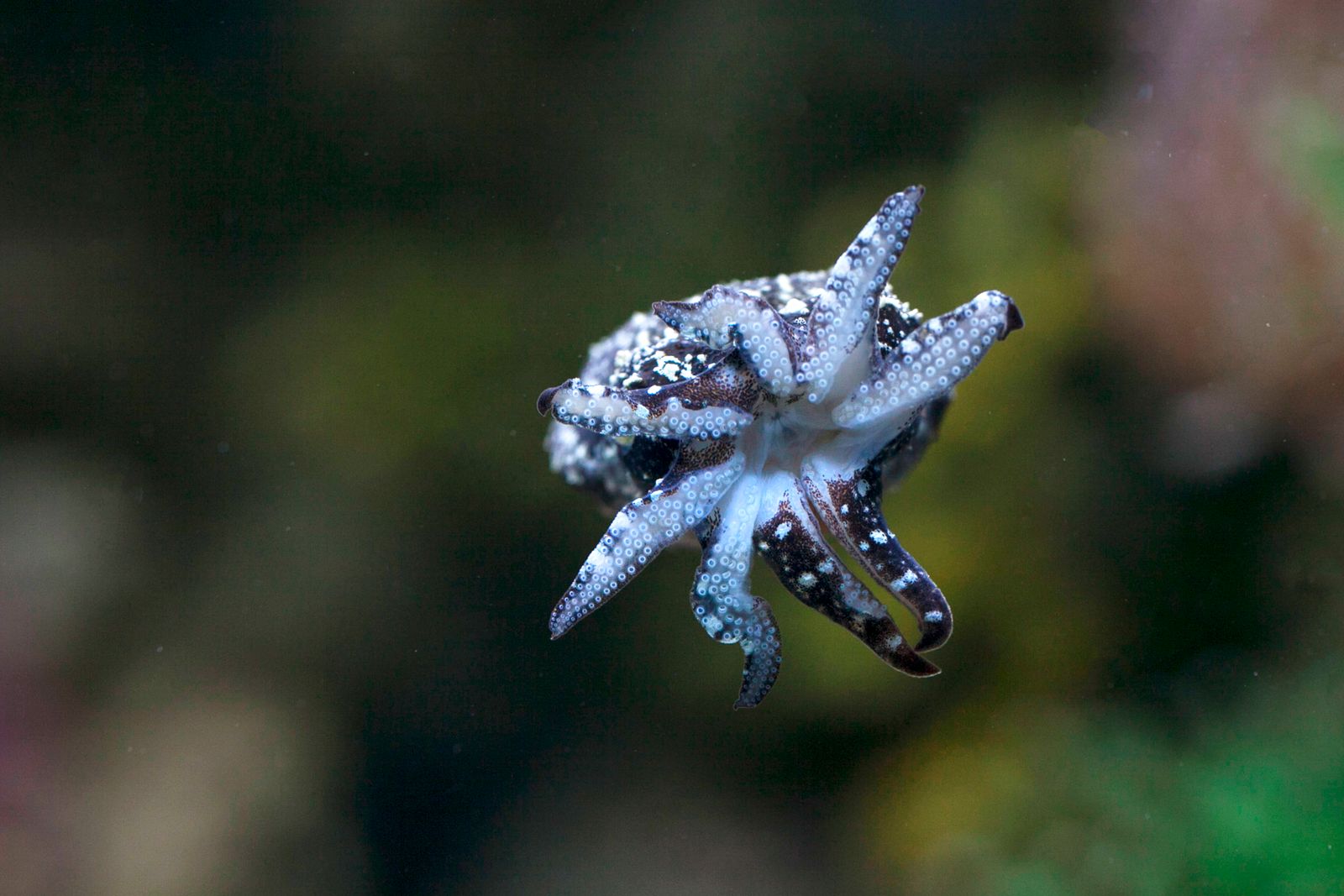
To test whether segmentation is a general cephalopod solution or something specific to sucker control, Olson also dissected longfin inshore squid (Doryteuthis pealeii). Squid have eight sucker-lined arms plus two long feeding tentacles. Each tentacle is a bare stalk with a sucker-covered club at the end, shot out ballistically to seize prey.
The result was a natural control experiment. The axial nerve cord in the bare stalk is not segmented; the club at the tip is, in the same corrugated-pipe pattern as the octopus arm. Where there are suckers to control, there is segmentation. Where the appendage only needs to launch and retract, there is not.
Octopuses and squid diverged more than 270 million years ago, and the segmented cord shows up in both wherever a dexterous, sucker-laden appendage needs governing — though not identically. Squid tentacle clubs have fewer segments per sucker, which fits their ecology: squid hunt visually in open water and use the club as a grabber, while octopuses prowl the seafloor and use the arms as taste-and-touch instruments.
Soft robotics is copying the diagram
The engineering payoff is direct. A soft arm has effectively infinite degrees of freedom, which is the reason it can slip through a crack or curl around an oddly shaped object. It is also the reason a central controller struggles to command it: the computational cost of solving the arm’s geometry from one brain grows too fast.
In May 2026, Emanuela Del Dottore, Barbara Mazzolai and colleagues at the Istituto Italiano di Tecnologia published a tendon-driven soft arm whose ten silicone suckers each carry their own optical contact sensors in Nature Machine Intelligence. Each sucker fires a local suction reflex on contact; a higher layer collects contact directions from all ten, works out how the object is lying, and picks a grasp. It cites the Chicago segmentation paper, and it grabbed bottles and artificial starfish underwater with no camera and no operator. Olson has said the suckerotopy and segmentation results give designers exactly that circuit framework to copy — repeated local processing units along a soft limb, talking to their neighbours, coordinated by intent rather than micromanaged.
The comparison to spacecraft engineering is closer than it looks. Pushing decision-making out to subsystems so the central computer only sets goals is a pattern space engineers have converged on for decades, from hierarchical onboard autonomy for long-duration underwater vehicles to collaborative autonomy for uncrewed aircraft and satellite swarms navigating without ground contact. Evolution got there first, by hundreds of millions of years.
The segmentation is the wiring, though, not the whole animal. An octopus opening a jar, copying another octopus’s solution, or recognising an individual keeper is doing something that pulls the central brain and the arms into a shared computation, and the details of that handshake are still open. As ScienceAlert noted in its coverage of the Chicago work, this is among the most unusual nervous systems on Earth, and much of what makes it strange is how a decentralised body still produces coherent, goal-directed behaviour.
Ragsdale’s framing in the university’s announcement is worth keeping in mind: animals with sucker-laden appendages that move like worms need the right kind of nervous system, and different cephalopods have, in his words, “come up with a segmental structure” whose details shift with the demands of the environment.
The next time an octopus at an aquarium reaches an arm around a corner and gropes at something it cannot see, the movement is not being driven from behind the eyes. It is being driven by a chain of small clusters of neurons running down that arm, each handling its own segment, each mapping its own suckers, passing signals to its neighbours, sending only a summary back to the brain — a boneless animal with the equivalent of a spinal cord in every limb, feeling its way across the seafloor with 350 million neurons that never needed permission.