
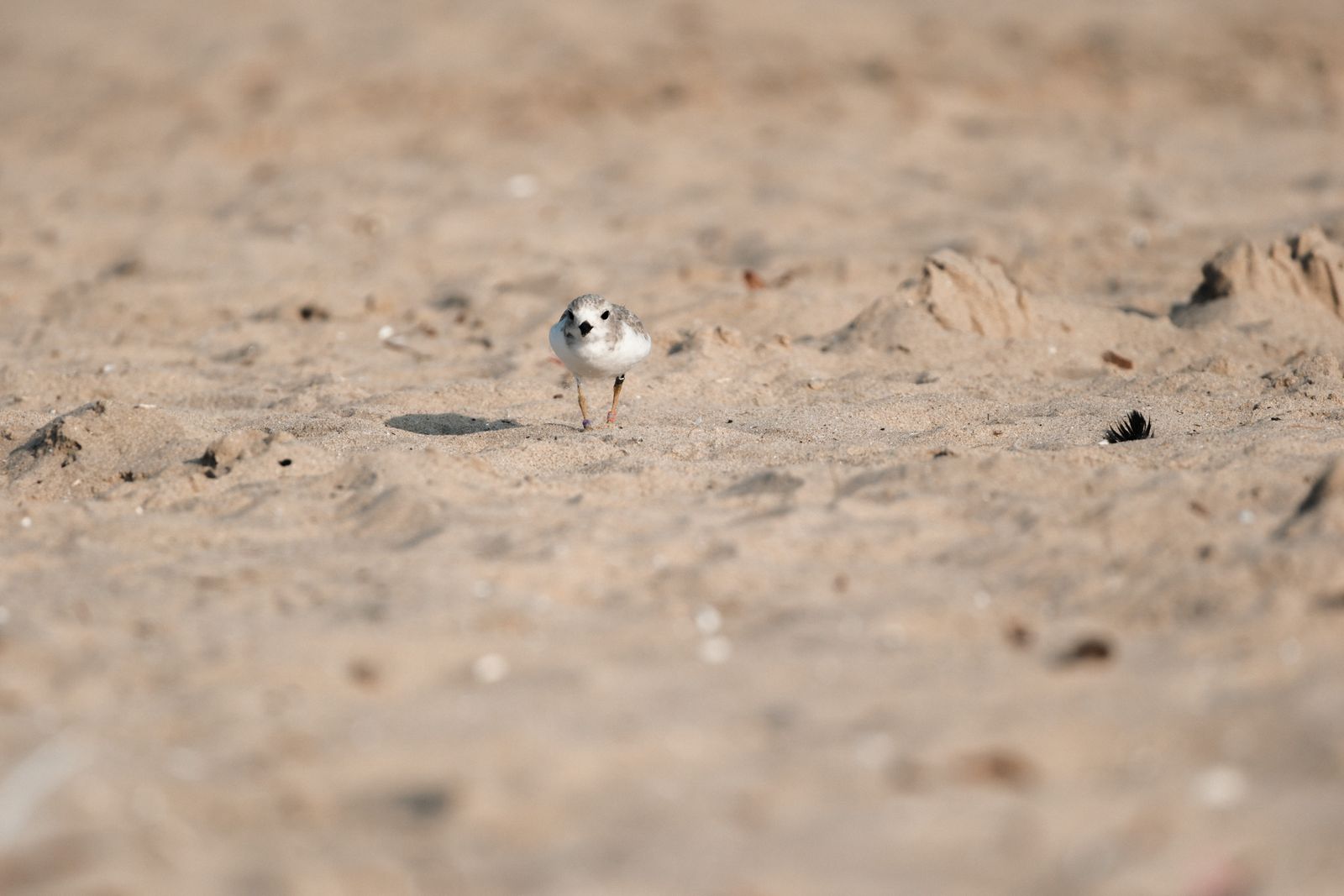
The specific base was Wurtsmith Air Force Base on Michigan’s Lake Huron shore, closed in 1993, and the ecological chain reaction it started can be measured in a single number: 12. That was the count of Great Lakes piping plover breeding pairs left on Earth in 1990, all of them clinging to a handful of Michigan beaches, when the base’s runways went quiet and the surrounding stretch of undeveloped Lake Huron sand — kept off-limits for decades by the Air Force footprint and adjacent state and federal holdings — became one of the quiet anchors of the bird’s recovery.
The Great Lakes population has climbed back to dozens of nesting pairs across Michigan, Wisconsin, Ontario and a few outposts in Illinois and Pennsylvania. The mechanism connecting the base closure to the chicks is not mystical. It is real estate. Piping plovers need wide, open, cobble-and-sand beach with almost no human foot traffic and almost no off-leash dogs, and the Cold War, by accident, had been preserving exactly that kind of shoreline behind fences for half a century.
A bird the size of a golf ball, and a beach the size of a runway
A Great Lakes piping plover is pale sand-colored above, white below, with a single black neck band and orange legs that flash when it sprints. The bird is nearly invisible on dry Lake Huron cobble until it moves. Chicks are precocial: within hours of hatching they are running the wrack line, tipping forward to pluck midges and beach hoppers out of the sand.
That life history is the problem. The nest is a scrape in open gravel above the high-water line. There is no cover. A jogger, a leashed retriever, a beach-driving pickup, a raccoon following the smell of a picnic — any of them can end a clutch. The Great Lakes population declined dramatically along shorelines from Illinois to Ontario. By 1990 it was 12 pairs, all in Michigan, and no chicks had fledged in Wisconsin, Indiana, Ohio, Pennsylvania or Illinois in living memory.
Why a bomber base helped
Wurtsmith opened as a gunnery range and became a Strategic Air Command bomber base, home to B-52s and KC-135 tankers on nuclear alert. Its footprint stretched across Iosco County near Oscoda, wrapping inland from Lake Huron and abutting Van Etten Lake. The base closed on June 30, 1993.
What mattered for the plovers was not the flight line itself. It was the fenced buffer, the restricted access to adjacent shoreline, and the way the base’s presence had frozen development on the Oscoda-area coast for decades. When the runways went silent, the shoreline did not immediately turn into condos. Much of the adjacent beach was already in state and federal hands — the Huron-Manistee National Forest, state game areas — and post-closure conservation planning kept large stretches undeveloped precisely at the moment the U.S. Fish and Wildlife Service was scaling up recovery work under the 1986 endangered listing.
The pattern is familiar from other Department of Defense properties where military land use, whether continued or wound down, often produces the one thing endangered ground-nesters need most, which is the absence of everyone else.
The number worth pausing on is 12. Twelve pairs. That is the population from which every Great Lakes piping plover alive today descends. Jade Arneson, a fish and wildlife biologist with the U.S. Fish and Wildlife Service, told WUWM that in 1986 the Great Lakes subspecies was federally listed as endangered, and by 1990 it was down to 12 breeding pairs, all in Michigan. The subspecies had winked out of Wisconsin, Ohio, Indiana, Illinois, Pennsylvania, New York and most of Ontario.
Recovery has been slow because a plover pair typically fledges one to three chicks a year, and only if predators, storms and beachgoers all cooperate. Doubling the population takes the better part of a decade. Getting from 12 pairs to current levels has taken decades and an unusual amount of hand-labor: nest exclosures made of wire mesh, round-the-clock volunteer monitoring, and captive-rearing programs that incubate abandoned eggs and release the fledglings back to the wild.

The Michigan core, and Wisconsin’s second act
The Sleeping Bear Dunes National Lakeshore on Michigan’s Lake Michigan coast, along with beaches in the eastern Upper Peninsula and the Wurtsmith-adjacent shore on Lake Huron, holds the majority of the population. Visitors to protected beaches learn that if you can’t cover a bird with your thumb held at arm’s length, you are too close. Orange rope and symbolic fencing mark nesting zones. Visitors can walk the water’s edge. They cannot cross the rope.
The dog rule is not decorative. The mere presence of an off-leash dog can cause an adult plover to abandon a clutch, because the birds read the dog as a coyote or a fox and cut their losses on the current season’s investment. A single unleashed golden retriever chasing gulls has, in documented cases, cost a beach its entire year of production.
The recovery is no longer only a Michigan story. In May 2016, Audubon Great Lakes’ Wisconsin conservation manager Tom Prestby photographed a female plover on the Cat Island Restoration Chain in Lower Green Bay and, zooming in on his camera screen, saw an egg beneath her. It was the first successful plover nesting anywhere on Green Bay in 75 years, and the first ever documented in Brown County, according to Prestby’s account to WUWM — a milestone the birds have now repeated every single season for ten years running.
Cat Island exists because the U.S. Army Corps of Engineers rebuilt a chain of barrier islands in Lower Green Bay. The rebuild was primarily a coastal-engineering and dredge-disposal project. It happened to produce, on its outer edges, exactly the sparse sand-and-cobble habitat plovers need. Wisconsin now holds multiple nesting pairs at the Apostle Islands in Ashland County and at Cat Island.
The theme repeats. A federal footprint — a bomber base, a Corps of Engineers dredge-disposal island, a national lakeshore — creates or preserves habitat that the private shoreline market would otherwise convert to houses, marinas and beach bars. The plovers move in.
Individual birds, tracked by leg band
Because the population is so small, biologists know most of the adults by name. Prestby told WUWM about Obie, the Cat Island male who returned in 2025 for his ninth breeding season at age 10, and who has fathered 26 fledged chicks over eight years. His usual mate, Violet, has fledged 23. Every bird carries a unique color-band combination read through a spotting scope.
The most famous individual was Monty, a male who nested for four summers at Chicago’s Montrose Beach with his mate Rose — the first plover pair to breed on a Chicago beach since 1955. The National Audubon Society documented how Monty’s presence turned a scrap of downtown Chicago lakefront into a monitored refuge. Monty has since passed away. His descendants continue to return.
The 2026 season
In late May 2026, biologists in Michigan and Wisconsin reported 12 endangered chicks hatched from monitored nests. It is a small number until you remember it equals the entire 1990 breeding population of the subspecies. Elsewhere, the recovery has reached far enough that Pennsylvania documented its own comeback nesting at Presque Isle State Park on Lake Erie, part of a statewide effort described by the Altoona Mirror.
The formal recovery target set by the U.S. Fish and Wildlife Service’s recovery plan is 150 nesting pairs sustained for five consecutive years, with at least 50 pairs outside Michigan. The population needs to hold its trajectory for another decade to be considered recovered.
The Wurtsmith closure is not the whole story. Predator management, captive rearing, banding, volunteer monitors who sit on beaches from April through August in every weather — all of it matters. But the underlying condition, the one without which none of the other tools work, is simply undeveloped beach.
The pattern shows up across the continent when human pressure lifts. Where devastation or decommissioning creates an absence of human activity, ecological recovery often follows.
The Oscoda shoreline never had to be restored in that sense. It was already there. The Air Force had held the line, unintentionally, since the Truman administration. When the base closed, the shoreline did not disappear into private lots. It was inherited by a conservation apparatus already looking for exactly this kind of ground.
What you would see if you stood there in July
The wind off Lake Huron at Oscoda in mid-July smells like wet cedar and warm sand. The waves are small. Roped-off zones with orange twine and small wooden stakes run along the upper beach where the driftwood collects. Inside the rope, if you have binoculars and patience, a bird the weight of a slice of bread stands motionless next to a scrape lined with pebbles the size of peppercorns.
Somewhere behind the dune line, a runway that once launched B-52s toward the Arctic circle is cracked and grown over with beach grass. The chicks, when they hatch, will run within hours. The beach they run on is quiet because, forty years ago, it was loud.
