A sea otter floating on its back in Monterey Bay will often pull a smooth stone from a loose flap of skin under its left forearm, balance it on its chest, and pound a mussel against it until the shell splits. Otters that do this routinely keep measurably healthier teeth than otters that bite prey directly, a difference biologist Chris Law and colleagues documented across 196 radio-tagged southern sea otters tracked along the central California coast and published in Science in May 2024.
The finding is small in scope and enormous in what it implies. A cracked molar in a sea otter is not a dental problem. It is a death sentence.
The calorie problem that makes teeth everything
An adult southern sea otter (Enhydra lutris nereis) has to eat roughly a quarter of its body weight every day to keep warm in Pacific water that hovers around 10 to 15 degrees Celsius. For a 25-kilogram female, that is six kilos of shellfish daily — the human equivalent of eating about 17 kilograms of mussels in 24 hours.
Otters do not have blubber. They rely on the densest fur of any mammal on Earth and a furnace-like metabolism paid for by constant foraging. Everything runs through the teeth.
When a molar cracks, an otter loses the ability to process the hard-shelled prey that makes up most of its calorie budget. It starves. That is why the tooth-damage numbers Law’s team assembled — years of foraging observations paired with dental scoring of individual tagged animals — matter so much.
What the tracking data actually shows
The study followed 196 radio-tagged southern sea otters, monitored by volunteer “otter spotters” working alongside researchers from UC Santa Cruz, UT Austin, the Monterey Bay Aquarium, the U.S. Geological Survey and the California Department of Fish and Wildlife. The animals were spread across five stretches of the central California coastline — Elkhorn Slough, Monterey, Big Sur, Piedras Blancas and San Luis Obispo. Observers recorded what each otter ate, how big and hard the prey was, and whether the animal used a tool to open it. The team also assembled dental assessments for individual animals.
Otters that reliably used stone anvils showed less tooth damage than otters that tried to bite prey open directly. The paper reports that tool users, especially females, reached larger and harder-shelled prey, and that the mechanical advantage translated into less damage during processing.
Female tool users came out furthest ahead. They consumed prey up to 35% harder than male tool users and otters that used no tools at all, despite smaller heads and a weaker bite. In effect, a rock lets a smaller animal eat like a bigger one.
Why the bay’s menu changed
Southern sea otters used to eat mostly sea urchins and abalone — soft targets, comparatively, that a strong jaw can crush without much help. Both prey species have collapsed in much of the otter’s range. Abalone were fished to a fraction of their historical numbers through the twentieth century, and kelp forests have crashed under warming water and urchin overgrazing.
What is left in many stretches of Monterey Bay are urchins in barrens where the kelp is gone. With nothing to graze on, those urchins are calorie-poor — nutritionally hollow shells that otters largely ignore. The animals are forced instead onto marine snails, clams, mussels and small crabs whose shells are much harder to open.
Snails are abundant in the bay but low in calories and, as Law told NPR, “basically like a rock that you have to break into”. Bite one directly and you risk your molars. Smash it against an anvil and you keep eating.
Females carry the tradition
The most striking pattern in the data was gendered. Female otters use tools far more often than males, and they use them on the toughest prey. Male otters are larger and stronger-biting, so brute force gets them further. Females are smaller, weaker in the jaw, and pregnant or nursing for much of their adult lives — meaning their calorie demands are even higher than baseline.
Tool use closes the gap. It lets a smaller female process the same hard-shelled snails a heavier male could crack in his teeth, without wearing hers down to the pulp.
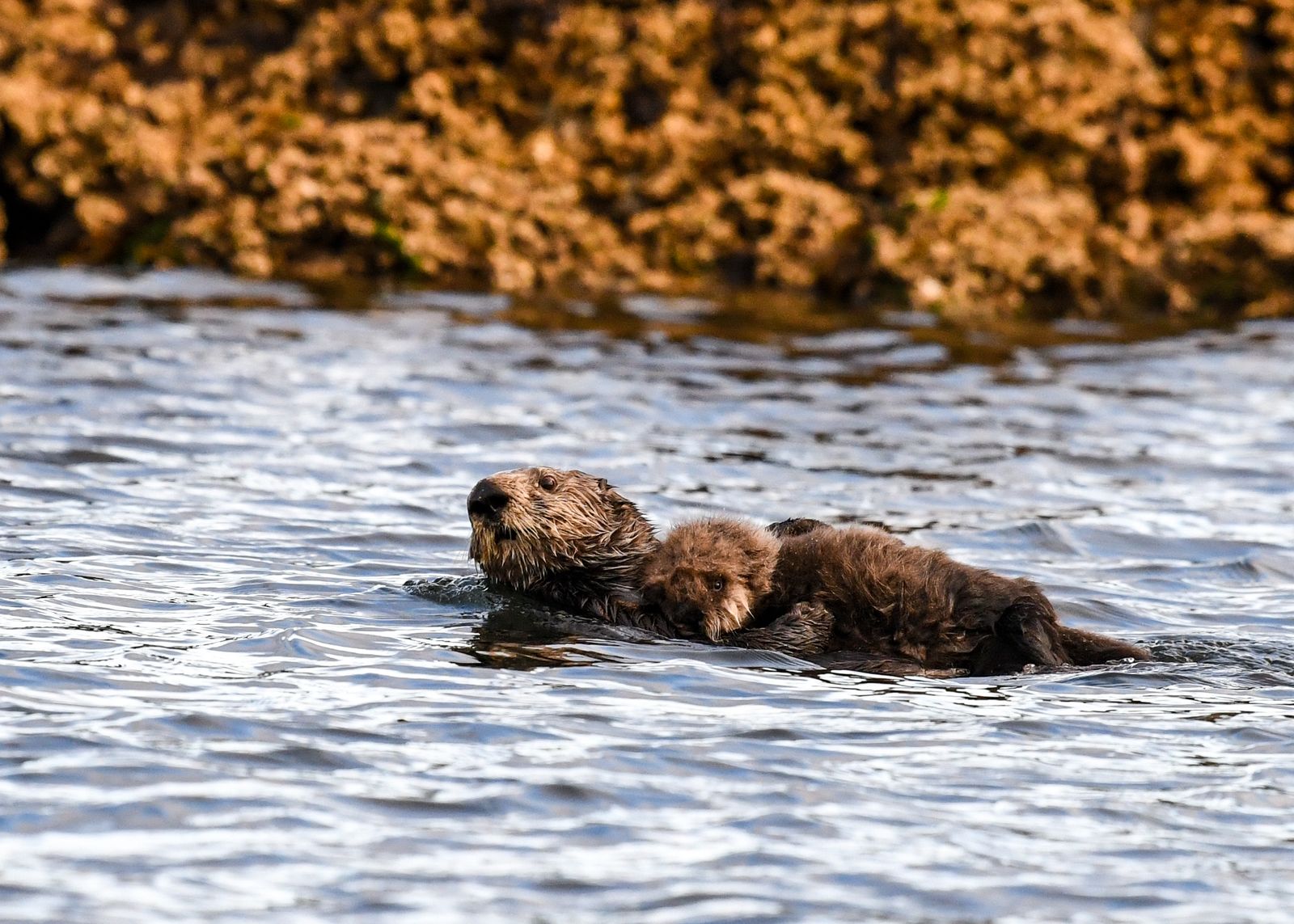
The behaviour also passes from mother to pup. Sea otter pups spend around six months riding on their mother’s chest, watching her crack shells against a stone she often keeps under her left forearm. Pups fumble with pebbles of their own, drop them, try again. The pattern is not unique to otters: Mongabay noted that female bonobos, chimps and dolphins also use tools more than the males of their species, and the study’s authors point out that females are often the ones who pass the behaviour to offspring.
The rock in the pouch
Sea otters have loose folds of furred skin running under each foreleg, and most individuals seem to prefer the left-side pocket for storage. On a dive an otter stuffs it with urchins, clams, snails, crabs — and, often, a favourite rock kept in reserve for the surface work.
Individual otters tend to reuse the same stone rather than pick up a new one each dive, and observers describe animals holding onto a preferred rock for long stretches. What they look for is practical: dense enough to shatter shell, light enough to tuck under a forearm, with at least one flat face.
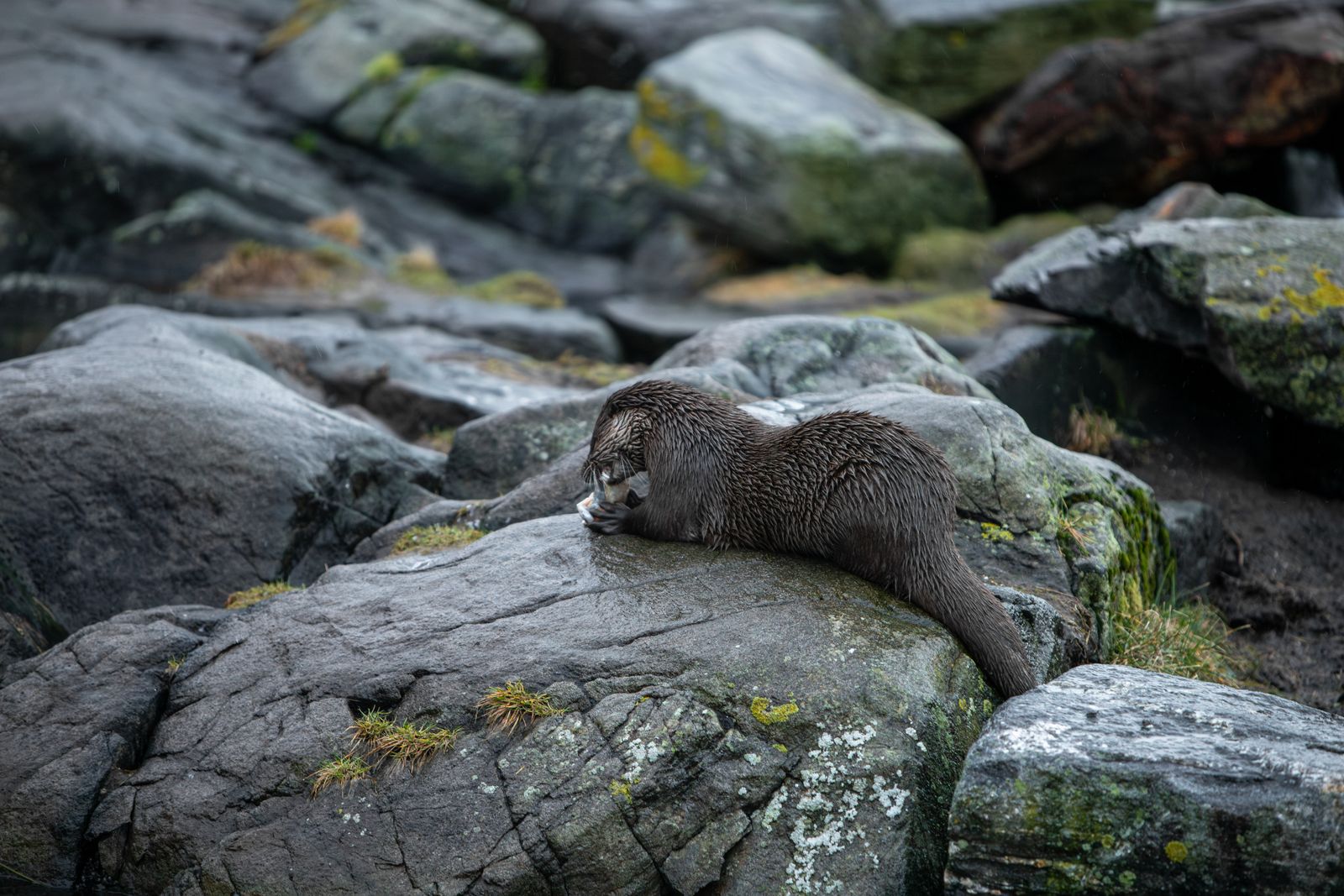
Not every anvil floats. Some otters work against fixed boulders along the shoreline instead, returning to the same rock again and again — and that habit leaves a physical record.
Glass bottles and other improvisations
Not every anvil is a rock, either. Observers in Monterey Bay have documented otters using shells, discarded glass bottles, and other hard debris as substitute tools. The behaviour is opportunistic. What matters is a dense, hard surface the animal can control with its forepaws while floating on its back.
Some otters barely use tools at all, specialising in soft prey. Others use them on nearly every dive and become snail specialists — animals that have essentially converted themselves into shell-cracking operations, running through low-calorie prey in enormous volumes because the tool keeps their teeth intact long enough to make the math work.
That specialisation is what shows up in the dental data. An otter that cracks its snails against a stone finishes the season with worn but functional teeth. An otter that crushes the same prey with its molars runs out of teeth first.
Why this matters beyond the bay
Southern sea otters are listed as threatened under the U.S. Endangered Species Act, with a California population of only about 3,000 animals. They are keystone predators: by eating urchins, they protect the kelp forests that shelter hundreds of other species. Kelp forests, in turn, sequester carbon and buffer coastlines.
An otter’s ability to switch prey when its preferred food disappears is a form of ecological insurance. The tool is what makes the switch possible. FOX Weather summarised the study as otters adapting by using tools to find new food sources — a species with a learned behaviour buffering itself against an ocean that is changing faster than its jaw can evolve.
For sea otters, the resilience is behavioural rather than anatomical. The rock in the pouch is the buffer.
An archaeological record made of shellfish
Between 2007 and 2017, a team from the Max Planck Institute for the Science of Human History, the Monterey Bay Aquarium and UC Santa Cruz studied one shoreline anvil site at Bennett Slough Culverts, in Elkhorn Slough. They found that the otters preferentially struck mussels against points and ridges on the rocks, working from the water rather than from land or from on top of the stone, and leaving the contact surfaces smoothed and worn.
The shells piled below carry an even clearer signature: both valves still attached, with a diagonal fracture running through the right side of the shell. The pattern was consistent enough across the midden that the researchers proposed it as a way to distinguish mussels broken by otters from mussels broken by people. Video of the animals suggested why — they held the shell in both paws but struck with the right slightly on top, which looks a great deal like pawedness.
That is a strange kind of continuity. A wild mammal is leaving a material record of its behaviour on the same shoreline where humans have been leaving shell middens for thousands of years. Both species crack the same shells against the same rocks for the same reason: the calories inside are worth the work.
What a pup sees
A southern sea otter born this summer in Monterey Bay will spend about six months on its mother’s belly, watching her hammer shells against a stone she may have carried since before that pup was conceived. Around weaning it will pick up its own first pebble, fumble it against a mussel, drop it, dive again.
Southern sea otters live roughly 10 to 15 years in the wild, with females often outlasting males. If that pup survives its first year — the hardest — the rock it eventually settles on may still be tucked under its forearm most of a decade from now, worn smooth by tens of thousands of strikes, its molars intact because the stone has done the work its teeth would otherwise have had to do.