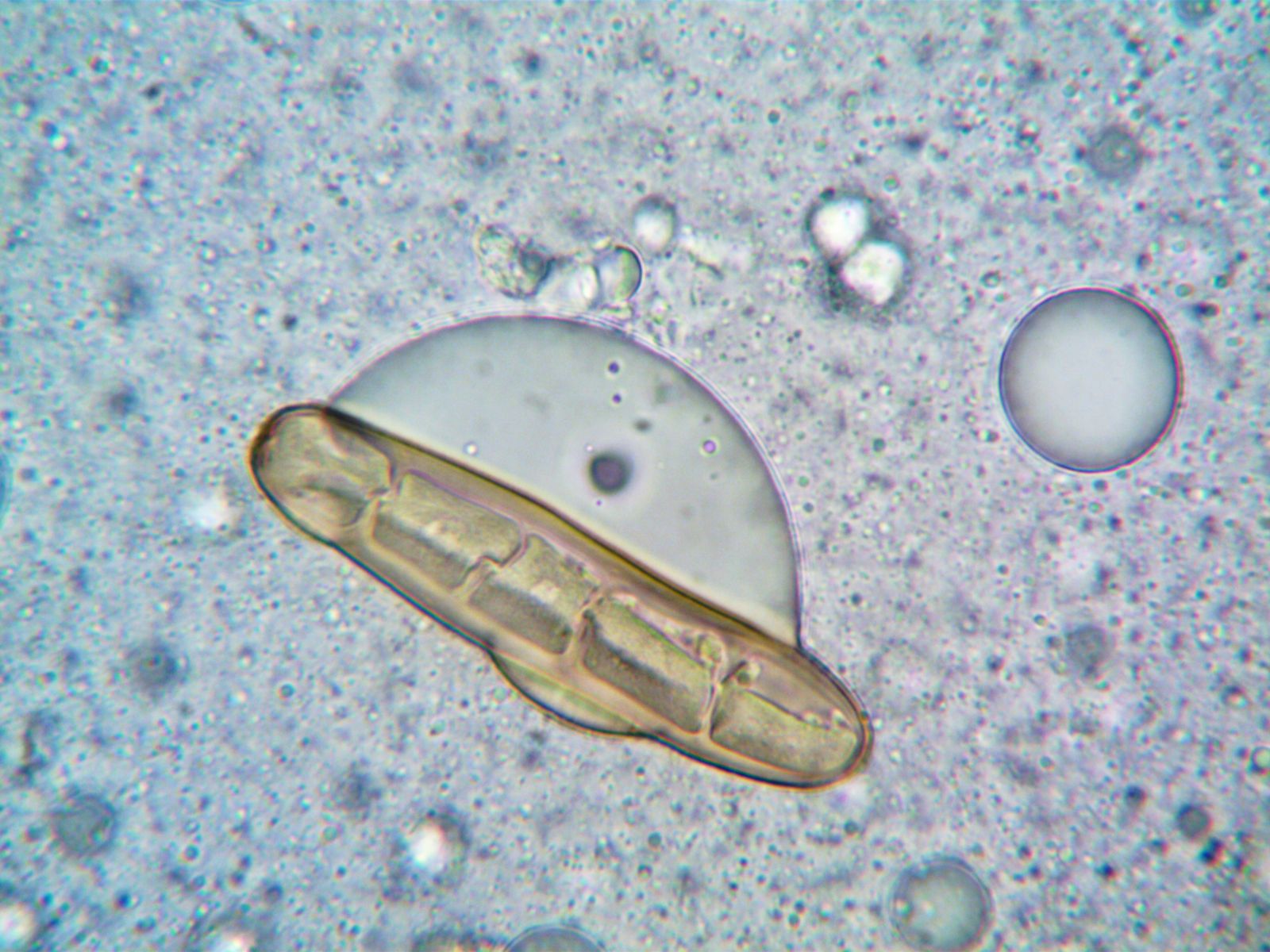
A tardigrade pulled from a clump of Antarctic moss can lose nearly all of the water in its body, tuck its eight legs beneath a rounded husk called a tun, and wait. It can wait through a decade of drought. It can wait at temperatures a few degrees above absolute zero, colder than anything that occurs naturally on Earth. And in 2007, aboard the European Space Agency’s FOTON-M3 capsule, tardigrades waited through ten days of open vacuum, unfiltered solar ultraviolet, and cosmic radiation — then rehydrated and produced normal offspring once back on the ground.
Most of them lived.
They were the first animals ever confirmed to survive direct exposure to the vacuum of space. Not shielded inside a capsule. Not tucked behind a window. Exposed on a tray on the outside of a spacecraft in low Earth orbit, where the pressure is effectively zero and the temperature on the sunlit side can swing by more than 200 degrees in a single orbit.
What a tun actually is
Tardigrades are microscopic. Most are shorter than a millimetre. They walk on eight stubby legs tipped with claws, they eat by piercing plant cells and algae with a stylet, and biologists have been calling them water bears since the 18th century.
They need liquid water to do anything alive. Feed, move, reproduce, metabolise — all of it depends on a film of water around the moss or lichen or sediment they live in.
When the water goes, so does the tardigrade — but not the way anything else goes. It pulls its legs inward. It contracts its body into a barrel about half its normal length. It expels almost all of its internal water. And it enters a state biologists call cryptobiosis, or hidden life, in which its metabolism drops to something close to zero — measurable only as a whisper against the background.
The husk is the tun. In that form, a tardigrade is not really alive in any active sense. It is also not dead. It is paused.
The glass trick
What keeps the paused tardigrade from falling apart is a class of molecules called Tardigrade Intrinsically Disordered Proteins, or TDPs. As the water leaves the cell, TDPs reorganise into a stable, glass-like matrix that fills the interior. Everything inside — DNA, ribosomes, membranes, enzymes — gets locked into place, as if suspended in clear resin.
The process is called vitrification. The molecules cannot move. Chemical reactions that would normally degrade proteins slow to a crawl. Ice crystals, which kill ordinary cells by puncturing membranes as they expand, cannot form because there is almost no water left to freeze.
Add water back and the glass dissolves. The tardigrade unfolds its legs. It begins walking, feeding, and looking for something to eat.
The 2007 experiment, in detail
The mission flew on the European Space Agency’s FOTON-M3 capsule in 2007. The samples came from species collected from European habitats and dried into tuns before launch. Once in orbit, a hatch on the outside of the capsule opened and the trays of dried tardigrades were exposed for ten days.
Some samples got vacuum only. Some got vacuum plus the full spectrum of solar ultraviolet, including the UV-B and UV-C wavelengths that the atmosphere normally filters out before they reach anything on the ground. Some got vacuum plus cosmic ionising radiation.
The vacuum alone did almost nothing. Survival was near-total. The UV was the killer — but even in the samples exposed to the full solar spectrum, a fraction lived, rehydrated, and laid viable eggs.
Tardigrades flew again in 2011 aboard NASA’s space shuttle Endeavour. In 2019, several thousand were spilled onto the lunar surface when Israel’s Beresheet lander crashed during its descent — although microbiologists have said their chance of actually colonising the Moon is effectively zero without liquid water or oxygen. In 2021, live tardigrades went up to the International Space Station for a long-term genetic study.
"We want to see what ‘tricks’ they use to survive when they arrive in space, and, over time, what tricks their offspring use," researchers explained about the ISS experiment. "Are they the same or do they change across generations? We just don’t know what to expect."
Radiation, and a new pigment
The vacuum trick and the cold trick are impressive. The radiation trick is stranger.
Ionising radiation kills by snapping DNA strands and by producing highly reactive molecules — free radicals — that attack proteins, membranes, and genetic material from the inside. Doses that would kill a human are routinely survived by tardigrades.
In 2024, a team at the Beijing Institute of Lifeomics led by Lingqiang Zhang published a paper describing a new tardigrade species — Hypsibius henanensis, collected from moss in China’s Henan province — and the genes that switched on when it was pummelled with radiation. The team found thousands of genes that became more active under the stress, involved in DNA repair, cell division, hormone metabolism, and immune response.
One gene stood out. DODA1 lets tardigrades produce betalains — the same class of red-purple antioxidant pigments that give beets their colour. The betalains mop up the reactive chemicals radiation generates inside a cell before they can do damage. When the team treated human cells with tardigrade betalains and then irradiated them, the treated cells survived far better than untreated ones.
That is the practical stake. If a beet-red pigment made by a moss-dwelling animal can protect human cells from radiation damage, the potential applications run from cancer therapy to shielding astronauts on the multi-year round trip to Mars.
The temperature range is almost absurd
The numbers on tardigrade thermal tolerance sound made up until you check them.
In tun form, they have survived brief exposure to extreme heat — hot enough to bake bread twice over. At the other end, they have been cooled to within a fraction of a degree of absolute zero and revived. That is colder than any natural surface in the solar system, colder than the shadowed floors of craters on the Moon, colder than the night side of Pluto.
The trick is the same one that protects them from vacuum. With almost no water in the cell, the sharp expanding ice crystals that puncture ordinary tissue during freezing never form. What remains is the TDP glass, holding every delicate structure in place until warmth and water return.
They have also been subjected to pressures around 6,000 atmospheres — roughly six times the pressure at the bottom of the Mariana Trench — and lived. Spacewar has covered the Soviet Venera 13 probe’s 127 minutes on the surface of Venus, where pressures reach about 90 atmospheres and the temperature melts lead. A tardigrade in tun form would shrug at the Venusian pressure. The heat would still cook it, but the pressure alone would not.
How long can they wait
The decade figure in the title is a conservative claim, and it comes from Antarctic moss because that is where some of the longest confirmed revivals have been documented. Tardigrades pulled from dried moss samples stored in museums have been rehydrated and revived after long periods of dormancy — including specimens frozen for decades that came back to life.
Older claims exist. Reports from the early 20th century describe revivals from museum moss samples over a century old, though modern researchers regard those as unverified. A decade is safe. Thirty years is documented. Longer than that is still argued about in the literature.
What is not argued is that the clock effectively stops. A tun at minus 20 in a jar of dry moss on a shelf is not aging in any meaningful biological sense. It is simply present, waiting for water.
Where they actually live
Tardigrades are not creatures of the extremes. They only do the extreme survival tricks when they have to. In ordinary life, they live in the film of water clinging to moss cushions on a stone wall, in lichens on tree bark, in wet leaf litter, in freshwater sediment, in the interstitial spaces of beach sand, in the moss beds of Antarctica, in the moss beds of a suburban roof.
Squeeze a handful of damp moss from almost anywhere on Earth into a dish of water, wait an hour, and put a drop under a decent microscope. There will be tardigrades. There are more than 1,300 known species. They are one of the most widespread animal groups on the planet.
Their extreme resilience is not an adaptation to space or to Antarctica specifically. It is an adaptation to the humdrum disaster of a puddle drying up. A moss cushion on a rock in the sun goes wet, dry, wet, dry, wet, dry across a summer. A creature that can pause through the dry stretches inherits the moss.
The vacuum tolerance is a side effect. A cell that can protect itself against total desiccation happens, by coincidence, to be protected against a lot of things that also strip water from tissue — freezing, boiling, hard vacuum, high UV, ionising radiation. Evolution solved the puddle problem, and the solution happened to work in orbit.
Why this keeps mattering
Understanding the TDP glass and the betalain pigment is not just biological curiosity. Freeze-drying vaccines with TDP-like proteins could let them survive transport without refrigeration. Radiation-protective compounds derived from tardigrade genes could shield tissue during cancer radiotherapy or during long-duration crewed spaceflight. The 2021 ISS experiment sent up thousands of tardigrades to see how their genes behave across generations in microgravity, with an eye toward human applications on Mars-class missions.
There is also the deep-time question. If a moss-dwelling animal on Earth can survive open vacuum and cosmic radiation for ten days as a dried husk, then the panspermia argument — the idea that life, or at least the raw ingredients for it, can travel between worlds inside meteoroids — moves a step closer to plausible. Not proven. Just harder to dismiss.
A tardigrade in a tun on a chunk of rock blown off Earth by an ancient impact would not, of course, wake up on Mars. There is no liquid water on the Martian surface. But the point of the 2007 experiment was that the transit itself is survivable. The vacuum and the cold and the radiation of interplanetary space do not, on their own, kill the passenger.
The husk on the shelf
Somewhere right now, on the underside of a piece of Antarctic moss preserved in a jar in a lab in Copenhagen or Tokyo or Cambridge, there is a barrel of a body about a quarter of a millimetre long. It has no measurable heartbeat because it has no heart. It has no measurable metabolism because it has no water. Its DNA is held in place by a glass matrix of disordered proteins that the animal manufactured in the last minutes before it went dry.
Drop it in a puddle. Wait half an hour. It will unfold its eight legs, uncurl its snout, extend its stylet, and start looking for algae to eat, as if nothing had happened.
Which, from its point of view, is exactly right. Nothing did.