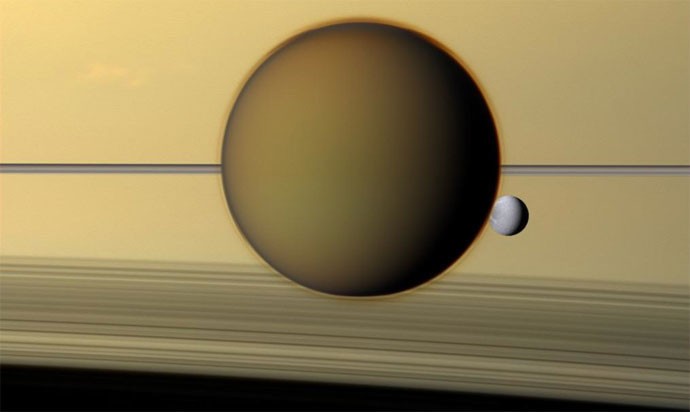
Titan is running a chemical deficit that should have emptied its sky long ago.
Saturn’s largest moon is roughly 4.5 billion years old. Yet methane, which makes up about five per cent of its atmosphere near the surface, is steadily dismantled by sunlight. Depending on the model, the present supply should last only about 10 to 100 million years, with many modern summaries narrowing the useful estimate to roughly 10 to 30 million years.
That mismatch is not a minor accounting error. Methane drives Titan’s clouds, rain, rivers and seas. Its destruction also feeds the orange organic haze that hides the surface. Without a source, the moon visible today could not retain its present methane-rich climate for more than a small fraction of its history.
NASA describes the source as a mystery. Cryovolcanism is a leading suspect: material rising through an icy crust could release methane from Titan’s interior, perhaps through eruptions involving water and ammonia rather than molten rock. But no spacecraft has watched such an eruption happen.
Edited by Lachlan Brown
Sunlight makes the haze and starts the countdown
At Saturn’s distance, sunlight is about 100 times fainter than it is at Earth. It is still powerful enough to alter an atmosphere given millions of years. High above Titan, ultraviolet photons split methane and nitrogen molecules. Energetic particles in Saturn’s magnetic environment contribute as well.
The molecular fragments recombine into ethane, acetylene, hydrogen cyanide and increasingly complex carbon-rich compounds. Some become the tiny particles that form Titan’s haze and eventually settle onto its dunes and plains. Hydrogen, light enough to escape Titan’s gravity, can be lost to space.
This chemistry is not a closed cycle. A methane molecule converted into a heavier hydrocarbon does not automatically return as methane. A widely cited review of Titan’s methane cycle put its photochemical lifetime between 10 and 100 million years. The exact figure depends on assumptions about reaction rates, atmospheric escape and the size of accessible reservoirs, but every credible estimate is short compared with the moon’s age.
Titan’s weather can obscure the distinction. Methane evaporates from lakes, condenses into clouds, falls as rain and flows back through channels. That spectacular circulation only redistributes molecules that already exist. As recent SpaceWar coverage of Titan’s reversed landscape explained, the moon has a water-like weather system built from liquid methane. Evaporation can refill the air after rain, but it cannot replace methane permanently converted into haze and other compounds.
Four billion years does not mean the same methane survived
The age comparison carries an important qualification. Scientists are not claiming that today’s methane molecules have endured unchanged since Titan formed. The opposite is the point: they almost certainly have not.
A short atmospheric lifetime allows several histories. Titan may release methane continuously at about the rate it is lost. It may outgas in large episodes separated by quiet intervals. The atmosphere could also be declining after a relatively recent pulse, with humanity observing a temporary methane-rich chapter. These possibilities make the word “replenishment” broader than a permanently active volcano.
What can be rejected is a simple primordial atmosphere that sat undisturbed for 4.5 billion years. If Titan began with methane and never received more, sunlight should have processed that inventory many times over. The gas now present must therefore be geologically young, renewed, or drawn from a reservoir that was protected until comparatively recently.
An ice volcano could connect the reservoir to the sky
Cryovolcanism is volcanism built from outer Solar System materials. Titan’s crust is water ice. Beneath it, gravity and radio measurements indicate a buried liquid-water ocean, probably containing salts and perhaps ammonia. In this environment, warmer water-rich material or slush can play the role that magma plays on Earth.
Methane may be stored in clathrate hydrate, a crystalline form of water ice whose molecular cages trap gas. Heat, decompression or mechanical disruption can destabilise those cages. Methane could then migrate upward through fractures, escape in a sudden eruption or seep slowly enough to leave little obvious surface evidence.
A 2006 Nature model by Gabriel Tobie, Jonathan Lunine and Christophe Sotin proposed that Titan experienced three main episodes of methane release as its interior evolved. The latest was placed within roughly the past 500 million years. An ESA explanation of the study said cooling and crystallisation in an internal ocean could create thermal anomalies in the crust, dissociate methane clathrates and drive continuing outgassing.
That model shows how a very old moon can carry a much younger methane atmosphere. It does not prove that Titan follows that precise history. Interior temperatures, ice-shell thickness, clathrate distribution and the efficiency of gas transport all remain uncertain.
Cassini found plumbing clues, not a smoking vent
The Cassini-Huygens mission supplied evidence that Titan’s deep interior has communicated with its exterior. The Huygens probe detected argon-40 in the atmosphere. This isotope is produced from radioactive potassium associated with rocky material, so its presence shows that internally derived gas escaped at some point.
Cassini’s gravity measurements strengthened the case for an ocean under the ice. Radar and infrared observations also revealed features that researchers have debated as possible cryovolcanic terrain. Sotra Patera, a deep depression beside the mountain Doom Mons, is often presented as the strongest candidate. Other apparently changing or unusually bright regions have also attracted attention.
The evidence stops short of an active eruption. A NASA astrobiology assessment explicitly noted that no active cryovolcanism had been detected on Titan, despite several plausible landforms. Cassini completed 127 close flybys before its mission ended in 2017, yet it never measured a methane plume rising from a vent.
That absence is not fatal to the hypothesis. A replenishing source could operate below Cassini’s detection threshold, occur in rare bursts or be concentrated in places and seasons the spacecraft did not catch. It does mean that “possibly ice volcanoes” must remain a hypothesis rather than a discovery.
The alternatives move methane without solving every part of the puzzle
Cryovolcanism is not the only path from storage to atmosphere. Methane could diffuse or seep through fractures without building a volcanic edifice. Clathrates near the surface might be disturbed by tectonics or local heating. Impacts can excavate methane-bearing ice, although recent modelling indicates that impacts by themselves supply too little gas to balance photochemical destruction.
Water-rock reactions in Titan’s interior, including serpentinisation, could generate methane rather than merely release a primordial store. Methane might also have been produced as organic material inside the moon was heated. An extensive post-Cassini review of Titan’s interior argues that atmospheric methane and radiogenic argon make interior-to-surface exchange difficult to avoid, while leaving the timing and mechanism open.
The polar seas are reservoirs, but not ultimate sources. They exchange methane with the air and help sustain weather over seasons. They cannot account for methane carbon that ultraviolet chemistry has irreversibly moved into heavier compounds. The same is true of rain, wet ground and possible subsurface hydrocarbon aquifers unless those reservoirs are themselves resupplied.
There is also a less comfortable possibility: replenishment may not be keeping pace. Titan’s current atmosphere could be the fading aftermath of its latest outgassing episode. In that case the moon does not need a vent operating today, only one recent enough that photochemistry has not yet finished the job.
Dragonfly will investigate the record, not drill to the source
NASA’s Dragonfly rotorcraft is scheduled to launch no earlier than July 2028 and arrive at Titan in late 2034. It will fly between equatorial sites, analyse surface samples, monitor the atmosphere and study local geology. The mission is designed primarily to investigate habitability and the chemistry that precedes biology, but its measurements will also sharpen models of Titan’s methane system.
Dragonfly may identify chemical or geological traces of exchange between the surface and interior. Atmospheric measurements can improve the loss budget, while seismic and meteorological data can constrain the environment above the buried ocean. Still, the rotorcraft will not bore through tens of kilometres of ice to inspect a clathrate layer, and its planned route does not include the north polar seas or Sotra Patera.
The methane mystery may therefore survive the next mission. What is already clear is the scale of the clue. A gas that sunlight removes in tens of millions of years surrounds a world more than four billion years old. Titan has either renewed that gas, released it recently, or caught us during an improbably short final act. The atmosphere tells scientists that a reservoir and a delivery history exist. It has not yet revealed where they are.