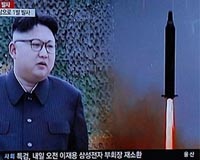
UN Secretary General Antonio Guterres on Monday condemned North Korea's latest ballistic missile test and called for a united international response to the "further troubling violation" of UN resolutions.
His statement came ahead of an urgent UN Security Council meeting called to discuss Sunday's missile test — nuclear-armed North Korea's first since US President Donald Trump assumed office.
The North's leader Kim Jong-Un "expressed great satisfaction over the possession of another powerful nuclear attack means which adds to the tremendous might of the country", state news agency KCNA said on Monday.
Guterres appealed "to the international community to continue to address this situation in a united manner," in an apparent reference to the United States and China, Pyongyang's ally.
"The DPRK leadership must return to full compliance with its international obligations and to the path of denuclearization," Guterres said in a statement, referring to North Korea.
Permanent UN Security Council members China and Russia joined a chorus of international criticism of the launch near the western city of Kusong.
The council will meet around 2200 GMT on Monday following a request by the United States, Japan and South Korea.
"I would certainly hope that the Security Council would come up with a clear and strong message," Japan's Ambassador Koro Bessho told reporters ahead of the meeting.
North Korea is barred under UN resolutions from carrying out ballistic missile launches or nuclear weapons tests.
But last year it conducted two nuclear tests and numerous missile launches in its quest to develop a nuclear weapons system capable of hitting the US mainland.
The latest missile — said by Pyongyang to be able to carry a nuclear warhead — flew east for about 500 kilometers (310 miles) before falling into the Sea of Japan (East Sea), South Korea's defense ministry said.
Footage on the North's state television showed the missile being moved on a newly developed mobile erector launcher.
It was launched at a near-vertical angle, igniting in mid-air after lift-off and switching direction while in flight.
Photos released by KCNA showed the missile blasting into the sky with a smiling Kim watching from the command center, and standing on the launch field surrounded by dozens of cheering soldiers and scientists.
It said Kim "personally guided" preparations for Sunday's test of what it described as a surface-to-surface "medium long range" Pukguksong-2, a "Korean-style new type strategic weapon system."
– Solid fuel –
KCNA said the missile was powered by a solid-fuel engine — which needs a far shorter refuelling time than conventional liquid fuel-powered missiles, according to Yun Duk-Min of the Institute for Foreign Affairs and Security in Seoul.
"They leave little warning time and therefore pose a greater threat to opponents," he said, adding that such missiles are harder to detect by satellite before launch.
The North has previously made claims for its weapons capabilities that analysts consider unconvincing. But Seoul's military confirmed the North's claim on the solid-fuel engine.
Pyongyang's latest announcement was the first time a Pukguksong-2 has been mentioned, although last August it test-fired what it said was a submarine-launched ballistic missile (SLBM) marked as a Pukguksong-1, a name which translates as "North Star".
Kim said at the time that the missile put the US mainland and the Pacific within striking range.
An official with South Korea's Joint Chiefs of Staff told reporters the Pukguksong-2 appeared to have been fired based on the same "cold launch" technology used in last year's SLBM test.
The method — in which a missile is initially propelled by compressed gas before its engine ignites mid-air — is considered safer. It is also easier to hide the launch location.
North Korea claims it has developed an intercontinental ballistic missile (ICBM) capable of hitting the US mainland but has not tested one as yet.
– Armed provocation –
The South has said that Sunday's launch was intended as a test for Trump, who responded by pledging "100 percent" support for Washington's key regional ally Japan.
Trump has pressed China, the north's sole major ally and key trade partner, to play a bigger role in restraining its wayward neighbor.
In Tokyo Japan's top government spokesman Yoshihide Suga said Monday China plays an "extremely important" role and called on Beijing to take "constructive action".
China's foreign ministry spokesman Geng Shuang said it opposes North Korean missile launches that violate UN resolutions.
Russia's foreign ministry called the launch "a demonstration of contempt for UN Security Council resolutions".
But Joel Wit, a senior fellow at the US-Korea Institute at Johns Hopkins University, said more provocations were likely in response to upcoming US-South Korean military exercises.
Chronology of North Korean missile development
Seoul (AFP) Feb 13, 2017 –
North Korea has ramped up its missile programme over the last year, with a series of rocket tests that have sent regional tensions soaring.
In a fresh show of strength seen as a challenge to new US President Donald Trump, the North on Sunday launched a new ballistic missile, sparking calls for an urgent United Nations Security Council meeting.
Here are some key dates in the North's missile programme:
Late 1970s:
North Korea starts working on a version of the Soviet Scud-B (range 300 kilometres or 186 miles). Test-fired in 1984
1987-92:
Begins developing variant of Scud-C (500 km), Rodong-1 (1,300 km), Taepodong-1 (2,500 km), Musudan-1 (3,000 km) and Taepodong-2 (6,700 km)
Aug 1998:
Test-fires Taepodong-1 over Japan as part of failed satellite launch
Sept 1999:
Declares moratorium on long-range missile tests amid improving ties with US
July 12, 2000:
Fifth round of US-North Korean missile talks ends without agreement after North demands $1 billion a year in return for halting missile exports
March 3, 2005:
North ends moratorium on long-range missile testing, blames Bush administration's "hostile" policy
July 5, 2006:
Test-fires seven missiles, including a long-range Taepodong-2 which explodes after 40 seconds
July 15, 2006:
UN Security Council adopts Resolution 1695, demanding halt to all ballistic missile activity and banning trade in missile-related items with the North
Oct 9, 2006:
North conducts underground nuclear test, its first
Oct 14, 2006:
Security Council approves Resolution 1718, demanding a halt to missile and nuclear tests
April 5, 2009:
North launches long-range rocket which flies over Japan and lands in the Pacific, in what it says is an attempt to put a satellite into orbit. The United States, Japan and South Korea suspect it is a disguised test of a Taepodong-2
April 13, 2009:
UN Security Council unanimously condemns launch, agrees to tighten sanctions. North quits nuclear disarmament talks in protest, vows to restart its plutonium programme
May 25, 2009:
Second underground nuclear test, several times more powerful than the first
June 12, 2009:
Security Council passes Resolution 1874, imposing tougher sanctions on the North's atomic and ballistic missile programmes
Feb 18, 2011:
Satellite images show the North has built a launch tower at a complex on the west coast
December 31, 2011:
Kim Jong-Un declared the North's "supreme leader" during memorial ceremonies for his late father Kim Jong-Il
April 13, 2012:
North launches what it has said is a long-range rocket to put a satellite into orbit, but it disintegrates soon after blast-off and falls into the ocean
December 12, 2012:
A multi-stage rocket successfully places an Earth observational satellite in orbit
February 12, 2013:
Third underground nuclear test
January 6, 2016:
Fourth underground nuclear test. North says it was a hydrogen bomb — a claim doubted by most experts
February 7, 2016:
North says its second successful space rocket launch has placed another Earth observation satellite in orbit
March 9, 2016:
Leader Kim Jong-Un claims the North has successfully miniaturised a thermo-nuclear warhead
April 15, 2016:
Failed attempt to test-fire what appears to be a medium-range missile on the birthday of founding leader Kim Il-Sung
April 23, 2016:
North test fires a submarine-launched ballistic missile
July 8, 2016:
US and South Korea announce plans to deploy an advanced missile defence system — the US THAAD (Terminal High Altitude Area Defence)
August 3, 2016:
North fires a ballistic missile directly into Japanese-controlled waters for the first time
August 24, 2016:
Successfully test-fires a submarine-launched ballistic missile, in what it says is retaliation for large-scale South Korea-US military exercises.
September 5, 2016:
Fires three ballistic missiles off its east coast as top world leaders meet at the G20 summit in China
September 9, 2016:
Fifth nuclear test
October 15, 2016:
An intermediate-range Musudan missile, theoretically capable of reaching US bases on Guam, is tested but explodes shortly after launch
February 3, 2017:
US Defense Secretary James Mattis warns of an "effective and overwhelming" response to any nuclear attack by the North
February 7, 2017:
US and Japan conduct the first interception of a ballistic missile target using a jointly-built ship-launched missile, that successfully hits its target in space
February 12, 2017:
North conducts new ballistic missile test. The missile is launched near the western city of Kusong and flies east about 500 kilometres (310 miles) before falling into the Sea of Japan (East Sea)